Your Data, Their Profit: The Consumer Cost of AI Surveillance Pricing
With surveillance pricing, Big Tech has reinvented the ripoff.
Download the full testimony.
At its core, this hearing in front of the Senate Judiciary Committee concerns a simple, age-old principle: Americans deserve fair pricing.
This page includes the written and opening testimonies of Dr. Lindsay Owens, Ph.D., as well as video of her opening remarks.
Dr. Lindsay Owens, Ph.D.
President and CEO, Groundwork Collaborative
“Your Data, Their Profit: The Consumer Cost of AI Surveillance Pricing”
Crime and Counterterrorism Subcommittee of the Senate Judiciary Committee
August 4, 2026
Chairman Hawley, Ranking Member Durbin, and Members of the Subcommittee,
Thank you for the opportunity to testify before you today on this important topic. My name is Dr. Lindsay Owens. I am the President and CEO of the Groundwork Collaborative, an economic policy think tank based in Washington, DC. I am also the author of the forthcoming book Gouged: The End of a Fair Price – and What That Means for Your Wallet, which examines how companies use new technology and sophisticated pricing strategies to overcharge consumers.
At its core, today’s hearing concerns a simple, age-old principle: Americans deserve fair pricing. By definition, surveillance pricing, or charging different people different prices for the same item based on personal data, is a direct contravention of that principle. The opaque, manipulative pricing strategy undermines consumer autonomy and price transparency, driving up costs for everyday necessities that too many Americans already struggle to afford.
Congress has an opportunity to protect working families from this emerging form of personalized price gouging, stopping corporations from squeezing working families to boost profits. As the subcommittee weighs the path forward on holding corporate retailers and platforms accountable for offering fair, transparent pricing, I appreciate the opportunity to outline how surveillance pricing works, the immense risks it poses for consumer privacy and market fairness, and why prohibiting its use is both necessary and urgent.
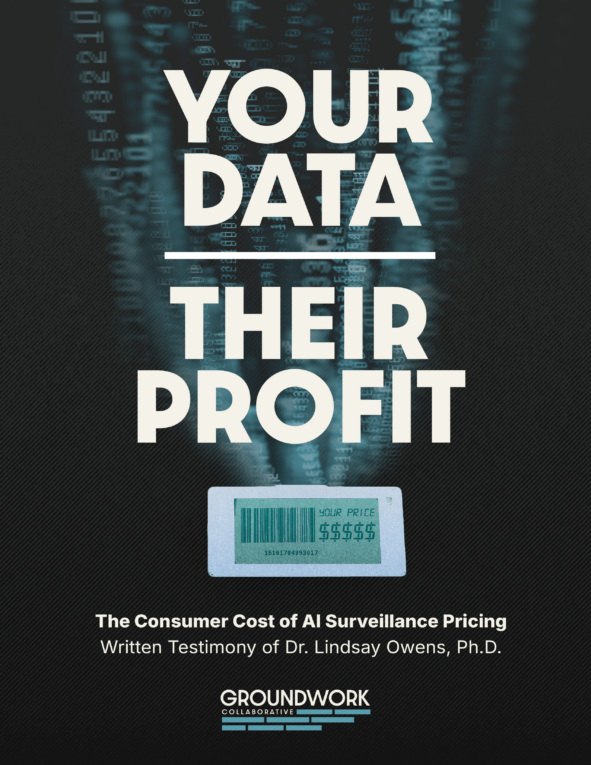
With surveillance pricing, Big Tech has reinvented the ripoff.
Download the full testimony.
To fully grasp the implications of surveillance pricing, it is helpful to place this practice in the broader historical evolution of pricing writ large. For thousands of years, personalized – rather than fixed – pricing was the norm. Buyers and sellers negotiated the value of a good directly, haggling and then exchanging the amount that was agreed to.1 In fact, the notion of a fixed, clearly displayed price – a simple number on a tag – is a relatively modern phenomenon, only emerging in the nineteenth century.2 In the shadow of the Industrial Revolution and mass production, the Quakers’ concerns about the fairness as well as the inefficiency of haggling spurred the advent of fixed prices, and ultimately, the invention of the ubiquitous price tag, which was first introduced at Wanamaker’s department store in Philadelphia.3
For most of the twentieth century, the “cost-plus model” was the dominant approach to pricing in the American economy.4 Under this model, a company calculates the amount required to manufacture a good or deliver a service (the cost), and then adds their desired profit margin on (the plus). Together, these two components determined the price consumers ultimately pay. While this model was not immune to abuses like price gouging or price fixing, it established a baseline of transparency and predictability that allowed consumers to make informed choices about their purchases. In fact, when a group of economists interviewed 200 U.S. price setters in the 1990s, they told him plainly that they avoided deviating from this model because customers would consider it unfair.5
However, beginning in the 1980s and accelerating sharply at the turn of the 21st century, this baseline of transparency began to deteriorate.6 Corporations, driven by a new generation of consultants and executives that I like to call “profit evangelists,” began to embrace a different theory of pricing: the so-called “value-based” model. Under this approach, prices are no longer tethered to the cost of production or to competition in the marketplace, but instead to what companies believe they can persuade consumers to pay. Put simply, the value-based model directs firms to capture the full extent of each consumer’s individual willingness to pay.
Two major developments, one in market structure and the other in technological capacity, have since accelerated this shift, allowing the new “value-based” pricing paradigm to undermine transparency, predictability, and fairness across our economy.
First, decades of deregulation, weak antitrust enforcement, and deference to corporate power fostered runaway corporate consolidation. Since 1997, at least 75% of U.S. industries have consolidated.7 Mergers and acquisitions also eliminated nearly 3,000 public firms tracked by S&P since 2000.8 As a result, many markets lack meaningful competition and consumers are left with far fewer choices. Today, the U.S. has just four major airlines and three major cellphone companies.9 Consolidation grants the remaining corporate giants the freedom to hike prices without fear of being undercut by the competition. It’s hard to stay in business overcharging customers who can walk across the street for a fair price.
Put simply, the value-based model directs firms to capture the full extent of each consumer’s individual willingness to pay.
In addition to market dominance, rapid technological innovation has enabled companies to turn pricing into a highly engineered science. Innovation in digital technologies and displays allow companies to change prices instantaneously.10 Kroger11 and Walmart12 have both announced their intention to expand electronic shelf labels throughout their stores, among other U.S. grocery retailers.13 With this technology in hand, stores can adjust prices depending on the time of day, the day of the week, the location of the shopper, the number of other customers, the weather outside, or any other criteria imaginable.
These forms of variable pricing are expanding rapidly. According to Arival, a tourism market research and events firm, only 1% of attractions (museums, amusement parks, etc.) used variable pricing prior to 2021. Today, it’s 17%.14
Furthermore, powered by advances in cloud computing, data collection, surveillance technologies, and artificial intelligence, companies can now purchase, track, store, and analyze your personal data at a scale that would have been unimaginable a decade ago. Often, this data harvesting occurs without the explicit consent or even the understanding of consumers.15 Loyalty programs are a key culprit. Companies lure consumers in with the Trojan horse of seemingly generous perks, then use the program to scrape personal data, experiment with pricing and behavior, and then quietly flip the bargain by hiking fees or trimming benefits.16
Often, this data harvesting occurs without the explicit consent or even the understanding of consumers
Armed with advanced technology and increasing market power, companies deploy a dizzying array of tactics designed to extract the maximum profit from each consumer. They tack on hidden fees,17 tacitly collude with their competitors on price increases,18 and individualize prices for consumers that can be determined by granular, personal data.19 The sharpest edge of the “value-based” pricing landscape, and the subject of this hearing, is surveillance pricing.
Also known as personalized pricing, surveillance pricing describes the burgeoning process of using personal data to craft consumer-specific prices.20 Put plainly, drawing on information companies collect on your income, your location, your online behavior, and even how long you linger over a product online before buying it, companies can now identify the highest price each consumer is willing to pay, and charge not a penny less.21
This proliferation of surveillance pricing tactics represents a direct affront to long-standing principles of consumer autonomy, market fairness, and price transparency. More than eight in ten Americans believe that businesses should charge all customers the same price for the same item. More than three-fourths support banning companies from using personal data to set individualized prices. Even when presented with the fact that discounts may be set using personal information, 72% would accept smaller average discounts rather than give up their personal data for pricing.22 Despite this broad opposition, companies continue to innovate tactics to extract the maximum amount from every transaction. Every consumer interaction becomes an opportunity for exploitation – from grocery aisles to airline tickets, hotel bookings, and taxi rides.
A 2025 Federal Trade Commission (FTC) report confirms that corporations are already deploying these invasive and exploitative tools across major industries.23 The FTC ordered documentation from companies including Mastercard, Accenture, and McKinsey and found both a wide breadth of the types of data collected from consumers as well as deep granularity. Companies monitor whether your mouse cursor highlights a product name, hovers over a buy button, or starts drifting toward the exit button. They are able to use data to compile “inferred traits,” including emotional state, purchase intent, willingness to pay, and even likely eligibility for food assistance programs. A combination of the vast array of data at these companies’ disposal, sophisticated algorithms that turn data into detailed consumer profiles, and the ability to rapidly change prices online or on electronic shelf labels gives these companies more pricing power over the consumer than ever before. The intermediaries surveyed by the FTC boasted the ability to provide 2-5% revenue growth and 1-4% margin increases with these practices.
More than eight in ten Americans believe that businesses should charge all customers the same price for the same item.
Examples of the sensitive data companies collect and use to personalize prices include:
Beyond violating norms of fairness, this erosion of pricing transparency and predictability puts both households and markets in a precarious position. Our economy depends on stability. Families must be able to plan a budget and trust that prices for essentials like groceries, housing, and insurance won’t shift arbitrarily.
Personalized prices aren’t the only way corporations profit from our personal data. Often marketed as “price optimization” the data itself has become a business. For example, Kroger collects data on the shopping habits of its 63 million customers, which not only enables the company to execute targeted pricing campaigns, but also to monetize and sell their customer’s data to third parties and affiliates.35 These vast databases of your personal information are very lucrative, and Kroger reports its “alternative profits” business – which includes its precision marketing arm – as accounting for over 35% of net income.36
Kroger is not alone in its attempt to monetize customers’ personal data. The global market for personal data is projected to surge to nearly $700 billion in revenue by the end of the decade.37 Additionally, a market of middlemen has emerged, sourcing data and implementing price changes on behalf of other companies. One such firm, Fetcherr, is plainspoken about the invasive nature of their business model, noting that the “secret sauce” is “all the data we can get our hands on,” and that “we are very stealth about how they work.”38 It’s a sweet deal for corporations: consumers are both the product being sold and the ones paying the price.
A consumer’s last line of defense against unfair pricing has been the ability to shop around for a better deal. But recently, the line between the seller and the customer is blurring with advances in generative AI, and in particular, “agentic commerce.” AI agents, or models with access to tools and able to act on behalf of the user, are increasingly being used and marketed in the online shopping experience. They can select products, complete purchases, and seek out coupons or discounts. In principle, an agent could be the most powerful tool for comparison shopping to date: Gone are the days of pulling up four different airlines’ websites to look for the same flight or checking several grocery stores’ weekly ads to see who has the cheapest ground beef or berries this week – shoppers can merely ask a bot to find them the best deal. They have the potential to be tireless, instantaneous, and immune to manipulation. In practice, whether these advances in technology can deliver the ultimate price discipline depends on one key question: whose side is the agent on?
It’s a sweet deal for corporations: consumers are both the product being sold and the ones paying the price.
The early evidence is not reassuring. Researchers at the University of Washington and Princeton examined the behavior of large language models once advertising and commercial incentives are introduced – following OpenAI’s announcement that ads would be woven into ChatGPT.39 They found that the models consistently favored the company over the user, steering them to more expensive products and even towards predatory ones, like payday loans.
It is difficult to understate the rapid development and deployment of this technology and the risks it poses for customers. McKinsey estimates that agentic commerce could be a $5 trillion market by 2030.40 Google’s Universal Commerce Protocol embeds product discovery and checkout directly inside Google Search and Gemini, allowing customers to add products they’re considering buying from anywhere on Google and then tracks deals, prices, and availability.41 On the retailer end, it allows companies to offer custom deals to specific shoppers and deploy dynamic pricing. While Google claims merchants are prohibited from displaying prices to shoppers that exceed those posted on their own websites, a rule set by a platform – whose paying customers are retailers – is not a protection consumers can rely on. Individual retailers, such as Walmart, Target, Home Depot, and dozens of others, have developed their own assistants. Half of Walmart app users use Walmart’s AI assistant “Sparky,” and shoppers who use the agent spend roughly 35% more than those who did not, according to a recent earnings call.42 These agents have access to swaths of data on customers – what shoppers tell them, what they’ve purchased in the past, and in some cases, what they’ve hovered over with their mouse or even what other websites they’ve visited. All of that can be used to infer exactly how much they’re willing to pay for a product and set the price tag accordingly.
The potential harms to consumers from surveillance pricing deployed through agentic commerce are great. Imagine the parent of a sick child asks Gemini about their child’s symptoms and how to care for them. Concerned about their child’s fever, they instruct Gemini to order a thermometer and medication. Because the AI assistant can assess the urgency of the purchase, it could charge the parent more than other customers.
For consumers there is almost no way to push back. In the past, you could comparison shop or clip coupons to find a better deal. But online, shoppers are isolated from each other. Most people have no idea they’ve been targeted with personalized prices, and uncovering it would require comparing prices across users, devices, and locations all at once – an impossible task for most consumers. In the end, consumers are often paying more without ever knowing it.
The potential harms to consumers from surveillance pricing deployed through agentic commerce are great.
The answer isn’t to teach everyone how to beat the machine. It’s to set clear rules of the road so the machine plays fair.
There is clear momentum at the federal, state, and local level to address surveillance pricing. In Congress, Senator Gallego has introduced S.3387, the One Fair Price Act of 2025, which would prevent companies from using customer’s personal data to set individualized prices. More than 40 bills in 24 states and cities have been introduced just this year prohibiting companies from using personal surveillance data such as browsing history, purchase behavior, and location to set individualized prices.43 The New York State Legislature recently passed the One Fair Price Act (S.8623B/A.9349B), which is the strongest ban on surveillance pricing at the state level yet. New Jersey Governor Sherrill signed the Fair Pricing Protection Act (A4523) into law last month, which prohibits retailers from using personal data to set individualized prices on groceries and other household essentials. Three bills have been introduced in Tennessee banning pricing based on surveillance data, and bills in Texas would require disclosure of personalized pricing. State attorneys general have also launched investigations into allegations of deceptive and surveillance pricing, including New York Attorney General Letitia James, who initiated an investigation based on Groundwork’s research on Instacart’s pricing experiments.44
Still, there is more that can and must be done to ensure that Americans receive a fair price. In future, it is imperative for privacy laws to extend further. By design, surveillance pricing pushes companies to spy more on their customers – collecting ever more data to wring out every possible dollar of profit. We should tightly regulate or ban personal data harvesting as well as prohibit data pooling, and block deals like the abandoned Kroger-Albertsons merger and unwind completed ones like Walmart-Vizio where a primary synergy involves combining massive datasets to enable personalized pricing.
To address the risks presented by the rise of unregulated agentic commerce, there is a straightforward solution from the physical world to be ported over to the digital realm. When a human being acts as your agent, like a broker, realtor, or attorney, the law requires that they act in the best interest of their client and that they disclose any conflicts of interest. An AI agent that spends a consumer’s money should be held to the same standard. Senator Warner has proposed such a solution with his AI AGENT Act.45
Furthermore, the existing legal framework is insufficient to effectively regulate individualized pricing discrimination. Though equal protection laws provide a starting ground, they fail to address pricing practices that respond to the full spectrum of factors influencing consumers’ perceived willingness to pay. High costs are already taking a toll on Americans, particularly low-income ones. Surveillance pricing only increases the leverage corporations have over consumers to extract profit. New regulation and congressional attention to the matter, like today’s hearing, is imperative to prevent the continued exploitation of working families and help Americans receive a fair price for everyday necessities.
Dr. Lindsay Owens, Ph.D.
President and CEO, Groundwork Collaborative
“Your Data, Their Profit: The Consumer Cost of AI Surveillance Pricing”
Crime and Counterterrorism Subcommittee of the Senate Judiciary Committee
August 4, 2026
(as prepared for delivery)
Chairman Hawley, Ranking Member Durbin, and Members of the Subcommittee,
Thank you for the opportunity to testify. I’m here today to discuss a hidden practice that is coming for every line in the household budget, from groceries and gas to concert tickets and airfares. It’s called surveillance pricing, and it’s what happens when corporations charge people different prices for the same item based on their personal information. It’s also a subject in my forthcoming book Gouged: The End of a Fair Price – and What That Means for Your Wallet.
With surveillance pricing, Big Tech has reinvented the ripoff. Personalized pricing is not new. Sellers used to haggle with customers, sizing them up to decide how much they could charge. That changed with the invention of the price tag in the late 19th century. Since then, American consumers have operated under a basic assumption: that every customer would be charged the same price for the same item.
Prices were historically set by what is known as the ‘cost-plus’ model: a company takes the cost of producing a good and adds a reasonable profit margin on top. But more recently, executives and consultants pushed firms in a different direction, urging companies to capture the full extent of what customers are willing to pay.
Today, companies deploy a dizzying array of tactics designed to extract maximum profit from each transaction. They tack on hidden fees, collude on price hikes with their competitors, and deploy AI-powered pricing experiments on unsuspecting shoppers.
This new squeeze on your wallet is made possible by both corporate consolidation and technological advances. After all, it’s hard to overcharge a customer who can walk across the street for a better deal. And new capabilities, including the rise of AI, have turned pricing into a highly engineered science.
The most powerful weapon in this new pricing arsenal is surveillance pricing. Companies can now purchase, track, and analyze your personal data at a previously unimaginable scale. They catalog your location, your purchase history, and even your cursor movements to better predict exactly how much they can charge you. Even nominally beneficial programs, like loyalty rewards, can be used to harvest your information, turning customers into guinea pigs in sophisticated pricing experiments.
Imagine you’re the parent of a sick child. It’s midnight. You ask Walmart’s AI shopping assistant Sparky to suggest a thermometer and some Tylenol. Sparky knows that your purchase is urgent, potentially leveraging that vulnerability to overcharge you. As agentic commerce reshapes how we shop online, with AI agents gaining access to your habits, purchases, and personal conversations, the risk of being ripped off will only grow.
This isn’t just hypothetical. Target’s app hikes the price when it knows you’re in the store. DoorDash has developed technology that tailors recommendations based on how hungry it thinks you are. Travel sites like Expedia have charged users from high-cost cities more for identical hotel rooms. And Kroger’s loyalty program uses your data to predict how much money you make. A 2025 Federal Trade Commission report confirms that companies are already deploying surveillance pricing in major industries.
But surveillance pricing isn’t just unfair. It erodes transparency and predictability and makes it harder for families to budget, let alone comparison shop. As we do more of our shopping online and on our phones, we have no idea if we’re being charged a different price than our neighbor.
I’m often asked what consumers can do to protect themselves. Uncovering surveillance pricing requires comparing prices across users, devices, and locations all at once. This is a hard task for veteran researchers and a nearly impossible one for ordinary consumers.
The answer can’t be to teach everyone how to beat the machine. We must set rules of the road so the machine plays fair. Clear and transparent prices are essential for a functioning capitalist economy.
The good news is, momentum is on the side of shoppers. This year alone, more than 40 bills in 24 states and cities, red and blue alike, have been introduced or passed to curtail surveillance pricing. More than three-fourths of Americans support banning the practice entirely.
It’s not too late to preserve fair pricing in America. We can start by pricing products again, rather than people.
Thank you. I look forward to your questions.
Video: Dr. Lindsay Owens’ opening remarks
[1] Davies, G. (2002), A History of Money from Ancient Times to the Present Day, 3rd ed. Cardiff: University of Wales Press, 720 pages. Paperback: ISBN 0 7083 1717 0.
[2] “Lost Art of Haggling a Casualty of Retail Modernization,” Opinion, Bloomberg, September 27, 2012, https://www.bloomberg.com/opinion/articles/2012-09-27/lost-art-of-haggling-a-casualty-of-retail-modernization.
[3] Bronson Arcuri and Benjamin Naddaff-Hafrey, “The Price Tag Hasn’t Always Existed, It Had To Be Invented,” Planet Money Shorts, n.d., 3:13, accessed November 10, 2025, https://www.npr.org/sections/money/2018/02/28/589278258/planet-money-shorts-the-invention-of-the-price-tag.
[4] Utpal M. Dholakia, “When Cost-Plus Pricing Is a Good Idea,” Harvard Business Review, July 12, 2018, https://hbr.org/2018/07/when-cost-plus-pricing-is-a-good-idea.
[5] Alan Blinder et al., Asking About Prices: A New Approach to Understanding Price Stickiness, Russell Sage Foundation, 1998.
[6] Paul Krugman, “Reckonings; What Price Fairness?,” New York Times, October 4, 2000, https://www.nytimes.com/2000/10/04/opinion/reckonings-what-price-fairness.html.
[7] Gustavo Grullon et al., “Are U.S. Industries Becoming More Concentrated?,” SSRN Scholarly Paper 2612047 (Social Science Research Network, September 11, 2019), https://doi.org/10.2139/ssrn.2612047.
[8] Chris Hudgins and Peter Brennan, “Market-Leading US Companies Consolidate Power in Era of ‘superstar’ Firms,” S&P Global, January 17, 2023, https://www.spglobal.com/market-intelligence/en/news-insights/articles/2023/1/market-leading-us-companies-consolidate-power-in-era-of-superstar-firms-73773141.
[9] The Editorial Board, “Americans Pay a Price for Corporate Consolidation,” Opinion, New York Times, August 26, 2023, https://www.nytimes.com/2023/08/26/opinion/biden-lina-khan-ftc.html.
[10] Elizabeth Warren and Robert P. Casey, Jr, “Warren, Casey Investigate Kroger’s Use of Digital Price Tags, Warn of Grocery Giant’s ‘Surge Pricing’ Causing Price Gouging and Hurting Consumers,” August 7, 2024, https://www.warren.senate.gov/imo/media/doc/warren_casey_letter_to_kroger_re_electronic_shelving_and_price_gouging.pdf.
[11] Alexander Coolidge, “We Found Some of Kroger’s Controversial Digital Price Tags. Here’s How They Worked.,” Grocery Stores, USA TODAY, n.d., November 10, 2025, https://www.usatoday.com/story/grocery/stores/2025/10/14/how-kroger-digital-price-tags-work/86687099007/.
[12] Daniela Boscan, “New Tech, Better Outcomes: Digital Shelf Labels Are a Win for Customers and Associates,” Walmart, June 6, 2024, https://corporate.walmart.com/news/2024/06/06/new-tech-better-outcomes-digital-shelf-labels-are-a-win-for-customers-and-associates.
[13] Macklin Fishman, “How Digital Price Tags Could Change the Future of Grocery Shopping,” Retail, CNBC, October 3, 2025, https://www.cnbc.com/2025/10/03/electronic-shelf-labels-are-taking-over-us-grocery-stores.html.
[14] Harriet Baskas, “Welcome to the Zoo. That’ll Be $47 Today – Ask Again Tomorrow.,” Economy, NBC News, June 14, 2025, https://www.nbcnews.com/business/economy/museums-zoos-aquariums-are-embracing-dynamic-pricing-rcna210877.
[15] Dave Dayen and Lindsay Owens, “The Age of Recoupment,” The American Prospect, June 3, 2024, https://prospect.org/2024/06/03/2024-06-03-age-of-recoupment/;Theodore Rostow, “What Happens When an Acquaintance Buys Your Data?: A New Privacy Harm in the Age of Data Brokers,” SSRN Electronic Journal, ahead of print, 2016, https://doi.org/10.2139/ssrn.2870044.
[16] Stephanie T. Nguyen and Samuel A.A. Levine, The Loyalty Trap: How Loyalty Programs Hook Us with Deals, Hack Our Brains, and Hike Our Prices (Vanderbilt Policy Accelerator and the UC Berkeley Center for Consumer Law & Economic Justice, 2025), https://cdn.vanderbilt.edu/vu-URL/wp-content/uploads/sites/412/2025/10/17195957/The-Loyalty-Trap.pdf.
[17] Katie Scheuch, “News Release: Utah And the FTC Sue Live Nation and Ticketmaster for Deceptively Hiding Ticket Fees,” Utah Commerce Blog, September 18, 2025, https://blog.commerce.utah.gov/2025/09/18/news-release-utah-and-the-ftc-sue-live-nation-and-ticketmaster-for-deceptively-hiding-ticket-fees/; Kevin T. Dugan, “The Year Food-Delivery Prices Went Insane,” Intelligencer, December 26, 2023, https://nymag.com/intelligencer/2023/12/food-delivery-apps-like-doordash-got-so-expensive-in-2023.html.
[18] Noelle Mateer, “FTC, DOJ Consider Hotel Price-Fixing Case,” Dive Brief, Hotel Dive, n.d., accessed November 10, 2025, https://www.hoteldive.com/news/ftc-doj-hotel-price-fixing/712134/; Office of Public Affairs, “Justice Department Sues RealPage for Algorithmic Pricing Scheme That Harms Millions of American Renters,” U.S. Department of Justice Press Release, August 23, 2024, https://www.justice.gov/archives/opa/pr/justice-department-sues-realpage-algorithmic-pricing-scheme-harms-millions-american-renters.
[19] Keith A. Spencer, “Hotel Booking Sites Show Higher Prices to Travelers from Bay Area,” Travel, SFGATE (San Francisco), January 13, 2025, https://www.sfgate.com/travel/article/hotel-booking-sites-overcharge-bay-area-travelers-20025145.php.
[20] Abbey Stemler, “Surveillance Pricing,” SSRN Scholarly Paper 5159387 (Social Science Research Network, March 21, 2025), https://doi.org/10.2139/ssrn.5159387.
[22] “Polling,” Groundwork Collaborative and Data for Progress, May 21, 2026, https://www.filesforprogress.org/datasets/2026/5/dfp-gwc-dynamic-pricing-crosstabs.pdf.
[23] “FTC Surveillance Pricing 6(b) Study: Research Summaries; A Staff Perspective,” Federal Trade Comission, January 17, 2025, https://www.ftc.gov/system/files/ftc_gov/pdf/p246202_surveillancepricing6bstudy_researchsummaries_redacted.pdf.
[24] Casey Bond, “Target Is Tracking You And Changing Prices Based On Your Location,” Money, HuffPost, March 3, 2021, https://www.huffpost.com/entry/target-tracking-location-changing-prices_l_603fd12bc5b6ff75ac410a38.
[25] Jennifer Valentino-DeVries et al., “Websites Vary Prices, Deals Based on Users’ Information,” Tech, Wall Street Journal, December 24, 2012, https://www.wsj.com/articles/SB10001424127887323777204578189391813881534.
[26] Spencer, “Hotel Booking Sites Show Higher Prices to Travelers from Bay Area.”
[27] Valentin Hofmann et al., “AI Generates Covertly Racist Decisions about People Based on Their Dialect,” Nature 633, no. 8028 (2024): 147–54, https://doi.org/10.1038/s41586-024-07856-5.
[28] Akshat Pandey and Aylin Caliskan, “Disparate Impact of Artificial Intelligence Bias in Ridehailing Economy’s Price Discrimination Algorithms,” Proceedings of the 2021 AAAI/ACM Conference on AI, Ethics, and Society, July 21, 2021, 822–33, https://doi.org/10.1145/3461702.3462561.
[29] Julia Angwin et al., “The Tiger Mom Tax: Asians Are Nearly Twice as Likely to Get a Higher Price from Princeton Review,” Racial Justice, ProPublica, September 1, 2015, https://www.propublica.org/article/asians-nearly-twice-as-likely-to-get-higher-price-from-princeton-review.
[30] “A Consumer Investigation into Personalized Pricing,” Consumers International and Mozilla Foundation, February 8, 2022, https://assets.mofoprod.net/network/documents/Personalized_Pricing.pdf.
[31] “Kroger and Microsoft Partner to Redefine the Customer Experience and Introduce Digital Solutions for the Retail Industry,” Microsoft, January 7, 2019, https://news.microsoft.com/source/2019/01/07/kroger-and-microsoft-partner-to-redefine-customer-experience-introduce-digital-solutions-for-retail-industry/; Mayu Tobin-Miyaji, “Kroger’s Surveillance Pricing Harms Consumers and Raises Prices, With or Without Facial Recognition,” EPIC – Electronic Privacy Information Center, February 14, 2025, https://epic.org/krogers-surveillance-pricing-harms-consumers-and-raises-prices-with-or-without-facial-recognition/; Suzanne Smalley, “Kroger’s Facial Recognition Plans Draw Increasing Concern from Lawmakers,” The Record, October 17, 2024, https://therecord.media/kroger-facial-recognition-lawmakers-concerns.
[32] “Tyson Sees Increase in Frozen Product Sales with VSBLTY Technology,” VSBLTY, April, 17, 2019, https://vsblty.net/case-study/tyson-sees-increase-in-frozen-product-sales-with-vsblty-technology/.
[33] Eileen Guo, “Inside Clear’s Ambitions to Manage Your Identity beyond the Airport,” MIT Technology Review, November 20, 2024, https://www.technologyreview.com/2024/11/20/1107002/clear-airport-identity-management-biometrics-facial-recognition/.
[34] Dana Mattioli, “On Orbitz, Mac Users Steered to Pricier Hotels,” Tech, Wall Street Journal, June 26, 2012, https://www.wsj.com/articles/SB10001424052702304458604577488822667325882.
[35] Derek Kravitz, “Inside Kroger’s Secret Shopper Profiles: Why You May Be Paying More Than Your Neighbors, Make the Price Right,” Consumer Reports, May 21 2025, https://www.consumerreports.org/money/questionable-business-practices/kroger-secret-grocery-shopper-loyalty-profiles-unfair-a1011215563/.
[37] Joe Wilkins, “Facebook Allegedly Detected When Teen Girls Deleted Selfies So It Could Serve Them Beauty Ads,” Futurism, May 3, 2025, https://futurism.com/facebook-beauty-targeted-ads.
[38] Ted Reed, “Airline Pricing Systems Are ‘Ancient.’ Here’s How AI Can Help,” Forbes, August 21, 2024, https://www.forbes.com/sites/tedreed/2024/08/21/airline-pricing-systems-are-ancient-heres-how-ai-can-help/.
[39] Addison J. Wu, Ryan Liu, Shuyue Stella Li, Yulia Tsvetkov, Thomas L. Griffiths, “Ads in AI Chatbots? An analysis of How Large Language Models Navigate Conflicts,”arXiv, April 9, 2026, https://arxiv.org/abs/2604.08525.
[40] Deepa Mahajan, Hannah Mayer, Katharina Schumacher, Roger Roberts, Katharina Giebel, “The Automation Curve in Agentic Commerce,” McKinsey & Company, January 28, 2026, https://www.mckinsey.com/capabilities/quantumblack/our-insights/the-automation-curve-in-agentic-commerce.
[41] Aisha Malik, “Google’s New Universal Cart Wants to Follow Your Entire Shopping Journey across the Internet,” TechCrunch, May 19, 2026, https://techcrunch.com/2026/05/19/googles-new-universal-cart-wants-to-follow-you-across-the-entire-internet.
[42] Ben Stern, “Walmart CEO Reportedly Brags That Company’s In-App AI Agent Is Making People Spend 35% More Money,” Yahoo Finance, April 4, 2026, https://finance.yahoo.com/sectors/technology/articles/walmart-ceo-reportedly-brags-companys-030000384.html.
[43] AI Laws by State, “Surveillance Pricing Laws by State: Algorithmic & Personalized Pricing Regulation,” legislative tracker, updated April 2026, https://www.ailawsbystate.com/tools/surveillance-pricing-tracker.
[44] Office of the New York State Attorney General, “Attorney General James Demands Answers from Instacart about Algorithmic Pricing,” Press Release, January 8, 2026, https://ag.ny.gov/press-release/2026/attorney-general-james-demands-answers-instacart-about-algorithmic-pricing.
[45] U.S. Senator Mark Warner, “Warner Unveils Discussion Draft of Legislation to Create Innovative Market for Secure Artificial Intelligence Agents,” Press Release, June 29, 2026, https://www.warner.senate.gov/newsroom/press-releases/warner-unveils-discussion-draft-of-legislation-to-create-innovative-market-for-secure-artificial-intelligence-agents/.