
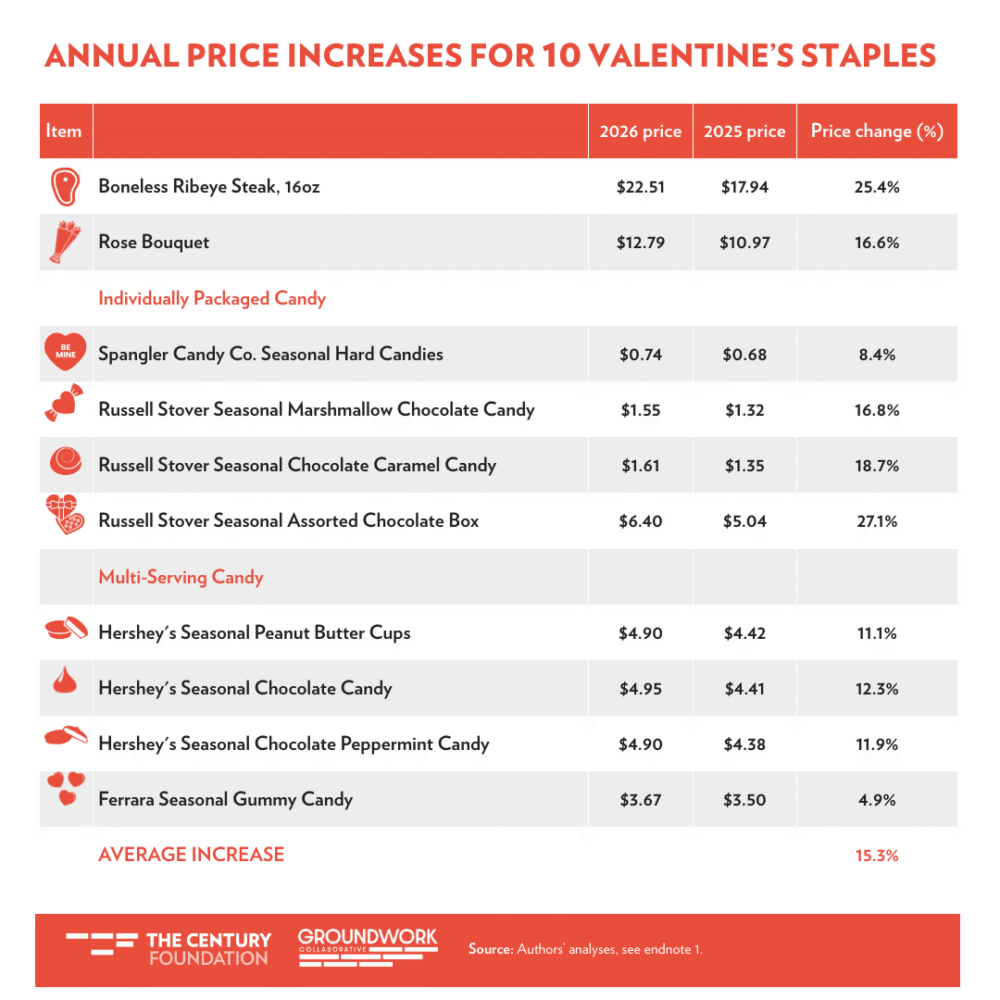
New analysis from Groundwork Collaborative and The Century Foundation finds that Valentine’s Day will be more expensive this year, with prices of classic gifts and goodies up 15.3 percent compared to last year, or more than five times the overall rate of inflation.
As friends and lovers across the country prepare to shower their valentines with gifts, candies, and fancy dinners, spending for the holiday is expected to soar to a record $30 billion. New analysis from Groundwork Collaborative and The Century Foundation finds that Valentine’s Day will be more expensive this year, with prices of classic gifts and goodies up 15.3 percent compared to last year, or more than five times the overall rate of inflation.
No matter how Americans plan to celebrate Cupid’s day this year, they’ll face higher price tags. For those who want to take their dates out to dinner, couples can expect to spend over $200 for their dining experiences as restaurant prices have climbed at nearly twice the rate of grocery prices over the past year. And for couples opting instead for a romantic night in, savings may also be hard to find—prices for ribeye steaks, for example, are 25 percent more than last year.
A fresh bouquet of roses is up more than 16 percent this year, and prices of the most popular seasonal sweets are running high as well. For example, chocolates from Russell Stover will run shoppers between 17 percent and 27 percent more this year, while packs of classic seasonal chocolate candies from Hershey’s are all up roughly 12 percent. For lovers of non-chocolate candy varieties, price increases range from 5 percent for heart-shaped gummy candy from Ferrera (the parent company of Brach’s) to 8 percent for seasonal hard candy from Spangler Candy Co., the maker of Sweethearts and Dum-Dums.1
This year, Spangler Candy Co.’s Sweethearts, the iconic heart-shaped candies, are leaning into the bleak economic reality, coupling their higher prices with new financially themed sayings like “split rent,” “buy in bulk,” and “share log-in.” The satirical messages capture that, even during the season of love, the cost of living remains Americans’ top concern. Rising prices have consumers down in the dumps on the economy: the Conference Board’s Consumer Confidence Index fell 10 percent over the past month to its lowest level since March 2014. More and more families are being forced to rely on “Buy Now, Pay Later” and other debt financing to cover everyday costs and a K-shaped divide continues to widen across the economy.
Many of these price hikes are a direct consequence of President Trump’s erratic and unpopular tariff agenda. Across the board, the Trump administration increased the average U.S. tariff to 17 percent, the highest level since 1932. Contrary to the president’s claims, U.S. consumers and businesses bear the brunt of these tariffs, as the price of imported goods has climbed nearly 7 percent from pre-tariff trends. New research from the Kiel Institute for the World Economy finds that American consumers and businesses are bearing 96 percent of the burden of Trump’s tariffs, while Goldman Sachs predicts that shoppers will shoulder 55 percent of tariff costs.
Valentine’s Day is one of the busiest days of the year for florists, as more than one in five Americans buy flowers to celebrate the holiday. More than 80 percent of cut flowers sold in the U.S. are imported from abroad, and Trump’s chaotic tariff agenda has ballooned bouquet prices. Rising import costs have been squeezing florists since last Mother’s Day, where tariffs added a roughly $25 million tax on imported flowers. In January, President Trump announced new tariffs on Colombia, the top cut-flower supplier to the United States, adding millions in extra costs for wholesalers and florists, pushing the price of flowers even higher leading up to Valentine’s Day.
The vast majority of cocoa bean production is concentrated in West Africa, while over one-third are processed in European nations. Though the Trump administration recently reversed course and exempted cocoa from its slash and burn tariff agenda, it was too late: for much of the past year, many cocoa and chocolate products faced tariffs ranging between 15 percent and 39 percent, driving up prices on Valentine’s inventory which retailers must order months in advance. Tariffs and supply shocks have forced cocoa prices to skyrocket. Small confectioners have had to raise prices on chocolate products due to the increased costs of raw cocoa. Large manufacturers like Hershey announced double-digit price hikes and smaller packages last fall, also citing cocoa prices as the primary driver.
Whether at home or at a restaurant, a dinner date will run wrought with higher prices or lower quality offerings, as restaurants struggle to absorb higher costs. For couples planning a night in, a classic steak dinner will come with an extra squeeze as beef prices have jumped 16 percent over the past year, driven by tariffs on imports and a constrained supply, as persistent drought and high feed costs thins cattle herds to a seventy-year low. Even a glass of wine may be pricier, as retailers and producers warn that prices for European wines could rise by as much as 30 percent this year due to Trump’s 15 percent tariffs on goods from the European Union. The pressure extends to domestic wineries, where rising cork and glass costs are leading winemakers like Kory Burke of California’s Dresser Winery to raise prices by as much as 15 percent per bottle.
As Americans exchange valentines, they won’t be sending President Trump and his economic agenda a “Be mine.” Indeed, nearly six in ten Americans disapprove of Trump’s economic leadership, and fewer than one in three voters believe the country is better off than it was a year ago. His cratering popularity is no surprise as the president’s economic agenda continues to raise prices and nearly one in four Americans spend 95 percent of their income on basic necessities like housing, groceries, gas, child care, and utilities.
[1]Authors’ own analyses and calculations based in part on data reported by NIQ for the listed product categories for the weeks ending January 24, 2026 and January 23, 2025 for the total U.S. market and total FMCG retailer channel. The conclusions drawn from the NIQ data are those of the authors and do not reflect the views of NIQ. NIQ is not responsible for and had no role in and was not involved in analysis and preparing the results reported herein or developing, reviewing, or confirming the research approaches in connection with this report.
Shamaal Sheppard, Contributor
Shamaal Sheppard is the associate director of policy and advocacy at Groundwork Collaborative.
Nia Law, Contributor
Nia Law is a special assistant and research assistant at Groundwork Collaborative.
Laura Valle Gutierrez, Contributor
Laura Valle Gutierrez is a fellow at The Century Foundation, where she uses her policy and research expertise to advance gender, racial and economic equity.