Innovative Research / Groundwork Collaborative
Swipe Right to Pay: How Dating Apps Turned Love Into a Subscription Service
February 25, 2026
Overview
While there are more dating apps than ever before, finding love through them has become more and more challenging — and more expensive.
I. Introduction
In February of 1976, 26-year-old Jeff Ullman used money borrowed from his parents to open a windowless, one-room office in Los Angeles where hopeful singles were invited to partake in the new phenomenon of “video dating.”1 For a fee, would-be romantics could record themselves, watch recordings of others, and screen potential matches for their looks, sense of fashion, conversation style, and interests all at once — before agreeing to meet a select few. Video profiles offered something novel: the ability to showcase personality in ways that traditional static questionnaires could not. These profiles were awkward, but allowed people to present a more vulnerable side before a first date. Despite lingering cultural stigma around dating services, the industry flourished: By the early 1990s, there were approximately 600 different video dating services in the United States. And then, something that seemed even better arrived: dating apps.
Tinder was free when it launched in 2012, and promised something revolutionary to the dating masses: instant access to potential partners with a simple swipe of the finger. For the first time, meeting romantic partners didn’t require expensive matchmaking services, elaborate video productions… or even needing to leave the couch.2 Soon, dozens of other apps promising the same convenience appeared: Hinge in 2013, Bumble and JSwipe in 2014, Facebook Dating in 2019.
But while there are more dating apps than ever before, finding love through them has become more and more challenging — and more expensive. Tinder was free when it launched, but now charges up to $50 per month for premium features like messaging someone before matching with them and having your likes prioritized to other users. The cost of Bumble’s most basic subscription tier has increased 200% since 2016.3 Hinge markets itself as “designed to be deleted” — but offers discounted subscription rates for six-month commitments. The apps that seemed to promise they would democratize dating have instead turned romance into a subscription trap, extracting maximum revenue from the people they claim to serve.
This transformation didn’t happen by accident. It happened by design, driven by the same corporate consolidation playbook that has concentrated power across the American economy. Two companies — Match Group and Bumble — now control the vast majority of the dating app market. Match Group owns Tinder, Hinge, Plenty of Fish, OkCupid, and Match.com, effectively giving it control over how more than half of young Americans search for romantic partners. And with that control has come systematic abuse and annoying frictions in the marketplace for love: predatory pricing, algorithmic manipulation, privacy violations, and business models that profit most when users stay single, frustrated, and, above all, willing to pay.
The apps that seemed to promise they would democratize dating have instead turned romance into a subscription trap, extracting maximum revenue from the people they claim to serve.
But it doesn’t have to be this way. What follows is a framework for bringing consumer protection to the forefront of the dating app industry. These reforms alone won’t solve America’s loneliness epidemic or guarantee that everyone finds love. But they will ensure that the search for human connection isn’t rigged against the people doing the searching, and that the companies mediating modern romance operate with basic fairness, transparency, and accountability.
Swipe Right to Pay: How Dating Apps Turned Love Into a Subscription Service
Without policy intervention, dating apps will continue optimizing for engagement and revenue rather than genuine connection — trapping millions in an expensive loop of artificial scarcity and manufactured hope. It's not you. It's “The Apps.” And The Apps are bad on purpose.
II. A Brief History of Monetized Romance: How Dating Moved Online—and Behind a Paywall
For most of American history, people met their romantic partners “in the wild” — that is, through the free, organic connections primarily provided by family, friends, church, or school. With the exception of professional matchmakers, these “meet-cutes” cost nothing but the time invested in participating in community life and fostering strong social networks.4
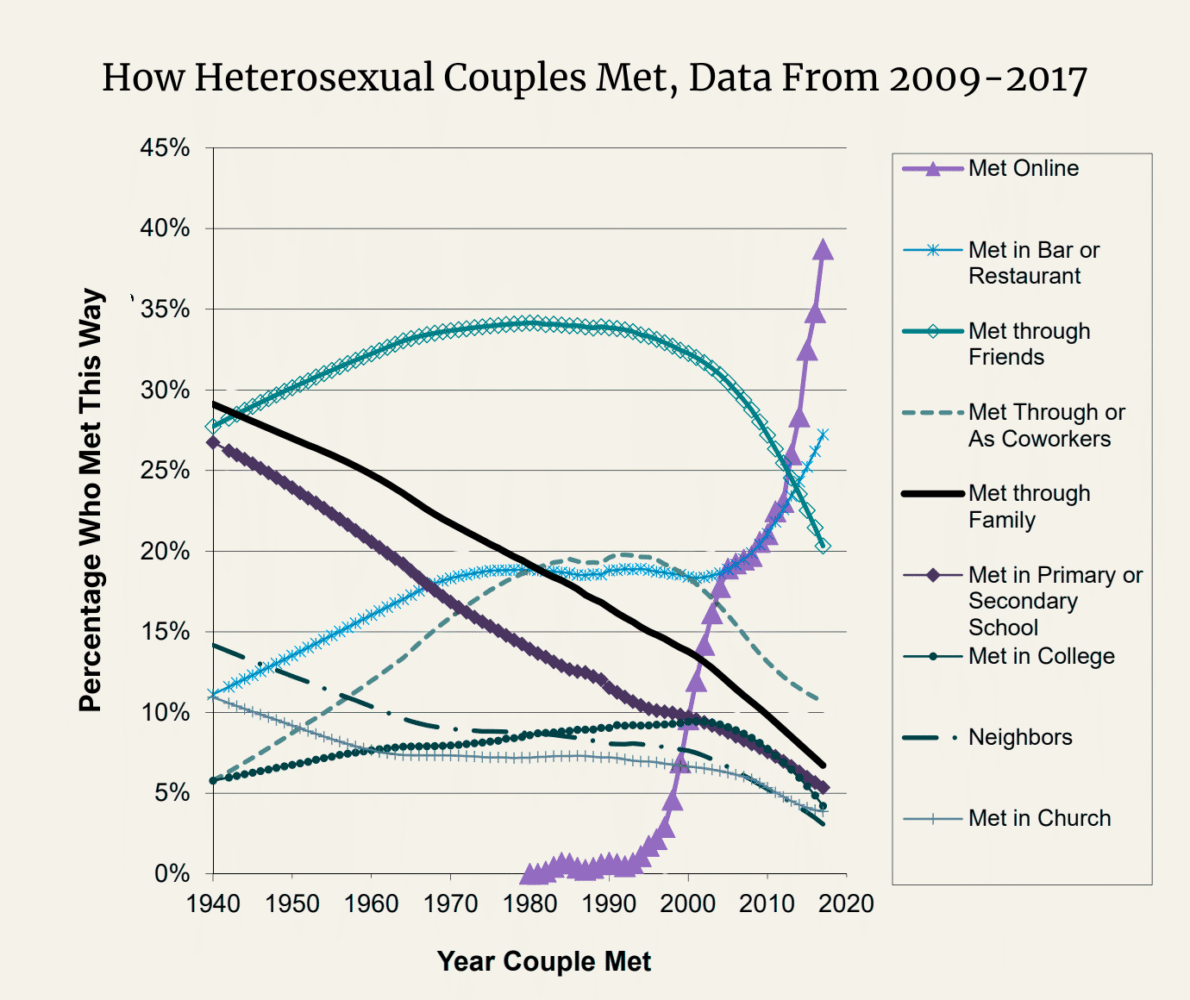
Reproduced from Rosenfield, Michael et al., Disintermediating Your Friends, (Proceedings of the National Academy of Sciences), 15, 1.
In 2000 — years after cell phones and personal computers invaded American homes — the most popular ways to meet a romantic partner were still through friends, coworkers, or at a restaurant or bar. Less than 10% of couples met online.
That changed in the 2010s, when meeting through online dating sites or apps became the most common way couples connected. The pandemic, and the social isolation that followed, dramatically accelerated this trend. As of February 2026, more than half of all adults between the ages of 18 and 49 have used online dating sites or apps.5 Among adults with partners, one in ten met their significant other online. For those under 30, that figure doubles to one in five.
Today, dozens of dating apps cater to virtually every demographic — from the omnipresent Hinge, Tinder, Bumble, and Grindr to those that are more niche, like Farmers Only for those who prefer country living, Feeld for the non-monogamous, Raya for celebrities and influencers, and Veggly for vegans. These platforms have also begun encroaching into non-romantic territory — Bumble for Friends promises to help you find pals, while apps like Timeleft organize dinners with strangers for a $26 monthly subscription.
Yet despite this abundance of options, it has become pricier and even more difficult to find a partner. When Tinder, Hinge, and Bumble first launched, they were completely free. Now, they employ a “freemium” business model where basic services are still free, but users have access to more features through paid subscriptions or à la carte purchases.
More than a quarter of the 32% of single Americans using online dating services pay for these services, averaging about $19 a month on either subscriptions or à la carte purchases. Over the past decade, the price of these subscriptions has increased by as much as 200%. At the same time, dating apps have limited the features available to non-subscribers, effectively pushing users toward paid premium plans.
Today’s singles face a convergence of social and economic forces that have made dating apps more a necessity than a choice. The pandemic fundamentally changed how people socialize. Virtual meetings and work-from-home arrangements supplanted in-person interaction throughout the early 2020s. Six years after the onset of COVID-19, many Americans remain significantly more isolated than they were in 2019 — a phenomenon so pronounced that the U.S. Surgeon General declared loneliness a public health epidemic.
Dating apps have limited the features available to non-subscribers, effectively pushing users toward paid premium plans.
Simultaneously, the physical spaces where people used to meet organically are vanishing. Urban design that’s hostile to pedestrians, rising commercial rents, car-centric development, and increasing social anxiety have eroded what sociologist Ray Oldenburg called “third places” — coffee shops, parks, community centers, and other venues where people feel comfortable lingering outside of work and home. Without these free gathering spaces, opportunities for organic connection have dwindled. As one dating app user told The Atlantic, dating apps have fundamentally changed how people interact: “[Asking someone out in person] wouldn’t be an abnormal thing to do, but it’s just not as common. When it does happen, people are surprised, taken aback” because “dating has become isolated from the rest of social life.”
Over the last 50 years, the percentage of Americans ages 25–34 not living with a spouse or partner has doubled, and is now at 50% for men and 41% for women.6 The intensifying affordability crisis has created a double-edged sword for those seeking partners. As co-CEO of the dating app Coffee Meets Bagel Quincy Kang recently put it, the affordability crisis has made surviving on a single income untenable for many Americans; but as young people struggle to find jobs, cover the cost of rent, and pay off student loans, the last thing they want is to pay subscription fees just to meet potential partners.
III. From Free to Freemium: The Corporate Takeover of Modern Dating
Dating apps weren’t always this bad. Like most platforms in the early days of the internet, they were once greeted with optimism — a way to optimize the search for love. But as the companies that owned these apps sought to monetize and scale up, a paradox emerged: Every successful match reduces these companies’ potential profit by two users.
This paradox has shaped the entire business model. As a class action lawsuit against the Match Group stated, dating apps are predicated on [the app’s] ability to turn non-paying users into paying customers. Because more than 98% of its revenue comes from subscriptions and in-app purchases, a company like Match Group has incentive to keep the free version of a dating app frustrating enough to make upgrading feel necessary, but functional enough to keep users from abandoning the platform altogether. Then, companies need to keep users single enough to keep making money while promising to find their match for life.
A Few Big Fish in the Sea: How a Handful of Companies Captured the Market for Love
The dating app market is dominated by two titans (based on total users): Match Group and Bumble.7 Match Group is at the top, with a $7.58 billion market cap. It is the world’s largest conglomerate of online dating apps, and operates some of the most popular platforms, like Tinder, Hinge, Plenty of Fish, OkCupid, and its namesake Match.com. Bumble, Inc. has a market cap of nearly $460 million, between Bumble and its friendship matching apps, like Badoo or Bumble for Friends.8 In 2025, Tinder commanded 25% market share, with Bumble close behind at 24%. And Hinge — also owned by Match Group — follows in third place, with an 18% share.
Match Group’s consolidation did not happen by accident. Since 2009, Match Group systematically acquired over 25 of its rivals, amassing a portfolio of over 40 brands. The company’s strategy — attempting to buy potential competitors and if they refused, deploying litigation to force their hand — delivered results.
Bumble’s experience illustrates this playbook perfectly. Launched in 2014 as a feminist alternative to Tinder, Bumble adopted the same “swipe-to-match” model but required women to send the first message. Within three years, the app had amassed over 22 million registered users at more than 70% year-to-year growth, competing with Tinder’s roughly 10%. The app gained so much popularity in such a short period of time that it was no surprise when Match Group attempted to acquire it in 2017 for $450 million. Bumble refused, but Match Group did not stop there. In response to the rejection, Match Group filed a lawsuit against Bumble in 2018, accusing the company of violating patents and stealing trade secrets. As news outlets alleged at the time, the lawsuit felt like a bargaining chip — a message to Bumble: “sell to us, and the lawsuit goes away.”
Other dating app startups have endured similar legal intimidation: Match Group sued Muzmatch, a dating app for Muslims, for trademark infringement while simultaneously making multiple offers to acquire the company. For companies like Bumble, that have the money to burn on legal fees, this type of litigation is a costly headache. Without deep pockets, smaller competitors are often left with no choice: either sell or be sued out of existence.
This type of anti-competitive behavior does not just cost companies — consumers also pay a price. Match Group’s market dominance means that the company doesn’t merely participate in the dating app industry — it sets the rules for how courtship gets commodified. And those rules prioritize extortion over authentic connection.
In February 2024, Clarkson Law Firm filed a lawsuit against Match Group on behalf of several former customers, alleging that the company designed its platforms with addictive, gamelike design features that “lock users into perpetual pay-to-play loop that prioritizes corporate profits over its marketing promises and customers’ relationship goals.” The lawsuit details a pattern of deceptive and coercive practices commonly deployed on gambling sites: algorithms that hide quality matches to incentivize premium upgrades, notifications that trigger compulsive app-checking, artificial scarcity through daily swipe limits, and variable pricing schemes that charge users different amounts based on secretive algorithmic assessments. All of this, the plaintiffs argued, contradicts Match Group’s stated mission and marketing, perhaps best exemplified by its subsidiary Hinge’s own tagline: “designed to be deleted.”
This wasn’t Match Group’s first brush with regulatory accountability. In 2019, the Federal Trade Commission (FTC) sued Match.com for using fraudulent profiles to lure non-subscribers into purchasing paid memberships and stymied users’ efforts to cancel their memberships. The FTC’s complaint revealed that between 2013 and 2016, more than half of the messages and “likes” that free users received came from accounts that Match had already flagged as fraudulent. In August 2025, Match settled for $14 million.
Dating apps operate under the same economic logic as other social media platforms: The more users on a particular platform, the more valuable it becomes to each individual user. This is known as “network effects.” These economies of scale present a natural tendency toward consolidation. People gravitate toward apps on which they’re likely to find the most matches. Like Facebook or Instagram, dating apps are designed to capture and monetize attention through endless scrolling and addictive engagement loops. But while social media addiction wastes users’ time, dating app addiction wastes their time and money — all while systematically preventing the very connections that would free them from the platform.
Bait and Switch: How Free Apps Became $600-a-Year Subscriptions
Seventy-eight percent of respondents to a 2025 survey reported feeling emotionally, mentally, or physically exhausted by dating apps. The primary source of their fatigue? An inability to find quality connections. While users often blame themselves for their lack of success, mounting evidence suggests that dating apps themselves are engineered to prevent meaningful matches — not because the technology is unable to do so, but because failed connections are more profitable than successful ones.
Technology critic Cory Doctorow has a term for this dynamic: “enshittification.” Though not specific to dating platforms, the term describes a predictable pattern of corporate behavior, enabled by market dominance, deployed to convert non-paying users into subscribers. When a tech platform first launches, it offers a quality user experience to rapidly build a customer base and loyal following. Once it achieves some degree of market dominance, it shifts focus from serving users to extracting maximum revenue from them. Service quality deteriorates, prices rise, and users find themselves trapped on a platform that no longer works well but has no viable alternatives.
When Tinder first launched in 2012, it was free — and did not promote ads to users. In 2015, Tinder introduced its first subscription tier, Tinder Plus. The service cost $9.99 per month for users under 30, and was $19.99 for users 30 or older. It also included several premium features: the ability to rewind a profile you accidentally swiped left on, unlimited daily likes, a Passport feature that allowed you to change your location, and — now making you pay for what had once been free — no ads. Tinder Plus now costs $24.99 per month — a 150% increase, while Tinder Platinum, the app’s highest-tier plan launched in 2020 costs $49.99 per month.9 Today, subscribing to the three major apps can cost more than $2,100 per year.10 And, for users on “luxury apps” like The League — which promises users exclusivity — memberships run between $299.99 per month for the most basic offering and $2,499.99 per month for VIP access.
Users can also purchase one-off features like “boosts” that say they promote their profile to more users and “roses” to jump to the top of a potential match’s queue, and dating apps have increasingly paywalled features. Many users have reported that Hinge started charging for filters that were previously free, including those specifying politics, religion, or interest in having children — alignment on all of which can be dealbreakers for singles. Tinder originally offered every user one free “super like” per day, which they can use to signal special interest in a potential match. When Tinder Gold launched in 2017, it offered five super likes a day; now, it only offers two super likes per week. Non-subscribers are currently only offered one free super like per month. Users can purchase additional super likes from $1.50 to $3.33 each, spending as much as $100 to access a feature that was once free.11
Ghosted by the Algorithm: When Apps Hide Profiles to Sell Premium Features
Paywalling is just one of the underhanded tactics tech companies will use to frustrate users into paying for love. Dating apps also gatekeep what they algorithmically determine to be individualized “quality matches,” making them harder to contact without payment. Hinge, for example, operates the notorious “Rose Jail” or “Hinge Jail” (names coined by social media users), which is a special feed filled with quality matches that are hard for users to contact (Hinge refers to these profiles as a user’s “Standouts”). To connect with these high-grade prospects, a user must send a “rose” — a premium show of serious interest. Through artificial scarcity (users only get one free rose per week and they don’t roll over), Hinge presents users with a false tradeoff. If you want to meet your potential spouse, you must pay for more roses. (And at $9.99 for three digital roses, you could nearly pay for an actual bouquet.)
“Hinge Jail” means the people users may be most likely to be interested in are deliberately placed out of reach unless they pay. It’s not that these users are more selective or less available — the company has simply programmed them to be “out of reach” for free users.
Beyond the ubiquitous paywalls, dating app users increasingly report a more insidious practice called shadowbanning, where companies may quietly make a user’s profile invisible to others while allowing them to continue using the platform — and paying for it. Profiles that used to receive dozens of matches per week suddenly go dead. Social media platforms like TikTok are flooded with users and commenters offering tips and techniques to “escape the algorithm” — an indicator of a collective anxiety that reveals how little control or transparency dating app users have over their own profiles. While companies have officially denied the practice, critics allege that the unfalsifiable practice is routinely used to throttle overactive users and reduce match rates to make premium features seem more appealing.
Selling User Secrets: How Dating Apps Monetize Personal Information
Few industries collect more sensitive personal information than online dating. Dating apps sit on a treasure trove of information: intimate conversation history, sexual orientation, religious and political beliefs, and even users’ exact location. As journalist Judith Duportail recounted in The Guardian, when she requested her dating information from Tinder, she got back a whopping 800 pages detailing her Facebook likes, her education, the age-rank of the men she was interested in, and when and where every online conversation with every single one of her matches occurred on the app. Duportail wrote, “Tinder is often compared to a bar full of singles, but it’s more like a bar full of single people chosen for me while studying my behaviour, reading my diary and with new people constantly selected based on my live reactions.”
But these dating app companies do not collect personal information for users’ benefit — it is for their bottom line. Personal data is the new fuel of the economy: an untapped source of revenue to be sold to third parties or refined into profitable insights. A 2020 report by the Norwegian Consumer Council found that at least 10 dating apps, including Tinder and OkCupid, transmitted sensitive user data to at least 135 different third-party companies. A 2020 New York Times investigation found that OkCupid sent a user’s ethnicity and profile information to a marketing firm, and had posted a list of more than 300 advertising and analytics “partners” with which it may share users’ information.
Perhaps even more insidious than selling personal data to advertisers is using it to gouge customers and charge them different prices for the same service. In 2019, Tinder settled a $23 million class-action age discrimination lawsuit for charging people over 30 twice as much for its subscriptions services. Under the settlement, Tinder agreed to stop charging users in California, where the case was filed, different prices based on their age. In 2020, the consumer group Choice found that straight men over 50 were charged five times more than some other users to sign up for Tinder Plus in Australia. Queer women under 30 were offered the cheapest deal, at $6.99 per month, while city-based straight men over 50 were given the most expensive rate of $34.37.
There is evidence that Tinder also uses personalized pricing techniques in the U.S. A 2022 study conducted by Mozilla and Consumers International found that, on average, 30–49-year-olds were charged 65.3% more than 18–29-year-olds for Tinder Plus. The study, which spanned six countries, found that the highest price for Tinder Plus was between four and six times more than the lowest. In the U.S., a Tinder plus subscription ranged from $4.99 to $26.99 per month.
Perhaps even more insidious than selling personal data to advertisers is using it to gouge customers and charge them different prices for the same service.
Tinder has previously acknowledged that it uses “a number of factors” in its personalized pricing algorithms, but it has refused to clarify what those factors are. This deliberate opacity creates a fundamental information asymmetry: Dating apps know everything about users, but users know nothing about how that information is being used to determine the price they pay.
Instead, users are left to crowdsource understanding through Reddit threads and op-eds, piecing together anecdotal evidence to figure out why they’re paying $27 monthly while their friend pays only $5 for identical features. It’s a system designed to keep consumers confused, annoyed, and unable to make informed decisions about whether they’re being ripped off.
IV. From Extraction to Connection: Regulating the Dating App Industry
Despite widespread user dissatisfaction, dating apps remain the dominant gateway to romantic connection, making regulatory intervention not just warranted but essential. The evidence of declining app quality is unmistakable: Tinder has lost millions of users in major markets the past couple of years. As of late 2025, monthly U.S. Tinder users were down roughly 40% since early 2022 — from 18 million to 11 million. In June 2025, Bumble laid off 30% of its workforce, citing declining revenue and falling user totals. But dating apps’ chokehold on modern matchmaking leaves consumers with few options for alternative dating prospects.
The dating app industry’s exploitation of lonely hearts didn’t happen by accident — it happened by design, enabled by a regulatory vacuum that has allowed a handful of corporations to consolidate the market, manipulate users, and extract maximum profit from one of life’s most personal pursuits. But this dynamic need not continue. Just as dating app companies transformed courtship through technology, policymakers can transform dating apps to serve users rather than just their bottom lines.
Policymakers should rein in the industry’s worst excesses. They should protect consumers from predatory pricing and deceptive practices, ensure transparency in how algorithms determine who gets to meet whom, and safeguard the intimate data users share during their search for connection.
Subscription Pricing Protections. Dating apps have exploited their captive user base through aggressive and opaque pricing schemes that trap consumers in a cycle of escalating costs. Consumer protections to help address these abuses include:
- Requiring Price Transparency: Dating apps should be required to disclose their pricing structures clearly and provide a minimum of 30 days advance notice before any price increases take effect. Legacy users who subscribed at lower price points should be grandfathered in at their original rates.
- Tiering Disclosure: If dating apps create different tiers of user experience based on payment level, they must clearly disclose what free users can and cannot access, and how paid features impact match quality and quantity. The promise of dating apps — connecting compatible people — should not be paywalled for free users, even if premium features offer enhancements.
Algorithm Disclosure and Fairness. The black-box algorithms that determine who sees a user’s profile and who appears in their queue are perhaps the most pernicious aspect of modern dating apps. Policymakers should ensure that users are able to understand the basic rules governing their search for connection by:
- Requiring Algorithm Use Disclosure: Dating apps should be required to disclose (in plain language) how their algorithms work, including what factors influence profile visibility, how often profiles are shown to other users, and what behaviors might reduce reach.
- Prohibiting Secret Penalties: The practice of shadowbanning — quietly reducing a user’s visibility without notice — should be explicitly prohibited unless tied to clear, disclosed violations of platform rules (such as harassment or spam). If an app reduces someone’s profile visibility, it must notify them and explain why.
- Prohibiting Artificial Scarcity: Apps should be barred from deliberately hiding “quality matches” behind paywalls à la “Hinge Jail.” If the algorithm determines that two users are highly compatible, that information should not be weaponized to extract payment. Apps should not be able to engineer artificial scarcity by making algorithmic matches systematically harder to contact without payment.
Cancellation Rights. The friction that dating apps build into cancellation processes reveals their true priorities: keeping users paying regardless of satisfaction. Policymakers can alleviate this consumer burden by:
- Requiring Easy Cancellation: Canceling a dating app subscription should be as simple as subscribing. Since the Trump administration failed to enforce the FTC’s “click to cancel,” policymakers should require subscription-based apps to provide one-click cancellation options that don’t force them to navigate byzantine menus, contact customer service, or jump through multiple confirmation screens.
- Establishing a Universal Right of Withdrawal: Consumers should have a meaningful window — at minimum 14 days — to cancel subscriptions and receive full refunds. Such a cooling-off period should be standardized across all subscription-based platforms to prevent companies from burying cancellation rights in dense terms of service.
- Requiring Automatically Pro-Rated Refunds: When users cancel in the middle of their subscription period, they should receive automatic pro-rated refunds for unused time. This basic fairness principle eliminates the perverse incentive for companies to make cancellation so difficult that users give up.
Data Privacy and Security. Dating apps collect some of the most intimate information people share digitally: relationship history, sexual preferences, private conversations, and real-time location data. To protect sensitive personal data and consumer privacy, policymakers should:
- Require Apps Use End-to-End Encryption: All private conversations on dating apps should be protected by end-to-end encryption, ensuring that only the parties conversing have access to the messages. Dating app companies themselves should not have access to user communications, thereby mitigating the potential for both privacy violations and the risk of data breaches exposing intimate conversations.
- Require Automatic Data Deletion: The EU’s “right to be forgotten” should be a baseline standard in the U.S. When users delete their accounts, their data should be permanently deleted within a reasonable timeframe (for instance, within a maximum of 30 days). Users should also have the right to request deletion of specific conversations, photos, or profile information at any time. Additionally, dating apps should be prohibited from retaining user data indefinitely for advertising or algorithmic training purposes.
- Institute Geolocation Protections: Real-time location tracking poses serious safety risks, particularly for women and LGBTQ+ users. Charging for premium features based on a company’s awareness of a user’s location — for instance, charging for “travel mode” — should be prohibited.
V. Conclusion
What Jeff Ullman started with borrowed money and VHS tapes has evolved into a sophisticated digital network of extraction. Dating apps have taken one of humanity’s most personal desires and turned it into a revenue stream — designed to flow perpetually, but never quite deliver satisfaction. Today, dating apps charge users up to $50 per month while engineering features designed to prevent the very connections it markets. “Hinge Jail” ensures a user’s “best matches” stay out of reach. Shadowbanning silences users’ profiles without explanation. Dynamic pricing charges users wildly different amounts. And companies collect and share users’ most intimate data with hundreds of third parties — all while marketing themselves as faithful companions in the search for love.
Without policy intervention, dating apps will continue optimizing for engagement and revenue rather than genuine connection — trapping millions in an expensive loop of artificial scarcity and manufactured hope. It’s not you. It’s “The Apps.” And The Apps are bad on purpose.
The fix is straightforward. Policymakers can institute basic transparency in pricing and algorithms, fundamental data privacy protections, and reasonable cancellation rights. In the game of love, dating apps reign supreme. But it’s time to stop letting them rig the match.
Footnotes
[1] Ullman’s company, Great Expectations, allowed customers looking for love to record themselves responding to basic questions like “what are you looking for in a partner?” and “what makes you angry?” They would then peruse the tapes of other singles in a VHS library until they found a potential match that piqued their interest.
[2] Modern dating apps originated in the gay community with Grindr and Scruff; Tinder brought them to people of all sexualities and quickly infiltrated mainstream dating culture.
[3] Bumble first offered a $9.99 monthly subscription option in 2016. Today, it costs $29.99 a month for Bumble Boost — the lowest-tier subscription, which offers many of the same features — an increase of 200%.
[4] In the U.S., professional matchmakers were primarily used by either immigrant communities interested in marrying people of similar religious and cultural backgrounds, or wealthy elites seeking socially, financially, or politically advantageous marriages.
[5] 51% of 18–29 year olds and 53% of 30–49 year olds have used dating sites or apps, compared to just 20% of adults above 50. These numbers are even higher for queer couples: 63% of people who identify as LGBTQ+ have used these platforms.
[6] For more and more women, choosing to stay single is a reflection of their financial independence, autonomy, and confidence rather than an inability to find a match.
[7] Match Group has 82 million active monthly users, while Bumble Inc (including Badoo), has more than 85 million users.
[8] After Tinder, Grindr has the second largest market cap at $1.98 billion.
[9] Features included in the Tinder Plus subscription may have changed over time.
[10] Calculated based on a monthly subscription for Bumble premium+, Hinge X, and Tinder platinum.
[11] Tinder charges $3.33 per “super like” if you purchase at least three, $2.50 each if you purchase twelve, and $1.50 each if you purchase fifty. The Gold subscription includes two free super likes per week and the Platinum subscription includes three.