Last summer, Republicans passed one of the most regressive tax packages in history, slashing basic needs programs that help families afford essentials to pay for giveaways to the wealthy and large corporations. One year after the passage of the so-called One Big Beautiful Bill Act (OBBBA), families across the country are still grappling with a cost of living crisis exacerbated by President Trump’s economic agenda. Millions have lost health care, face food insecurity, and are paying more on their monthly bills due to the cuts in the bill. Meanwhile, Trump’s promised benefits failed to materialize. Americans took notice. New polling from Groundwork Collaborative finds that:
- A majority of voters (55%) – including 61% of Independents – say Trump and Republicans in Congress have made it harder to afford health care in the past year.
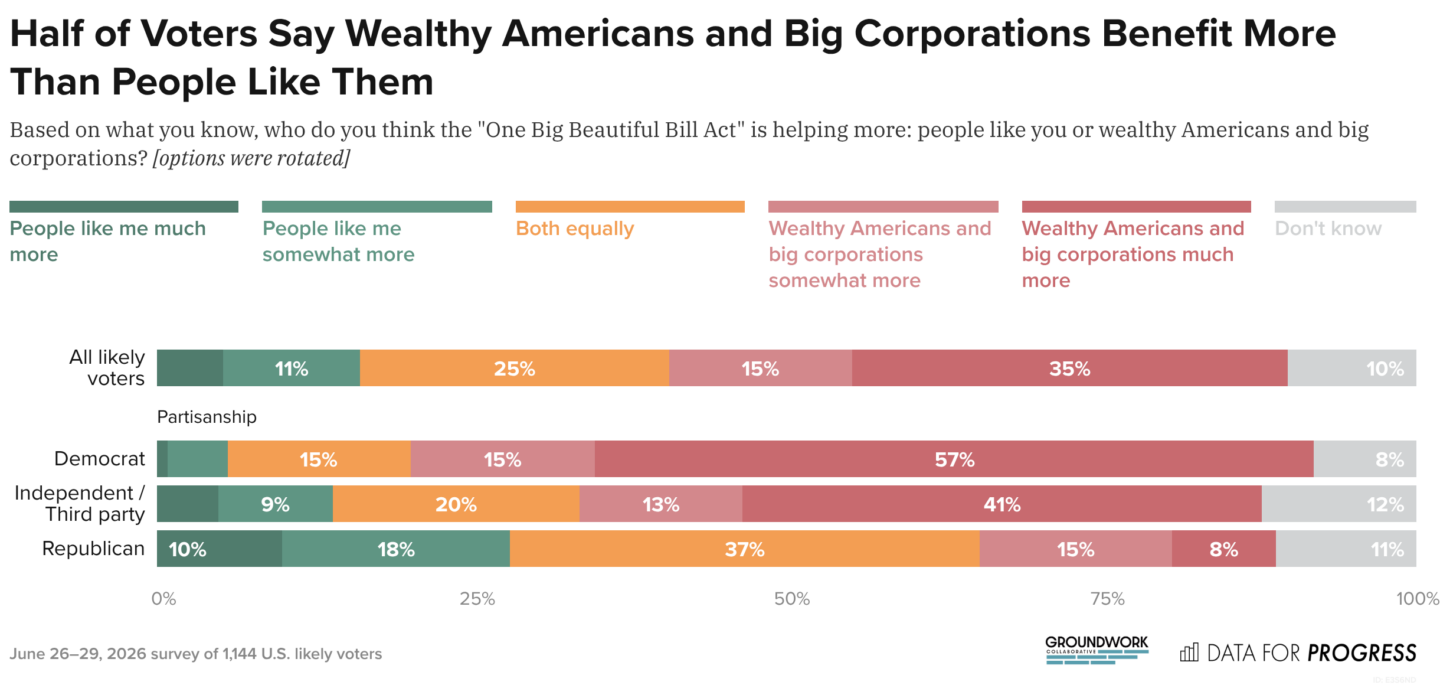
- Half of voters (50%) say the law helps wealthy Americans and big corporations more than people like them, with only 16% saying the latter.
- A clear majority (61%) of voters – including nearly 70% of Independents and 39% of Republicans – say the law’s health care cuts are not worth the $300-on-average boost to tax refunds.
With even more damaging provisions set to take effect in the months ahead, below are the ways in which the Republican tax law has made life harder and more expensive for working families:
Cuts to basic needs programs are driving prices up for health care and groceries.
After Trump’s tax law slashed over $1 trillion in Medicaid funding – the largest cut in Medicaid history – millions of Americans are losing access to health care.
- Since passage of the OBBBA, 3.8 million Americans have lost Medicaid and Children’s Health Insurance Program coverage. By 2034, a projected 15 million Americans will lose health insurance as a result of Republicans’ cuts.
- Over 1,000 hospitals, clinics, and nursing homes have shut down, reduced services, or are at risk of doing so – forcing Americans to travel farther for care, wait longer for treatment, or miss critical care altogether.
- So far, 40 maternity wards, 30 nursing homes, and over 360 clinics have already shut down as a result of the Republicans’ cuts.
- Starting in January 2027, states will require Medicaid expansion enrollees to report 80 hours of community engagement activities while also being required to redetermine eligibility for Medicaid expansion enrollees every six months.
- This means that you could lose your health insurance if your work hours dip or an emergency pops up, and an additional five to ten million Medicaid beneficiaries could lose coverage due to impending work requirements and frequent eligibility checks.
Republicans let the enhanced Affordable Care Act (ACA) Premium Tax Credit expire, driving up health insurance prices for millions.
- So far, at least 3 million Americans have had to drop enrollment in ACA marketplace health insurance plans this year because of dramatic increases in premium costs. And even more may lose coverage later this year as they struggle to keep up with rising premiums.
- Millions of Americans will spend on average $2,136 in annual ACA premiums this year – a 58% hike compared to last year – while in some states Americans are paying up to 220% more.
- Average ACA Marketplace deductibles increased by 37% (or $1,027 per person) to a record high of $3,786 in 2026. Many people have switched to higher-deductible plans because they could no longer afford the higher premiums for plans with lower deductibles, putting them at risk of incurring more out-of-pocket costs.
Americans are paying the price and rationing their own care to afford it.
- As premiums spike and coverage disappears, families are being forced to implement choices. In the last year, one in two Americans cut back on care, switched to cheaper coverage or took on debt.
- One in five Americans delayed or avoided going to the doctor. And of those who did, 1 in six took on credit card debt or medical debt to cover health costs.
- Two-thirds of voters now want major change – with 38% saying that simply reversing the Trump administration’s cuts doesn’t solve our health care crisis.
While American families struggle to afford groceries, Republicans cut $300 billion from the Supplemental Nutrition Assistance Program (SNAP).
- Americans continue to report rising grocery prices as a top concern. Higher diesel and fertilizer prices from Trump’s war in Iran are working their way through the food supply chain, leading to price hikes at the grocery store.
- Meanwhile, Americans are losing the grocery assistance they depend on. Since OBBBA’s enactment more than 4 million people have lost access to SNAP benefits, including over 800,000 children.
- SNAP participation has dropped in every state and in some states like Arizona, participation fell by as much as 53%.
- As a result of losing food assistance, Americans are struggling with growing food insecurity, with some food banks reporting a 25% increase in demand.
- Like Medicaid, the deepest SNAP cuts are still scheduled to hit: Starting October 1, states will have to cover 75% of SNAP’s administrative costs – which could cost them hundreds of millions of dollars a year – forcing states to tighten eligibility, cut benefits, or even drop participation entirely to balance their budgets.
- An estimated 2.4 million people will be cut out completely from SNAP benefits, while 4 million people will see some benefit reduction once changes are fully implemented.
- And an estimated 18 million children could lose access to free school meals thanks to the Republican cuts.
- A significant portion of families – including more than half a million children – would see their benefits reduced by an average of $100 per month. For example, a single mom with one child would see her food assistance payment drop to less than $5 per person per day – far too little to feed a family as grocery prices continue to rise.
Trump’s cuts have sent costs soaring and working families are feeling the heat.
With clean energy tax incentives set to expire this summer, projects that would have driven down energy and transportation costs are stalled.
- In 2025, an estimated $34.8 billion in clean energy investments were cancelled.
- The New Energy Efficient Home Credit, which incentivized the construction of energy efficient homes and was estimated to spur the construction of 3 million homes ends on June 30.
- Thanks to those cuts, Republicans have made it more expensive to buy an electric vehicle as gas prices eat into paychecks.
- The termination of the $7,500 tax credit for purchase of new EVs and $4,000 for buying a used EV has priced many Americans out buying it. In California for example, EV sales fell 40% year over year, while zero-emission market share fell to 13.7%, the lowest level since 2021.
- At the same time, gas reached its highest price in nearly four years because of Trump’s reckless war in Iran. The average household is expected to spend $857 more on gasoline this year.
Utility bills are on the rise, and so is the cost to make your home more energy efficient thanks to the OBBBA.
- As utility bills increased by 7.1% – more than twice the pace of inflation – and exceeded 20% in some states in 2025, the Republican tax bill terminated tax credits for home energy efficiency improvements last December.
- The tax credit helped families save more than $2,200 in energy costs each year by making it more affordable to install energy-efficient technologies.
- Not only are utility bills rising, but Republicans made it more expensive to make your home more energy efficient or generate your own energy.
This summer, many students will have no choice but predatory private loans or giving up on pursuing an education.
- Thanks to OBBBA, new borrowing caps on federal student loans go into effect on July 1st, limiting how much students and their parents can borrow, and forcing many to take out more expensive and less flexible private loans – with interest rates up to 23% – to fill the gap.
- Additionally, approximately 40% of Americans will likely be denied private student loans because they do not meet income and credit score requirements, forcing them to rely on predatory subprime student loans, or give up on pursuing an education altogether.
Corporations and the ultra-wealthy cash in. Working families are stuck with the bill.
Meanwhile, Congressional Republicans handed corporations and billionaires billions of dollars in tax windfalls – all of it paid for by cutting on essential programs that everyday Americans rely on.
- Four Big Tech companies (Amazon, Alphabet, Meta, and Tesla) collectively reported $315 billion in U.S. profits for 2025 – more than 30% higher than in 2024 – but they paid less than 5% of that in federal corporate income taxes.
- Tesla received over $1 billion in federal income tax breaks from American taxpayers last year and paid nothing in federal income taxes.
- In the four months after enactment of the Republican tax law, total federal revenue from the corporate income dropped by nearly a third.
- Thanks to the Republican tax law, these companies saved a collective $51 billion in taxes last year compared to what they would have paid under the full 21% federal corporate income tax rate. Much of these savings came from tax breaks expanded or preserved under the OBBBA.
And the tax savings Republicans promised working Americans? They never came.
- Trump claimed that OBBBA’s No Tax provisions would deliver the “biggest tax refund season ever” – projecting average refunds to rise by at least $1,000. In reality, the average refund was barely $300 more than it was in 2025.
- Meanwhile, the average household faces $857 in higher gas costs from the Iran war – a hit that eats up any refund gains.
- Sizable refunds primarily went to the wealthiest taxpayers. The Center for American Progress analysis found that fewer than 50% of taxpayers making less than $100,000 annually would receive an increased tax refund, while almost all taxpayers making more than $100,000 would receive one.
- The richest 1% of Americans will benefit more than the bottom 80% of Americans, receiving a total net tax cut in 2026 that is about $14 billion greater.
Americans have never liked the Republican tax law, and a year of living under it hasn’t changed their minds.
- New polling from Groundwork Collaborative finds majorities of voters concerned with rising costs that stem from Trump and Republicans tax law, including:
- A majority of voters (55%) – including 61% of Independents – say Trump and Republicans in Congress have made it harder to afford health care in the past year.
- 70% are concerned that 5 million Americans are losing health insurance as a result of OBBBA’s cuts, while 75% are concerned about insurance premium hikes.
- 70% believe Trump and Republicans have made it harder to afford groceries over the past year.
- 67% are concerned that nearly 4 million Americans have lost SNAP benefits as a result of the Republicans’ tax law.
- 61% – including 70% of Independents – say the OBBBA’s health care cuts are “not worth it” when told that over 5 million people will lose health care coverage, even if the average tax refund was $300 higher this year.
- 50% say the law helps wealthy Americans and big corporations more than it helps people like them.