
As Americans kick off the summer this Memorial Day weekend, Trump’s mishandling of the economy will leave families paying much more to enjoy the warmer season.
As Americans kick off the summer this Memorial Day weekend, Trump’s mishandling of the economy will leave families paying much more to enjoy the warmer season. Every direction Americans turn they’re seeing price hikes, whether they’re filing up at the pump, walking down the grocery store aisle, or booking a flight online.
This Memorial Day, families will spend significantly more to enjoy a classic backyard barbecue, with holiday staples up an average of 13% — four times overall inflation.1 Burgers will cost more as ground beef is 20% more expensive than last year, while brats and hot dogs are up 28% and 12%, respectively. Americans can also expect higher prices on the side dishes: corn will cost double what it cost last year. Dessert prices have soared, as store-bought pies will run families as much as 37% more.
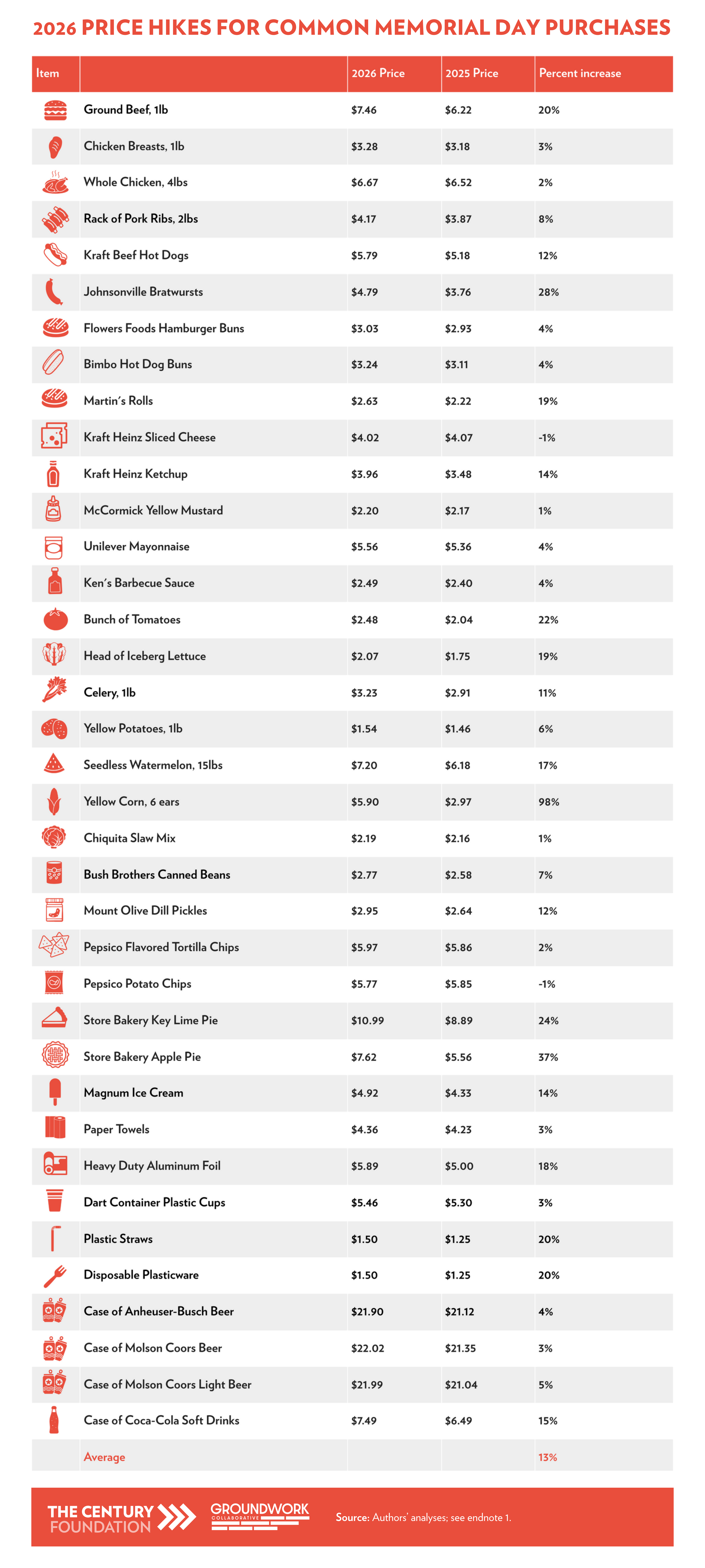
Higher fresh-produce prices in particular reflect Trump’s mishandling of the economy. Last year, the number of farmers filing for bankruptcy rose 46%, as Trump’s tariffs unleashed chaos and uncertainty in the industry. Fertilizer is an essential component for growing every item of produce and tariffs in place for much of 2025 drove fertilizer prices ever higher; these prices have remained elevated even after the Trump administration was forced to roll them back due to backlash. Trump also ended the U.S.–Mexico tomato agreement that had been in place for decades and replaced it with a 17% tariff on Mexican tomatoes. As a result, tomato prices have reached the highest level in nearly eight years. Furthermore, steel and aluminum tariffs significantly raised farm equipment costs for farmers, while reciprocal tariffs hurt farmers’ exports.
Trump’s war in Iran has cut off nearly one-third of global fertilizer supply, pushing up prices as struggling farmers face increased costs and lower crop yields. Farmers have reported fertilizers prices jumping yet another 25%, or approximately $200 extra per ton since the conflict began. The war has also increased diesel costs by about 45%, an increase that ripples through the supply chain — from higher expenses for running farm equipment to increased transportation costs needed to deliver food to American consumers. Importantly, fertilizers also affect the price of meat, since cattle, poultry, and other livestock are fed with crops like corn and soy.
Even the plates we eat on will be more expensive. The Middle East is a major producer of oil and petrochemicals, which is used to produce plastic. Disposable plasticware prices are up about 20% compared to last year. Increases in the price of plastic will ripple across grocery bills for months to come as packaging gets more expensive as well.
Jet fuel has soared to record highs and companies are passing these costs on to consumers. The average domestic airfare ticket is now 31% more expensive than in January, according to industry data. For a family of four, this equates to an extra $360 on plane tickets for a typical flight. This recent spike is just a continuation of a year-long trend, as the Consumer Price Index showed airlines airfare rose 20.7% from one year ago, the highest one-year increase since 2023. Additionally, all major U.S. carriers have announced additional price hikes of about $10 per checked bag in April 2026, citing the geopolitical environment.
And there are more hikes on the horizon. Southwest Airlines CEO Andrew Watterson told shareholders in a recent call with investors that there have been five industrywide fare hikes so far this year, and there are more on the way. Meanwhile, United CEO Kirby also confirmed prices will not come down, saying “The longer consumers pay these prices and airlines get used to this revenue stream, the more likely it is [to hold].” Trump’s reckless war in Iran will leave lasting damage in prices, far beyond the duration of the conflict itself as companies use instability situations as cover to raise prices and squeeze every cent out of Americans.
Trump’s reckless war in Iran will leave lasting damage in prices, far beyond the duration of the conflict itself as companies use instability situations as cover to raise prices and squeeze every cent out of Americans.
As part of the economic chaos caused by Trump’s Iran war, Spirit Airlines recently shut down operations, partially because of the unexpected increase in jet fuel prices. This is significant because the budget airline put downward pressure on competitors, who are now free to set higher prices as customers have no lower-cost choice. When Spirit closed ninety routes between 2024 and 2025, for example, the average airfare price for those routes increased 14%, twice the typical airfare inflation. In some cities, Spirit’s exit resulted in a 140% increase in ticket prices, with the route between Fort Myers to San Juan rising by $127, from $92 to $219. It is not a coincidence that just a few days after Spirit shut down, Delta announced that they will no longer be serving free snacks and soft drinks on short-haul flights — limiting such basic amenities to first-class customers only.
Even if Americans can afford airline tickets, flyers will be on packed planes — if their flights take off at all. Airlines have already cut over 2 million seats and 12,000 flights worldwide over the past two weeks, an unprecedented level of cancellations. United Airlines has removed over 21,000 flights off its summer schedule, while Delta and American cut over 13,700 combined. Due to increased jet fuel costs, airlines are cancelling less profitable routes or switching to smaller aircraft. And travelers caught amidst the flight cancellation chaos have less recourse than they otherwise would. The Trump administration canceled the Biden administration’s proposed rule to compensate U.S. passengers between $200 to $775 for significant flight delays or cancellation.
Airlines have already cut over 2 million seats and 12,000 flights worldwide over the past two weeks, an unprecedented level of cancellations.
Recently, Transportation Secretary Sean Duffy embarked on a road trip reality show for America’s 250th birthday. The trip was paid for by industries and companies that his department regulates, raising corruption concerns. After hitting the road on the corporate dime, Duffy encouraged every American to take a road trip this summer and said that “we’re in a good place [regarding fuel prices].” But that’s a costly suggestion for families, as average gas prices have hit the highest level since 2022, up to $4.50 nationally (up nearly $1.50 per gallon since before the start of the Iran conflict). Duffy’s road trip would cost nearly $900 in gas today, and for a 1,000 mile round-trip, Americans will now spend an average of $184 on gas, an increase of 51% due to Trump’s war.2
And even staying cool at home this summer will be more expensive. Tariffs have increased the price of HVAC equipment, while Trump’s budget law ended tax subsidies that Americans could receive for upgrading their air-conditioning system for more efficient models. On top of this, major HVAC manufacturers have been accused of price-fixing, making residential systems 8% more expensive than they would have been in a competitive market over the past six years.
For a 1,000 mile round-trip, Americans will now spend an average of $184 on gas, an increase of 51% due to Trump’s war.
Whether your family is hitting the beach, grilling in the backyard, packing up the car for a road trip, or catching a flight to see family and friends, nearly every aspect of this Memorial Day will be more expensive than last year, due to Trump’s reckless economic and foreign policies. But Trump? He’s not worried. As he said this week, “I don’t think about Americans’ financial situation.”
[1] Authors’ own analyses and calculations based in part on data reported by NIQ for the listed categories for the one-week periods ending April 25, 2026 and April 26, 2025 for the total U.S. market and total FMCG retailer channel. The conclusions drawn from the NIQ data are those of the authors and do not reflect the views of NIQ. NIQ is not responsible for and had no role in and was not involved in analyzing and preparing the results reported herein or in developing, reviewing or confirming the research approaches used in connection with this report.
[2] Calculation based on 24.4 MPG, the average fuel efficiency according to the Department of Energy, available at https://afdc.energy.gov/data/10310. Gas prices are updated by AAA as of May 12, 2026, available at https://gasprices.aaa.com/.
Agatha Pinheiro, Contributor
Agatha Pinheiro is a policy analyst at Groundwork Collaborative.
Breyon Williams, Ph.d, Contributor
Breyon Williams is the chief economist at Groundwork Collaborative.
Janelle Jones, Contributor
Janelle Jones is a visiting senior fellow at The Century Foundation.