Innovative Research / Groundwork Collaborative
AI at Work: Gains at the Top, Pressure for Everyone Else
August 3, 2026
Overview
Groundwork Collaborative and Ipsos recently conducted a survey of American workers to assess how AI is affecting America’s workforce and worker sentiment about AI.
The Groundwork Collaborative and Ipsos recently conducted a survey of American workers to assess how artificial intelligence (AI) is affecting America’s workforce and worker sentiment about AI. The results show a workforce that is bracing for AI rather than embracing it as workers expect AI to deepen existing levels of inequality.
Key Findings
- Overall, 51% of workers believe that widespread use of AI at work will only or mostly benefit business owners and executives, compared to just 6% who say most or all the benefits will go to workers. One in seven workers believe it will not benefit anyone.
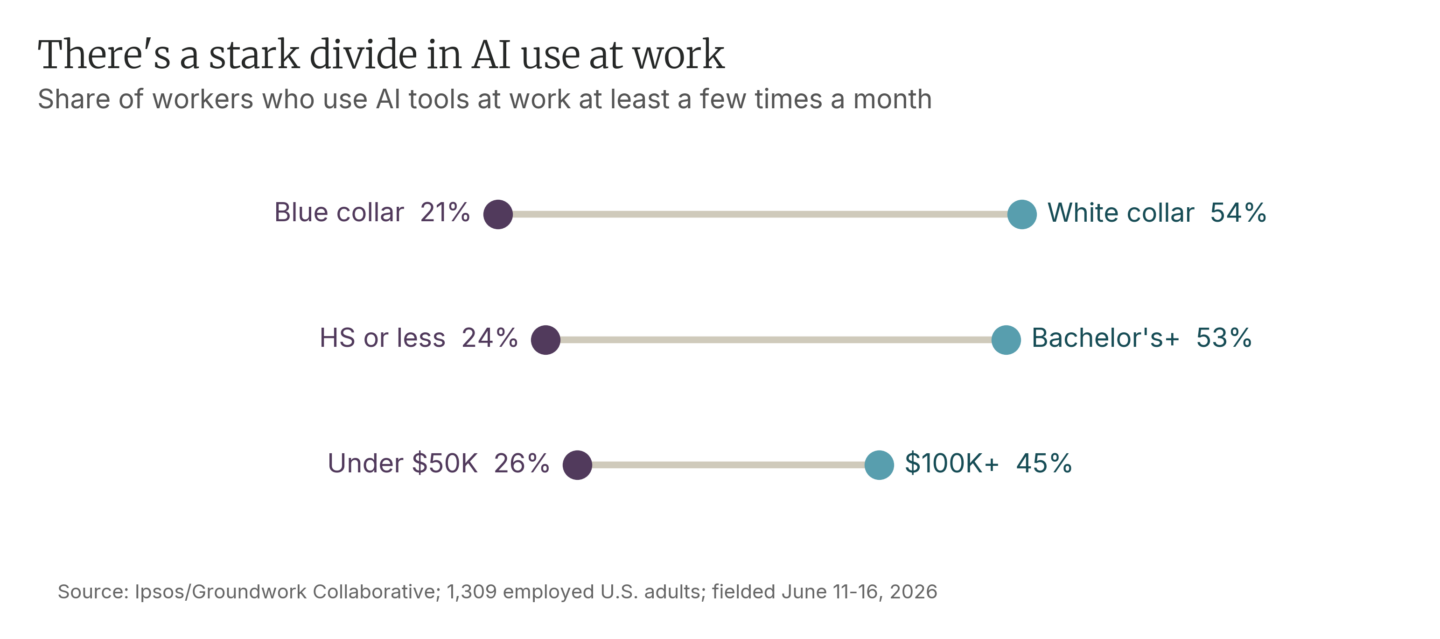
- Three in ten workers use AI at work at least weekly, but there are stark differences on income, education, and sector lines.
- Half of workers who earn less than $50k and without a college degree never use AI in the workplace, compared to the 80% of college graduates who use it at least occasionally.
- White-collar workers are far more likely than blue-collar workers to use AI at work at least monthly (54% vs. 21%).
- On a macro scale, two-thirds of workers expect AI to make work worse by eliminating jobs and putting greater pressure on workers, rather than improving the worker experience by freeing up time spent on repetitive tasks and assisting with more challenging work. This sentiment is consistent across race, gender, education, and income lines.
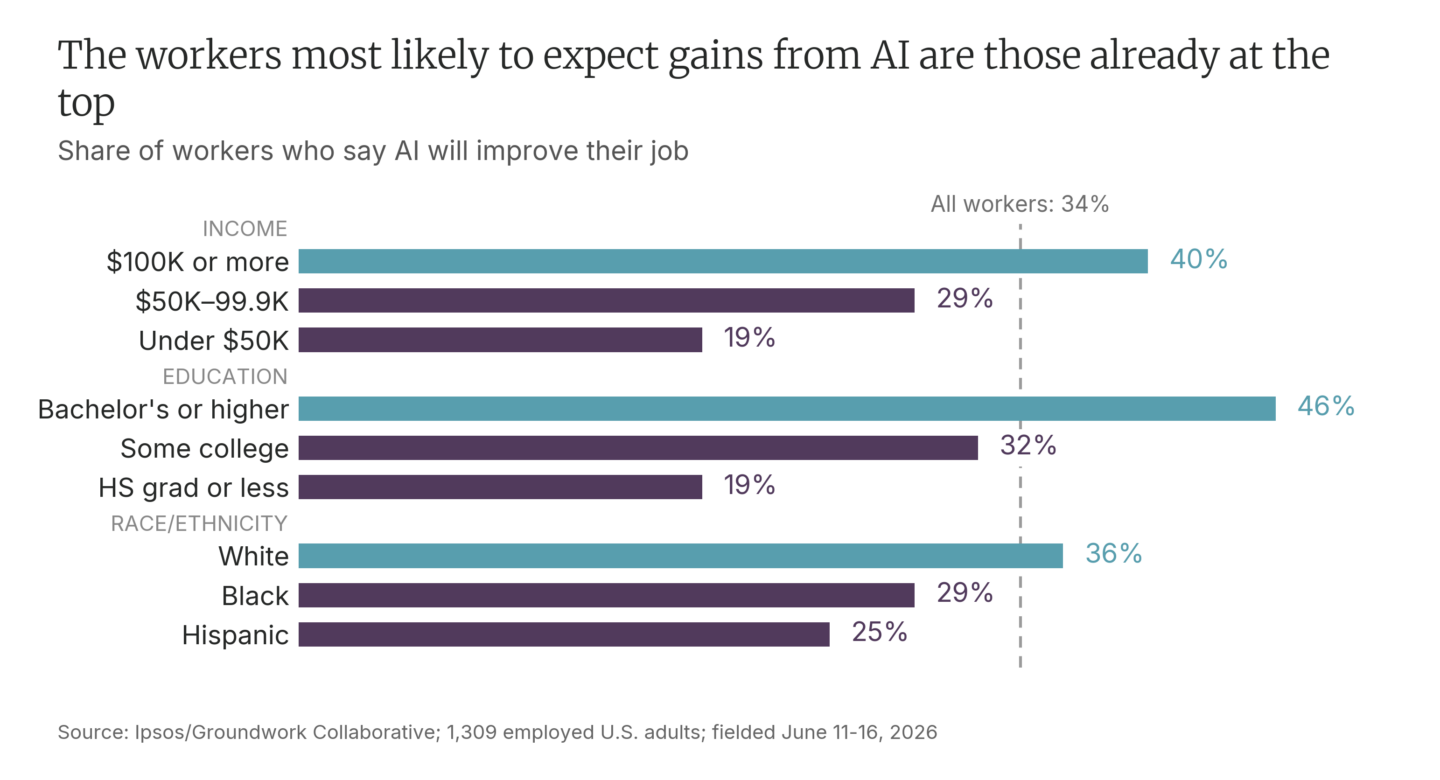
- When asked specifically about how AI will affect their own jobs, optimism is concentrated at the top.
- Nearly half of workers with a college degree (46%) and four in ten workers who earn more than $100k believe AI will help them with work and improve their job, compared to just 19% of those with a high school education.
- More than one in five workers who earn less than $50k believe AI will make their jobs worse by making tasks harder or less fulfilling, and 10% believe AI will replace their jobs altogether, compared with just 5% of high-wage workers.
- Black workers are far more likely than white workers to say AI will replace their job outright (12% vs. 4%).
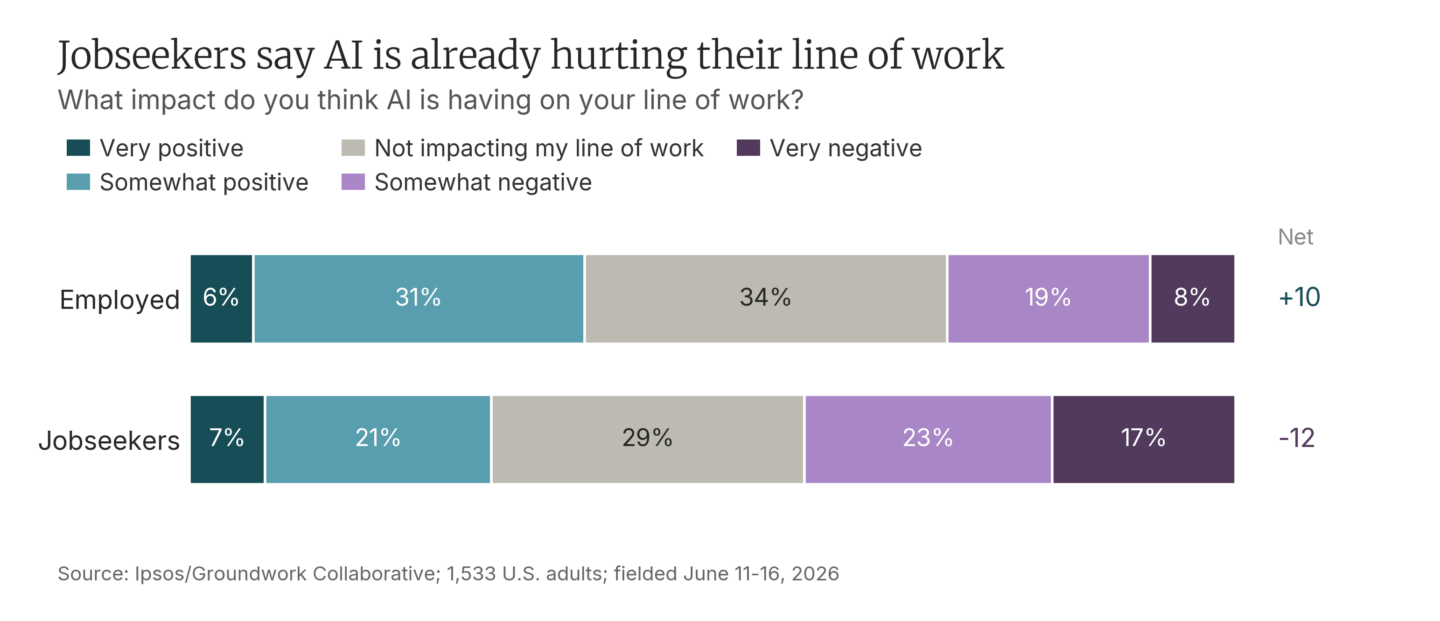
- Unemployed workers are much more likely than employed workers to feel that AI is having a negative impact on their line of work (41% vs 27%), and far more likely to say the effect is very negative (17% vs 8%).
Methodology: This survey was conducted by Ipsos between June 11–16, 2026, among 1,533 U.S. adults in the workforce. Results weighted to national benchmarks. Margin of error = +/- 2.7pp.
Download a PDF of this brief.