Disappointment for Dad: Father’s Day Gift Prices Skyrocket Nearly 20% Thanks to Trump’s Economic Chaos
Disappointment for Dad: Father’s Day Gift Prices Skyrocket Nearly 20% Thanks to Trump’s Economic Chaos
Popular grilling and grooming gifts up as much as 30% this year
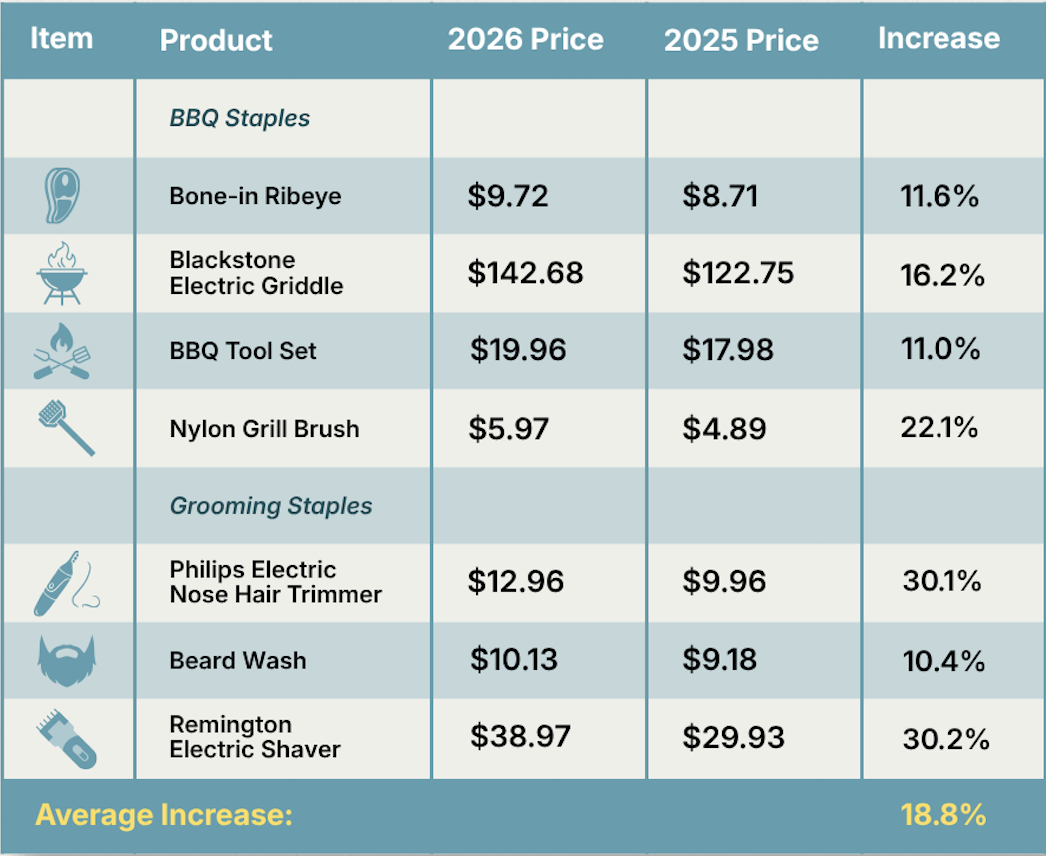
This Father’s Day, many dads are getting the unwelcome gift of higher prices. New analysis from Groundwork Collaborative finds that prices for popular Father’s Day gifts are up 18.8% on average this year. Upgrading dad’s grooming routine will be more expensive as the prices for both a Philips nose hair trimmer and a Remington electric shaver soar over 30%. And for families celebrating the holiday with a backyard barbecue, a bone-in ribeye has spiked nearly 12% higher than last year and the price of a Blackstone electric griddle has climbed more than 16%.
Since the start of his second term, Trump’s economic mismanagement has made holidays more expensive while driving up prices of everyday essentials, and his administration’s devastating cuts to critical programs have pushed working families to their breaking point.
Groundwork’s Managing Director of Policy and Advocacy, Elizabeth Pancotti, shared her take:
“Dads are in for disappointment this Father’s Day as prices continue to climb. While dads across the country should be able to relax and enjoy the day with loved ones, they’re instead forced to worry about how they’ll make ends meet in Trump’s economy.”
Background
- This year, 77% of consumers plan to celebrate Father’s Day. On average, consumers expect to spend $226, up from the previous record of approximately $199 in 2025. According to the National Retail Federation, consumers have been cutting back on other expenses to make Father’s Day fit within their budgets.
- Personal care items are one of the top Father’s Day gifts, with 40% of consumers buying them. Unfortunately, Trump’s on-and-off tariffs have increased prices for upgrades for dad’s grooming routine.
- Many shavers and trimmers are imported from China, which has faced multiple layers of tariffs, in addition to containing steel and aluminum components, which are also subject to additional tariffs.
- One of the small business owners who sued the Trump administration over its illegal IEEPA tariffs sells products like shavers, clippers, and trimmers. He was forced to spend over $600,000 on tariffs last year, as most of his products are made in China. At one point, the tariff bill on a shipment was higher than the value of the shipment itself.
- After Trump’s liberation day tariffs, Braun increased the price of its Series 9 All-in-One Beard Trimmer by $50, selling it for $150 last August. The price hikes have continued, and now the same trimmer is sold for $160 on Amazon.
- The Middle East is a major producer of the petrochemical used to make plastics and synthetic fibers. Trump’s reckless war on Iran has increased the price of these petroleum-derived products, helping drive up the cost of items like grilling tools, which cost nearly 22% more this year.
- The war has also cut off nearly one-third of global fertilizer supply, and farmers have reported fertilizers prices jumping 25%, feeding through to meat prices since cattle are fed with crops like corn and soy.
- Beef prices have been on the rise in the past year for a variety of reasons, including the smallest U.S. cattle herd in nearly 75 years. Now, ranchers are bracing for a New World screwworm outbreak. The parasite can cause livestock losses and force farmers to spend more on prevention and treatment, costs that are ultimately passed on to consumers through higher beef prices.
- Elon Musk’s DOGE cut funding last year for a project dedicated to monitoring and containing New World screwworms in Central America. This resulted in livestock being allowed to cross the border without the monitoring previously funded by USAID.
Authors’ own analyses and calculations based in part on data reported by NIQ for the listed categories for the one-week periods ending May 30, 2026 and May 29, 2025 for the total U.S. market and total FMCG retailer channel. The conclusions drawn from the NIQ data are those of the authors and do not reflect the views of NIQ. NIQ is not responsible for and had no role in and was not involved in analyzing and preparing the results reported herein or in developing, reviewing or confirming the research approaches used in connection with this report.