
By: Janelle Jones
Labor market data for the past year has shown a stalling economy, and as we ring in the new year — and the newest jobs report — there’s little reason to expect a change in course. Yesterday’s Job Opening and Labor Turnover Survey (JOLTS) data emphasized the sluggish hiring and firing environment, as employers are paralyzed by the turbulence caused by President Trump’s mismanagement of the economy. What little job creation there has been is almost exclusively in the health care industry. Despite the president’s promise to bring in a manufacturing renaissance, blue collar industries are shedding jobs for the first time since the initial COVID-19 shock and the depths of the Great Recession. Across the economy, employers are cutting expenses and jobs where they can, holding off on replacing workers who leave, and pulling back on pay raises. It’s only a matter of time before things tip from stagnation to outright contraction.
Although the headline numbers might not (yet) scream recession, two indicators that serve as canaries in the coal mines, often serving as flashing lights about a rough road for the economy up ahead, are in troubling territory: the different measures of underemployment and Black unemployment.
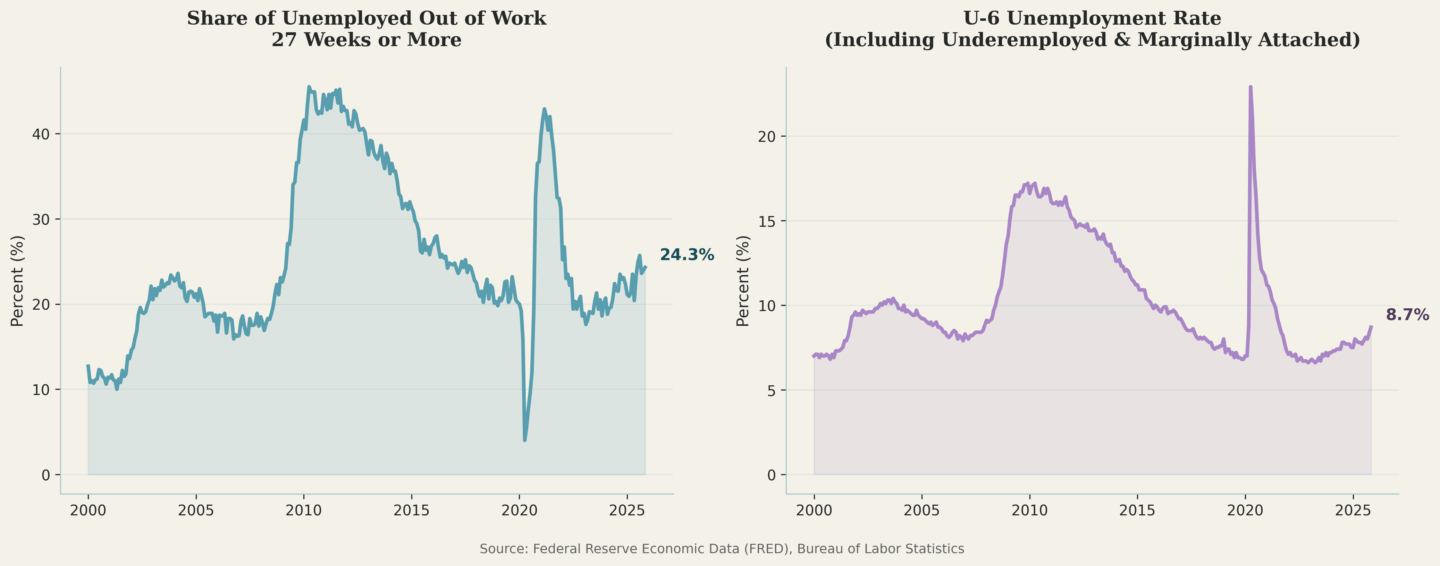
Measures of slack in the labor market are on the rise. Long-term unemployment rose steadily in 2025. At the end of the year, roughly one in four unemployed workers had been without work for more than six months — up 16% from the share at the beginning of the year. The underemployment rate (sometimes called the U-6 rate) includes people actively looking for work but can’t find it (the marginally attached), discouraged workers who want to work but haven’t looked in the past month, and people working part-time but want to work full time. This measure of underemployment shows just how much labor market potential is being left on the sidelines, and how workers on the margins, who often feel the effects of an economic downturn first, are faring. The rate of underemployment increased starkly last year, rising from 7.5% to 8.7% since Trump took office — more than three times the pace of the increase during the same period in 2008 leading up to the Great Recession.
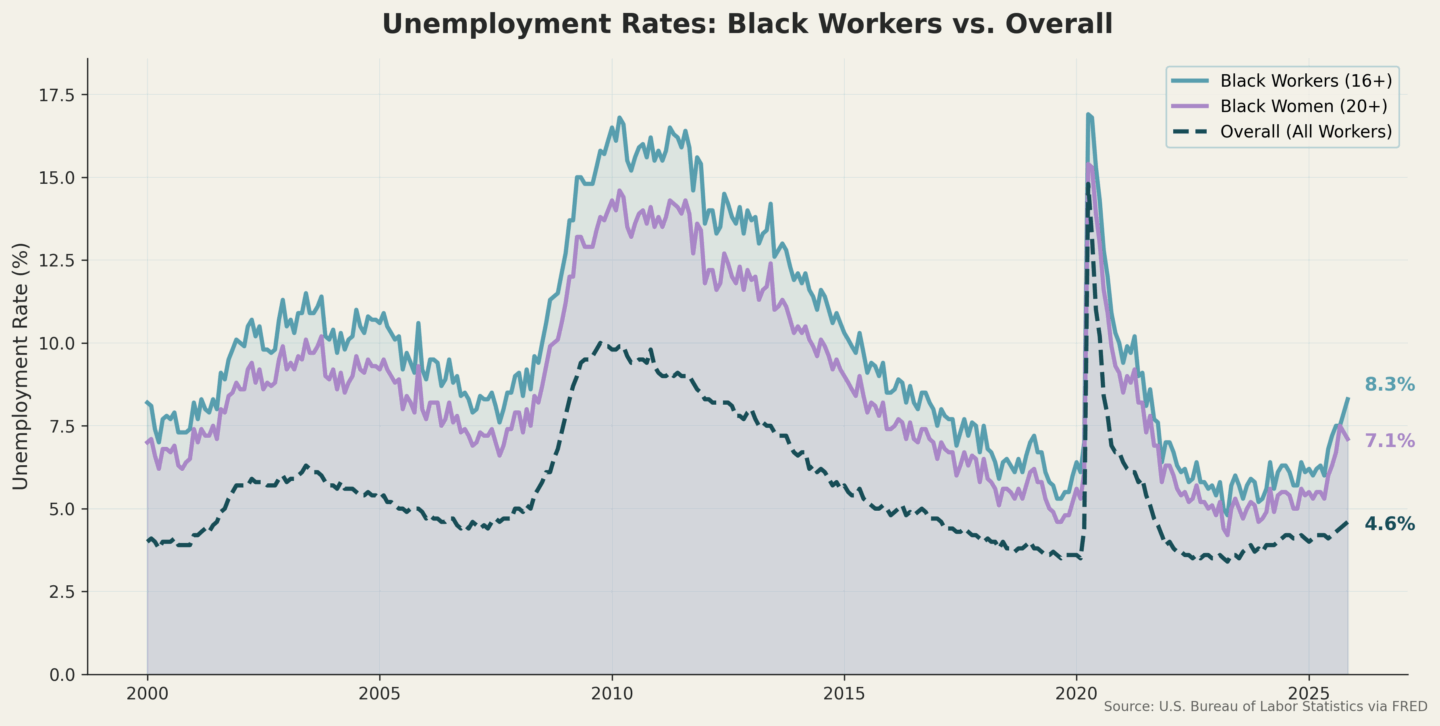
Similarly, an increasing Black unemployment rate is another harbinger of economic upheaval to come. The unemployment rate for Black workers is 8.3%, nearly twice the overall unemployment rate (4.3%). This is a recessionary rate. If the overall unemployment rate was that high, there would be a national outcry and response. In fact, the overall unemployment rate was 8.3% or lower when the economic stimulus packages of February 2009, March 2020, December 2020, and March 2021 were signed into law.
A recessionary economy for Black workers is a sign of underlying economic weaknesses, and is a strong indicator of forthcoming economic conditions for other groups of workers. In particular, Black women have a strong attachment to the labor market – that is, they are more likely than other groups of workers to have jobs. For example, the share of Black women working or actively looking for work (labor force participation rate) in November 2024 was 62.5, compared to a share of 57.4 for all women. So when the labor market weakens, Black women feel it swiftly. Worryingly, the unemployment rate for Black women has been steadily increasing.
While the government shutdown unfortunately disrupted labor market data collection in October, the trends in the data from the rest of 2025 — especially in September and November — point to concerning levels of deterioration in the strength of the labor market. As working Americans struggle with the worsening affordability crisis, many are also left worrying about the security of their paycheck. Tomorrow’s Jobs Day is unlikely to offer them much comfort, with December data underscoring that our most alarming indicators continue to flash.
As we get a more complete picture of the labor market in 2025 — a year filled with wide-ranging pressures and challenges — all signs point to an economy losing steam and already hanging our most vulnerable workers out to dry.