Death, Debt, and Paperwork: How the Business of Dying is Burying American Families
On average, families spend more than $7,000 on funeral expenses, and these expenses are often due within days.
Read the Report.
Grieving families navigate a series of services and systems that operate with minimal federal oversight, limited price transparency, and few meaningful consumer protections.
After a loved one dies, families are quickly confronted with a series of pressing financial and administrative decisions. On average, families spend more than $7,000 on funeral expenses, and these expenses are often due within days. Following the death of a loved one, families have to immediately begin managing a maze of administrative burdens, from contacting financial institutions to closing accounts and arranging memorial services. Meanwhile, bank accounts, property, and other assets can remain tied up in probate for months or longer. Even though families often have access to these funds on paper, in reality, they are not readily available. As a result, families are often forced to take on debt, draw down savings, or forgo services altogether.
Grieving families navigate a series of services and systems that operate with minimal federal oversight, limited price transparency, and few meaningful consumer protections. As families make consequential financial decisions at a moment of acute vulnerability, they have to manage costs, work through legal processes, and complete extensive paperwork with little coordination across systems. Wealthier households have access to estate attorneys and have the luxury of planning in advance: they can structure assets to avoid probate and ensure smooth transfers. Working families, often without substantial savings or access to estate planning, are left to contend with a system that extracts the most from those who can least afford it during an already painful and difficult time. Median household savings are roughly $8,200, meaning many households have little cushion to absorb these costs.
Life insurance is one of the few financial tools designed to provide families with immediate support after a death. However, life insurance coverage is uneven and increasingly inadequate. Nearly half of Americans do not have life insurance, meaning many families cannot cover funeral expenses or manage immediate costs after a loss. Access to employer-sponsored coverage is also highly unequal. While 77% of full-time workers have access to employer-provided life insurance, only 14% of part-time workers do. Just 20% of workers in the bottom tenth of wages have access to coverage, compared to 91% of top earners. Even for families with life insurance, policies can still fail to provide meaningful protection when someone dies. Forty percent of new life insurance policies are term-limited rather than permanent, meaning coverage can expire before a person dies. Consequently, families may spend years paying into life insurance policies that ultimately provide no support for funeral expenses or other end-of-life costs.
On average, families spend more than $7,000 on funeral expenses, and these expenses are often due within days.
Read the Report.
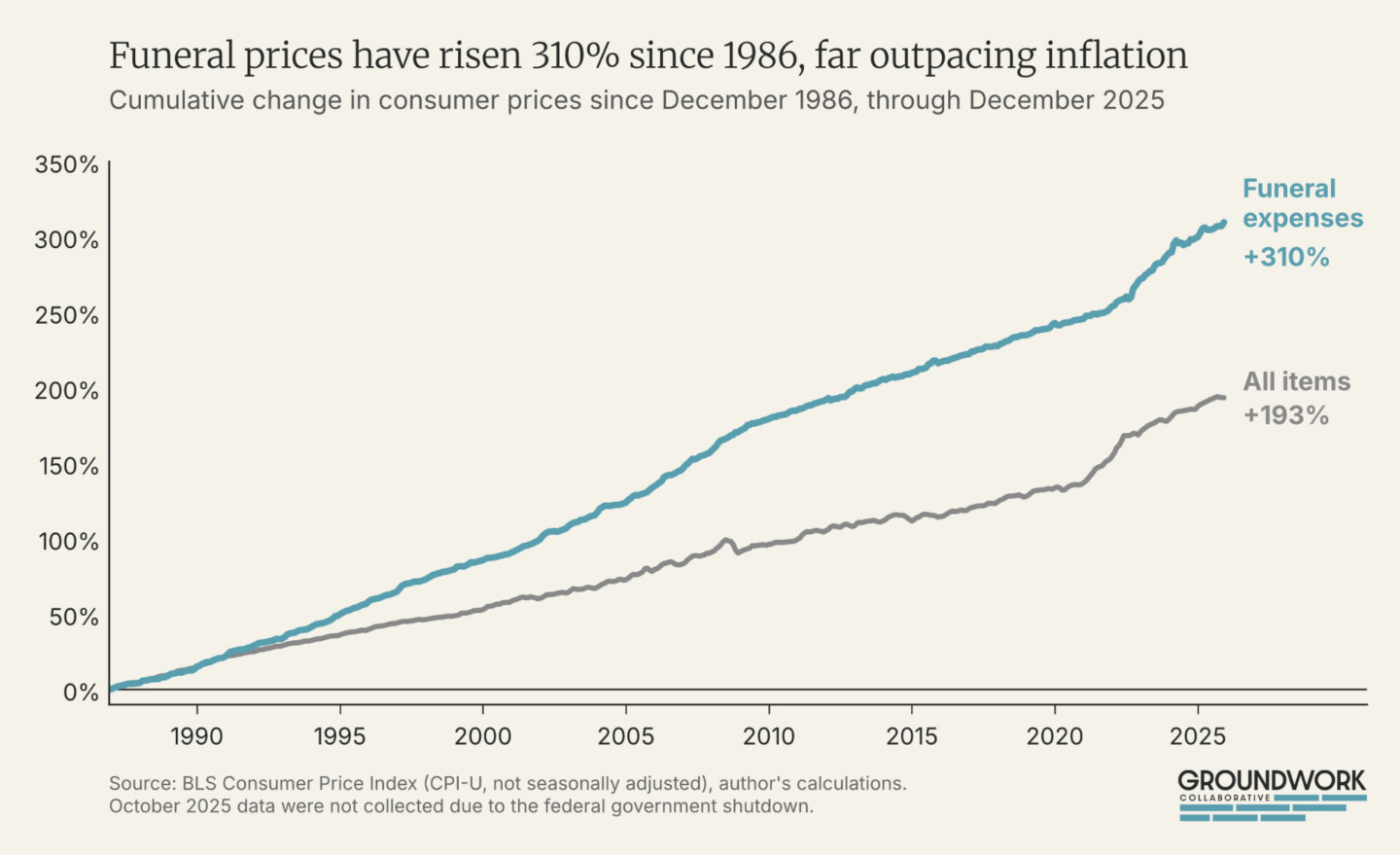
Funeral costs are the most visible and immediate financial burden families face after a death – and they are rising rapidly. The average funeral now costs $7,726, before cemetery plots, headstones, and other add-ons that can push the total above $10,000. Prices have surged 310% since 1986, far outpacing overall inflation of 193%. As prices increase, more families are going into debt to cover funerals, with the share rising from 14% in 2024 to 37% in 2025. Even families who plan ahead through pre-need funeral arrangements can face risk, as funds are sometimes mismanaged or fail to fully cover promised services.
Funeral prices stack up quickly as required services and add-on fees accumulate. According to the National Funeral Directors Association’s 2023 data, funeral homes charge a non-declinable basic services fee of $2,495 for both cremation and burial, along with $395 to transfer the body to the funeral home. Families also face additional charges for using facilities for viewing and funeral services. Even lower-cost options still carry added fees, including about $400 for cremation and $295 for an urn. For burial, costs increase further with additional required services. These include over $1,000 for embalming and other preparation of the body, as well as $2,500 for a casket. Burial also introduces a separate set of expenses outside the funeral home, including $1,000 to $3,000 for a headstone, around $1,000 for a burial vault, and $1,000 to $2,500 to open and close the grave. Taken together, these layered charges illustrate how quickly total funeral costs escalate, even when families attempt to choose lower-cost options.
But grieving families must make decisions about funeral expenses quickly, under emotional pressure, often with no time or ability to compare prices. Although federal rules require funeral homes to have itemized lists of services, most do not make that information easily accessible. Only 18% of funeral homes post prices online, leaving families to tackle a costly and opaque market at the worst possible moment.
The growing corporate concentration and financialization of the funeral industry have tilted the market away from consumers. Corporate chains and private equity-backed firms are consolidating the market, acquiring independent funeral homes and increasing their share of services. When these firms take over local funeral homes, families often face higher prices as the new owners seek to maximize profits. These firms own only one in five funeral homes, but they conduct a disproportionate share of funerals. As independent owners retire and sell their businesses in the coming decade, this consolidation is expected to accelerate, further reducing competition in local markets and giving providers greater power to set prices and limit consumer choice.
Independent funeral homes continue to play an important role in their communities and support families in moments of loss. Many funeral homes absorb costs to serve families who cannot afford funerals, including indigent burials and services for infants. Workers in the funeral industry typically earn around the median American wage. As corporate ownership expands, these locally owned funeral homes are increasingly crucial touchstones in communities.
After a death, families may have to navigate probate, the often costly legal process of settling a loved one’s estate. Probate fees can take a significant piece of an estate’s value, as costs are usually calculated as a percentage of the estate’s value, typically ranging from 3% to 8%. This means that even modest estates in probate can lead to thousands of dollars in legal and administrative expenses. For example, a family inheriting a $250,000 home may have to pay $7,500 to $20,000 in probate-related expenses. Fewer than one in four Americans have a will, and just 13% have a living trust, one of the few tools that lets assets pass to heirs without going through probate.
Beyond its expense, probate can take months or longer to complete. During this time, assets are often frozen, limiting families’ ability to access funds to cover immediate expenses. This means a family could technically inherit a home or savings, but because the assets are tied up in court, they can’t pay funeral bills, mortgage payments, or other urgent costs.
When these delays leave families struggling to pay bills, they may have little choice but to turn to high-cost borrowing. Some families rely on inheritance advances, which provide upfront cash in exchange for a portion of a future estate payout. These products often carry extremely high costs and can reduce the value of inheritances. Unlike traditional loans, traditional consumer protection laws often do not apply to inheritance advances, leaving borrowers with fewer safeguards against predatory practices.
Administrative Burdens: Time, Paperwork, and Delays After a Death
Grieving families face a series of administrative hurdles in the wake of a loved one’s death. Families have to close bank accounts, cancel IDs and passports, notify credit bureaus, and file final tax returns. They also have to cancel utilities, stop subscriptions, and forward mail. Credit cards and bank accounts sometimes continue to auto-charge recurring subscriptions unless families contact each service provider individually. On top of all that, families may need to contact employers, insurers, and benefits administrators to report the death and begin claims processes. Each of these tasks requires its own phone call and set of paperwork, creating a long and frustrating process.
These obligations can take hundreds of hours to complete: one industry survey estimated about 570 hours. Families wait on hold with call centers, complete repetitive forms, and follow up to ensure their requests have been processed. Delays are common, and families may still have to deal with additional bills and account activity that should have been resolved. Many institutions require original certified death certificates rather than photocopies, leading families to order 10 or more copies of the certificate. At the same time, access to financial resources may be limited due to probate or account restrictions. In practice, families are required to manage a complex administrative workload while they are handling immediate expenses and loss of income.
A Path Forward
After a death, families face high costs, limited information, and delayed access to funds. Policymakers should ensure families are protected at a moment when they have the least time and leverage.
Funeral costs are high, difficult to navigate, and often hidden until decisions are already made. Policymakers should ensure families can access clear pricing and avoid unnecessary or inflated charges by:
Providing a Basic Level of Support
Families are often required to cover funeral costs within days, regardless of their ability to pay. Policymakers should ensure a baseline level of support so that no family is forced into debt to afford basic services:
Probate can delay access to assets and impose additional costs, pushing families toward high-cost financial products that can leave them financially distressed. Policymakers should reduce these burdens and protect families from predatory practices by:
Creating a Centralized Bereavement Notification System
Families are required to contact dozens of separate institutions after a death, repeating the same information and submitting the same documentation multiple times. Policymakers should streamline this process by reducing duplication and shifting the administrative burden off families:
Families should not have to go into debt to bury a loved one or access what is already theirs. Instead, they are often forced to contend with opaque pricing, limited information, and delayed access to their own resources. Without reform, corporate consolidation in the funeral industry will continue to drive up prices, and probate lenders will continue to extract from vulnerable families. The path forward is clear: lower costs, improve access, and protect families from exploitation.