
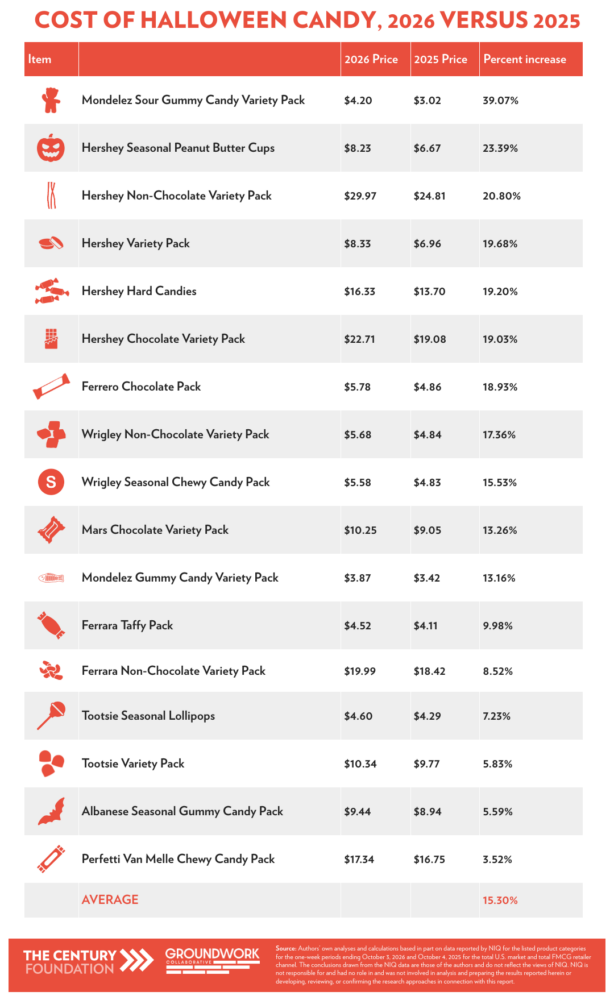
New analysis from Groundwork Collaborative and the Century Foundation shows that candy prices are up over 15% under Trump since last year – four times overall inflation.
With Halloween just around the corner, mummies, zombies, and giant spiders have staked their claims on lawns across the country. However, the scariest thing Americans face this Halloween won’t be a haunted house, but price tags in the candy aisle. New analysis from Groundwork Collaborative and the Century Foundation finds Halloween candy prices up 15.3% – a staggering four times overall inflation.
Wickedly inflated prices are hitting Americans’ pocketbooks at the same time as the effects of Trump’s disastrous policies are also straining families. In addition to tariff-driven price hikes, Trump’s costly war in Iran has disrupted supply chains and sent the price of gasoline and diesel skyrocketing, fueling higher prices for virtually any good that’s shipped to shelves. To make matters worse, price hikes come as families reel from ghoulish cuts to health care and food assistance programs, thanks to Trump’s budget law. There is simply no more wiggle room: 40% of households with young children plan to take on debt in order to cover this year’s Halloween costs.
Thanks to Trump, this Halloween is frightening for all the wrong reasons. Spooky season should be about candy, decorations, and the shivers you get from a good costume – not scary price hikes.
Whether handed out to trick-or-treaters, shared during a scary movie, or simply bought to mark the season, treats are central to celebrating Halloween. More than 95% of Halloween shoppers plan to purchase candy this year, with holiday confection spending projected to pass $4 billion. Unfortunately for consumers, our new analysis finds that Halloween candy favorites cost more than 15% more than last year.
Prices for candy variety packs – seasonal staples perfect for stocking up for trick-or-treaters or filling an office candy bowl – reached shudder-inducing highs this year. For chocolate lovers, the outlook is frightening: prices on packs from Hershey (maker of KitKat, Reese’s, and Heath bars) and Ferrero (maker of Butterfinger, Crunch, Baby Ruth, and 100 Grand) are up a whopping 19%. Fruity and gummy candy lovers will face even higher hikes: packs from Mondelez (maker of Sour Patch Kids and Swedish Fish), Hershey (maker of Jolly Ranchers and Twizzlers), and Wrigley (maker of Skittles and Starburst) have surged 39%, 21%, and 17.4%, respectively. Pumpkin-shaped treats will cost families a pretty penny: Hershey Seasonal Peanut Butter Cups will cost nearly one-fourth more.
Trump’s tariffs continue pushing prices up on everything from costumes to candy. Even toilet-papering a neighbor’s house or DIY-ing a mummy costume will cost more, with toilet paper prices surging due to Trump’s trade war with Canada. Aluminum tariffs put upward pressure on packaging costs, and plastic packaging prices are similarly rising thanks to Trump’s war in Iran disrupting global oil supplies – making candy wrappers more expensive, raising prices even more for those looking for a sweet fix.
Candy lovers could have caught a break this year. While extreme weather in West Africa – where 70% of the world’s cocoa is grown – ravaged crops and sent cocoa prices upward in 2023 and 2024, cocoa prices have fallen by more than half from their 2024 peak. Furthermore, wholesale prices of sugar have fallen by 10% and corn syrup 4% over the past year. But, thanks to corporate profiteering, consumers will continue to face high prices in the candy aisle.
While these input price decreases and last year’s tariff exemption on cocoa should have provided some relief for consumers, companies chose to keep sticker prices high and pocket the savings for themselves instead. Hershey’s gross profit margin reached 45% in the second quarter of this year, up from 30% a year ago with the help of a $9 million tariff refund that never made its way to customers. Fellow candy powerhouse Mondelez saw a similar trend, with gross profit margins jumping to 43%, up from 33% a year earlier. High consolidation in the candy market allows these corporate giants to increase prices without taking much of a hit on sales, as consumers have few alternatives to switch to for a bargain. Just five months ago, Hershey’s CFO bragged to investors it was well positioned to “rapidly recover margins.”
Despite frightening prices, Americans are determined to make the most of the season – even if that means stretching their budgets.
Halloween is one of Americans’ favorite holidays, with 74% planning to celebrate and combined spending projected to reach $13.5 billion. Amid this year’s price hikes, consumers feel the pressure to strategize while making every purchase. Nearly one-third plan to comparison shop and 26% say they will prioritize finding coupons and sales to find the best deal, while 23% expect to buy fewer items overall. Many consumers start their Halloween shopping early, with nearly half beginning before October, in order to spread out purchases and ease the strain on their budgets.
Similar to last year, when consumers also faced a brutal price environment thanks to Trump’s tariffs, discount stores remain shoppers’ go-to destination for Halloween purchases in 2026. This follows broader consumer shifts toward warehouse and discount shopping, with traditional outlet prices out of reach for many Americans.
While Americans are forced to go out of their way to cut costs and find savings, celebrating Halloween in 2026 remains unaffordable for many. According to a LendingTree survey, 24% of Halloween consumers anticipate taking on debt in order to cover Halloween costs. For families hoping to share the holiday with their kids, the picture is even bleaker: 40% of parents with children younger than 18 plan to take on debt this Halloween season. Coming right off the heels of a painfully expensive back to school season, in which nearly half of parents shouldered debt to finance supplies and lunches, this high-cost autumn has continued to push families to the breaking point.
Household debt haunts the American worker like the vengeful ghost of paydays past, with obligatory debt payments consuming 52 cents of every dollar of raise in real income they received. Consumer debt obligations are taking more and more out of workers’ earnings, now accounting for around 10% of working-age adults’ household incomes after taxes. It’s no wonder that consumer sentiment continues to fall: stalked by rising prices and mounting debt obligations, American households are feeling spooked.
With consumer sentiment sunk to the second-lowest level ever recorded – lower than at any point during the Great Recession – this Halloween season is shaping up to be full of more tricks than treats. As families navigate inflated prices and declining wages, many have stretched their wallets to the limit. If Trump does not end his war in the Middle East and his chaotic tariff agenda and reverse cuts to vital assistance programs, families will pushed closer to financial ruin not just during Halloween, but throughout the year.
Elizabeth Pancotti is the Vice President of Policy, Advocacy, and Research at Groundwork Collaborative.
Kyle K. Moore is chief economist at The Century Foundation, focusing on economic inequality in the frameworks of stratification economics, political economy, and public health.
Natalie Chapin is a policy intern at Groundwork Collaborative. She holds a bachelor’s in economics from the University of California, Los Angeles.
Douglas Simons is a policy intern at the Groundwork Collaborative and a masters in public policy student at Georgetown University.