Innovative Research / Groundwork Collaborative
Building Less, Paying More: Trump is Worsening America’s Housing Crisis
August 11, 2026
Overview
As families across the country buckle under the weight of rising housing costs, President Trump doesn’t seem to notice.
As families across the country buckle under the weight of rising housing costs, President Trump doesn’t seem to notice. While housing costs – the single biggest line item in most household budgets – continue to spiral out of control for buyers and renters alike, Trump’s own actions make it clear that his administration’s priorities lie elsewhere. In fact, when Congress passed the 21st Century ROAD to Housing Act last month – legislation to boost housing supply and crack down on Wall Street buying up single-family homes – Trump derided it as “so unimportant” and a “big yawn.”
Voters can’t afford to share in the President’s indifference toward the housing affordability crisis. As new polling from Groundwork Collaborative shows, over 80% of voters are concerned about the rising cost of housing. Among renters, nearly 9 in 10 are concerned about rising costs, including 60% who are very concerned.
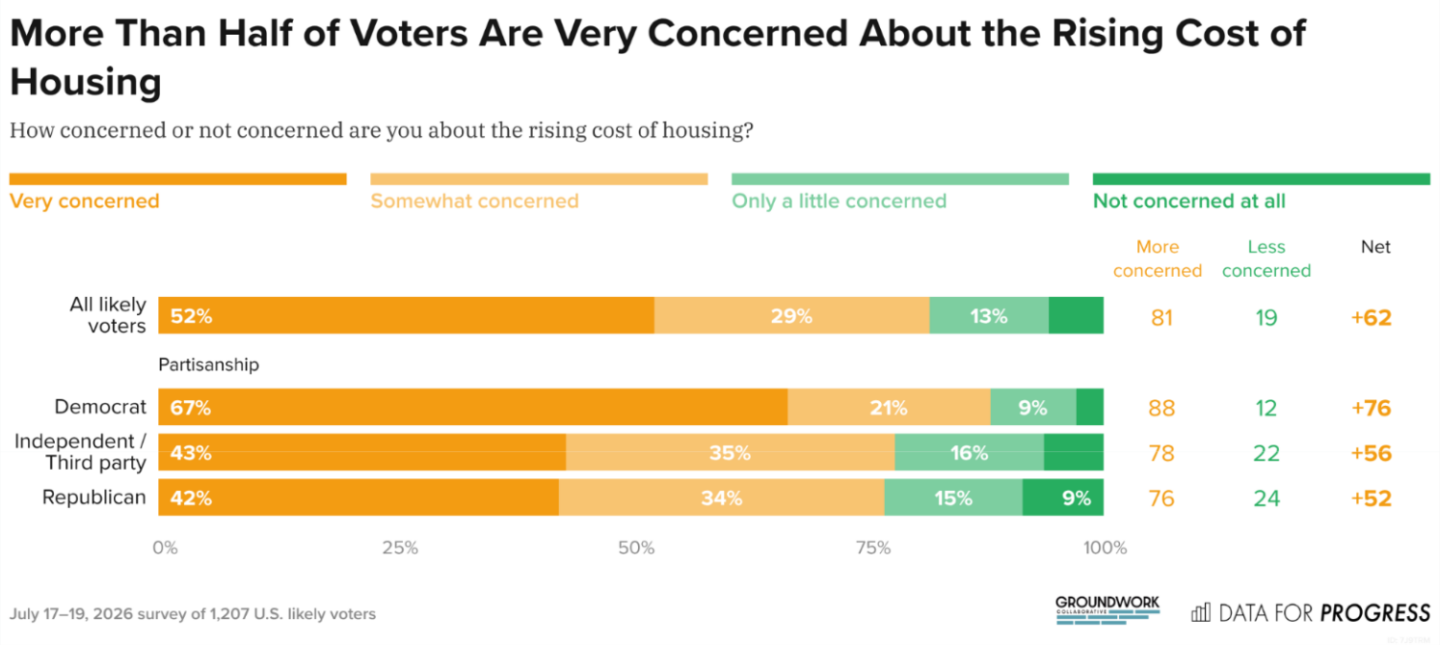
Families across the country are struggling to afford to keep a roof over their heads.
- Home ownership is out of reach for millions of families: The number of families who have become homeowners had the weakest growth in a decade, while the homeownership rate fell to 65% in 2025. The drop was steepest among under-35 households, down to 37% from 39% in 2022. Households of color also had larger than average declines during the same period, worsening existing racial homeownership gaps.
- Far from Trump’s promised return of the 2% mortgage rate, the average 30-year fixed rate remains elevated at 6.69%, as inflationary pressures from Trump’s tariffs and the war in Iran continue to push rates higher.
- The median mortgage payment for applicants in June 2026 was $2,191, far too much for family budgets already stretched thin by the rising prices of household essentials. And the median price for existing homes in July 2026 was $434,100, more than five times the median household income. Additionally, sales of existing homes have declined for the third consecutive month, as consumers are unable to afford those prices.
- In 2026, a family needs to earn almost $117,000 per year to be able to afford to buy a home – that’s almost a 50% increase from what families needed to earn in 2020 and well above the nearly $84,000 that the median American household earns every year.
- Rental prices are astronomical: The average monthly rental price for apartments is now $1,754 – up 18% since Trump took office and costing renter families an extra $271 a month. And renters insurance – often a requirement to lease – is up nearly 6% compared to last year.
- Renting is likely even more expensive than the data suggests, as major property companies nickel-and-dime consumers by tacking on unnecessary fees.
- Nearly 65% of renters pay at least one recurring fee on top of rent – like pet and utility fees – which can raise rent by more than 20%.
- Executives across the housing industry are warning that economic instability under Trump is a roadblock for consumers searching for homes to buy.
- Stuart Miller, the CEO of Lennar – one of the nation’s largest homebuilders – observed in their latest earnings call:
- “Higher energy prices touch every part of the American household budget and tend to depress consumer confidence. When families see gasoline at the pump and electricity bills climb, their willingness to make major financial commitments, including purchasing a home, moderates even when their underlying desire to own has not changed.”
- Ara Hovnanian, the CEO of Hovnanian Enterprises, highlighted the lack of confidence among consumers in the current environment “You heard a comment from other builders that mortgage rates are not necessarily driving customers. The reality is, the lack of confidence with everything that’s going on globally is really the driving factor. Whether it’s incentives, buydowns, base price reductions, customers are just a little more hesitant at the moment.
Due to Trump’s erratic policies, housing construction is more expensive – so less is getting built.
- Trump’s tariffs are raising the costs to build houses. Trump’s on-and-off tariffs are driving up material costs for homebuilding. The price of goods commonly used in new residential construction is up 6.9% from last year and the Center for American Progress estimates tariffs will add $17,500 to the cost of a new home. This cost will be passed on to consumers while also stalling new construction, resulting in 450,000 fewer homes built over the next five years.
- The war in Iran is raising the cost of construction materials. Trump’s war, which has driven up diesel fuel costs by nearly 66% from a year ago, is making it more expensive to transport building materials and equipment. Trump’s war is also driving up the costs of petroleum-based construction materials like roofing asphalts, up 9.2% from one year ago, further driving up the cost of construction.
- Ryan Marshall, the CEO of PulteGroup – one of the largest homebuilding companies – warned in a recent earnings call that rising oil prices could raise the cost of homebuilding:
- “Oil probably continues to be the one that I’m most nervous about just because of how much oil is in some pretty big-ticket items […] those are things that we’re really paying attention to, that could have an impact on not just price per square foot house costs, but ultimately maybe developed land cost. Of course, that ultimately goes into the total cost basket for the house.”
- Republicans eliminated existing tax incentives that made it cheaper to build housing: The so-called One Big Beautiful bill phased-out tax credits that incentivized the construction of energy efficiency homes. The New Energy Efficient Home Credit spurred the construction of 350,000 houses in 2024, and was projected to support the building of an additional 3 million homes over the next few years.
Under Trump, fewer homes are being built – worsening housing supply shortages that price out families.
- Fewer homes are being built, tightening supply and driving prices up. Since Trump took office, single-family housing starts have fallen by nearly 11% and the number of building permits issued – a measure of future construction – has also fallen by 11%. On a yearly basis, total spending on single-family construction is down 4%.
- Home builders are the most pessimistic since the Great Recession. In July, builder confidence in the market for new single-family homes fell two points to 34, according to the National Association of Home Builders Housing Market Index. Not since Trump announced his Liberation Day tariffs 15 months ago in April 2025, has the builder confidence index reached 40 – a streak unmatched since the foreclosure crisis of the late aughts.
- As a result of the slowdown in homebuilding, construction workers are struggling to find jobs. Over the past 12 months, residential construction has lost 44,200 jobs, marking the 17th consecutive month of annual decline and the longest stretch of annual losses since the Great Recession.
- The Trump administration is cutting funding for affordable housing. Trump’s budget request for fiscal year 2027 cuts at least $3.8 billion from HUD’s affordable housing, homelessness, and community development programs. If enacted, this would end funding for programs that help finance the construction of affordable housing like HOME, while making it more burdensome to receive HUD rental assistance.
New polling from Groundwork Collaborative shows just how disconnected Trump’s priorities are from the reality of everyday Americans:
- Majorities of voters say that Trump bears responsibility for the rising cost of housing and is focused on other priorities. The housing policies he has pursued are seen as benefitting private actors more so than renters and homeowners:
- 62% of voters – including 66% of Independents – say President Trump is responsible for the rising cost of housing.
- 66% of voters – including 76% of Independents – say Trump is more focused on his war in Iran than on lowering costs for everyday Americans.
- 65% of renters – including a disproportionate number of Independents (71%) – say corporate landlords benefit more from Trump’s housing policies than renters like themselves.
- Meanwhile, 59% of homeowners – including a disproportionate number of Independents (63%) – say private developers benefit more from Trump’s housing policies than homeowners like themselves.
- While Trump ignores working families’ housing needs, he’s laser focused on developing properties for his own businesses:
- During his second-term, Trump has already tripled the number of foreign developments his family business is involved in, helping them rake in a record-high $117 million in overseas revenue in 2025.
- Trump’s priorities are clear to voters: 56% percent of voters – including 63% of Independents – say Trump is more focused on using the power of the presidency to benefit his personal businesses rather than lowering costs for everyday Americans.
Download a PDF of this brief.