
Millionaires are among the least likely New Yorkers to move.
By Emily DiVito, Natalie Forman, and Kitty Richards
New York City’s wealthiest residents have had a lot to say about Mayor Zohran Mamdani’s tax-the-rich agenda, most of it some version of “if you raise my taxes, I’ll move.” Billionaire hedge fund manager Bill Ackman and Gristedes CEO John Catsimatidis both threatened to up and leave the city rather than pay more in taxes. After the mayor took office on January 1, 2026, word got out that Citadel’s Ken Griffin and Apollo’s Marc Rowan were shopping for real estate in Florida and Texas – both states with no personal income tax.
These are the same threats that New York’s rich have made for generations, and they have a lousy track record on follow-through. Millionaires are among the least likely New Yorkers to move. When a few do choose to leave the city, it’s family or work obligations that pull them away – not their tax bills pushing them to leave – and increased revenues from those who stay dwarfs what’s lost. If New York should worry about anyone leaving, it’s the nurses, bus drivers, and young parents who keep the city running but can’t make rent or find affordable childcare. The surest way to lose them is to keep underinvesting in the public programs they need to stay.
Despite the threats, millionaires tend to be all bark and no bite when it comes to so-called “tax flight.” Drawing on 45 million tax records over 13 years, one study found that millionaires tend to migrate less than the general population, with a 2.4% annual migration rate compared to 2.9% for everyone else. While New York did see an unusual spike in departures during the height of the COVID-19 pandemic, when remote work briefly cut many professionals loose from the office, it didn’t last long. By 2022, top earners were again leaving the state at low rates.
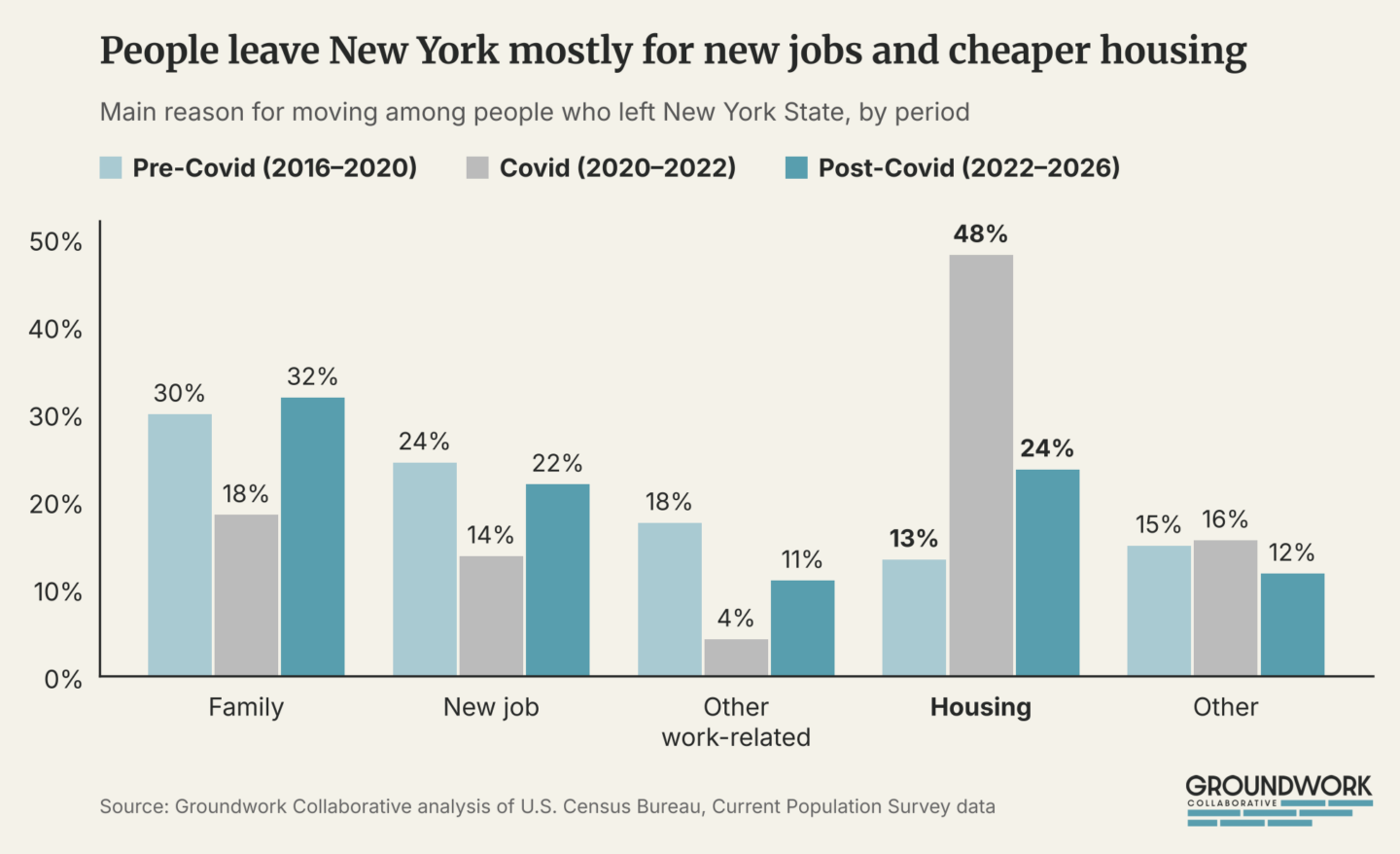
Taxes are rarely the main impetus for people to leave one city and move to another. Instead, families are primarily motivated by the practical realities of everyday life, like job opportunities or family obligations. Analysis by the Center on Budget and Policy Priorities reveals that in 2020, only 9% of interstate movers cite anything tax-related as a reason for the switch, whereas 68% cite job- and family-related motivations.
If New York should worry about anyone leaving, it’s the nurses, bus drivers, and young parents who keep the city running but can’t make rent or find affordable childcare.
Even when faced with higher tax bills, the effect that does exist is largely trivial. A 10% increase in a state’s top tax rate produces only a 1% drop in its millionaire population. If Florida – with no income tax, no estate tax, and consistently warm weather that has long been a pull for wealthy retirees – is removed from the data, there is virtually no tax-driven migration at all. And people leaving high-tax states are mostly replaced by other people moving in. Between 2011 and 2021, New York gained roughly two new residents for every three who left. Over the same time span, more than half of the families who moved from New York to no-income-tax Florida were replaced by those who made the reverse move.
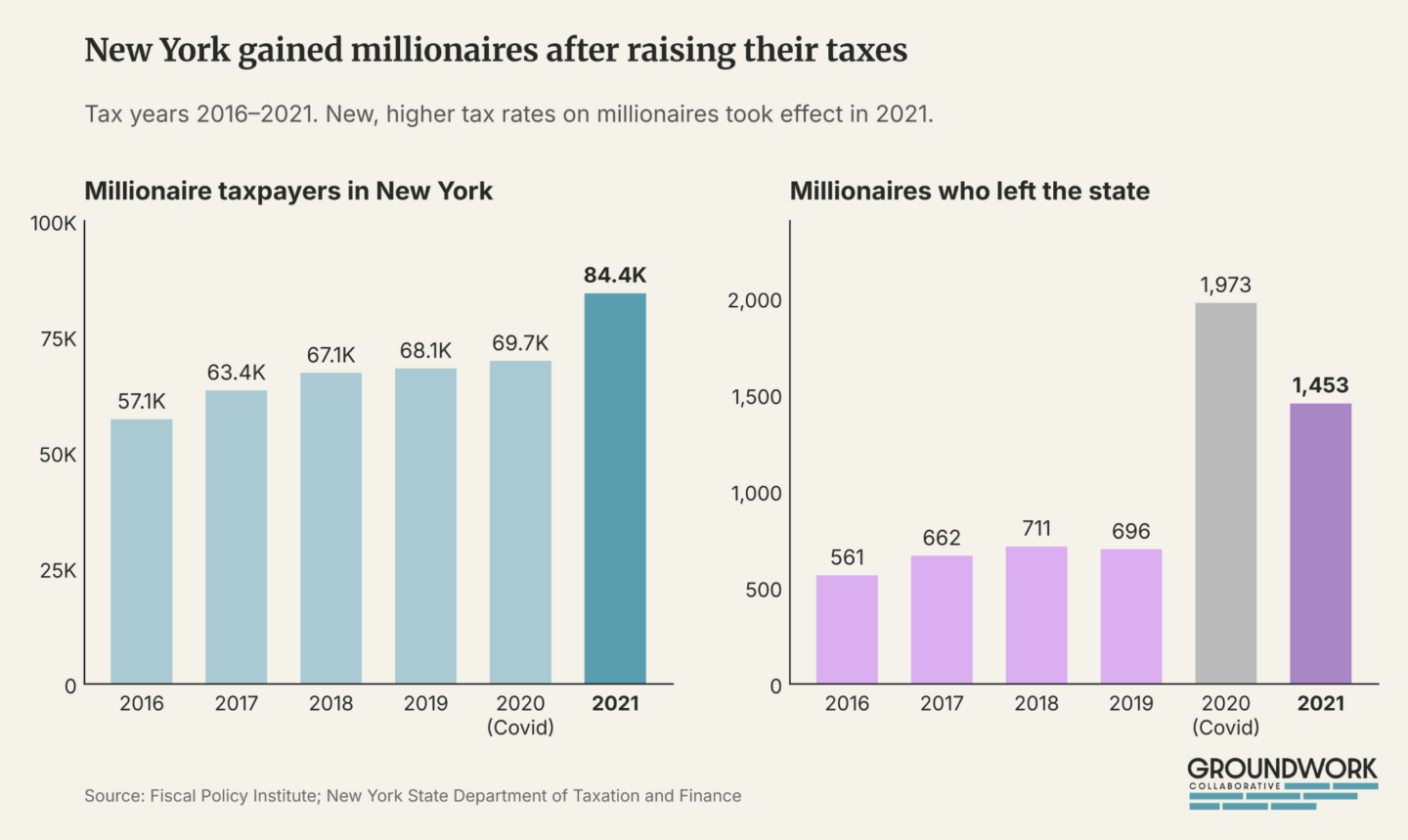
The clearest evidence comes from New York itself, where top earners’ tax bills have gone up twice within the last decade. In 2017, the Tax Cuts and Jobs Act (TCJA) put a federal cap on state and local tax (SALT) deductions, effectively raising taxes on the state’s highest earners. If millionaires were going to bolt because of their tax bills, that was the moment. But they didn’t. A 2025 study of nationwide tax filings found that millionaire migration patterns were “essentially identical” before and after the change. In 2021, New York replaced its 8.82% top marginal tax rate with three new, higher brackets, set to expire in 2032: a 9.65% tax on income over $1,077,550 for single filers (or $2,155,350 for joint filers); a 10.3% tax on income over $5 million; and a 10.9% tax on income over $25 million. The first year this new tax was on the books, New York’s total millionaire population grew 21% while the number of millionaires leaving the state actually declined 25%, according to the Fiscal Policy Institute. The broader economy didn’t buckle either: New York’s real GDP, which fell 10.6% at the start of the pandemic, fully recovered by the third quarter of 2021. It rose 4% above its pre-pandemic peak just a year later.
If tax flight were a legitimate cause for concern, wealthy people would congregate in low-tax states. But they don’t. New Jersey, Maryland, and Connecticut – all states with high income taxes – are home to the highest concentrations of millionaire households. The same holds true for inside New York, where 83% of the state’s millionaire tax filers live in just a few jurisdictions with some of the highest local tax burdens in the state: Manhattan, Long Island, and Westchester and Putnam Counties. The rich cluster in the most expensive, highest-taxed corners of a high-tax state.1
Skeptics point out that New York’s share of all U.S. millionaire earners fell from 12.7% in 2010 to 8.7% in 2022. What they tend to leave out, however, is that the statistic has nothing to do with millionaires leaving. New York’s millionaire population didn’t shrink over this period – it actually grew. From 2020 to 2022, New York gained roughly 15,000 millionaires on net. Millionaire populations in states like California and Texas simply grew faster during that timeframe, in large part because booming tech and finance industries pushed more of their residents’ incomes over the $1 million threshold.
The goal of state tax policy is not to maximize millionaire headcount, of course; it’s to raise funds for critical government services from the people who can most afford to pay. By that measure, a handful of departures barely register in the tax accounts.
States that have raised taxes on the rich have the receipts to prove their success. New York’s own 2021 high-earner surcharge brought in about $3.6 billion annually. Massachusetts’ 4% millionaires surtax collected nearly $3.4 billion in 2026 – well beyond the $2.4 billion officials projected for that fiscal year. New Jersey’s 2004 tax increase on incomes over $500,000 cost the state only $16 million in lost revenue from out-migration between 2004 and 2007 – a small fraction of the $1 billion in annual revenue from those who stayed. And California’s 2012 millionaire tax brought in $6.7 billion from 2015 to 2016 alone – more than four times what the accompanying sales tax raised.
If tax flight were a legitimate cause for concern, wealthy people would congregate in low-tax states.
In fact, accounting for migration, a state’s revenue-maximizing top income tax rate on incomes above $1 million is about 68% – far above any state’s current top rate.2 That leaves plenty of room to raise rates on the rich before migration could meaningfully cut into revenue.
New evidence from abroad shows how much room governments have to raise taxes on the very rich. Between 2021 and 2024, Norway raised dividend tax rates, closed capital gains loopholes, and nearly doubled the effective marginal tax rate on business wealth. The reforms set off plenty of international hand-wringing about a billionaire “exodus.” But a new study from a University of Texas economist finds that fewer than 100 individuals left Norway because of these reforms, all from the top 0.1%. There was also no significant drop of business founders or inventors moving into Norway. Moreover, wealth tax revenue gains for the state were a whopping 71.5%.
Under the current system, the households actually at risk of leaving New York aren’t millionaires, but working class families. The top 1% of New Yorkers – those making more than $815,000 annually – leave the state at one-quarter the rate of everyone else.3 In other words, New York has historically lost its working and middle class at four times the rate of its wealthy.
Those leaving are disproportionately families with young children and those priced out of the rising cost of housing, with 36% of New York state leavers citing housing affordability as their reason for departure. Black and Hispanic residents are leaving at notably higher rates than white New Yorkers.
It’s precisely this group of people – working families struggling to make ends meet, renters watching their leases climb – that keep New York’s economy running. They’re the city’s shoppers and commuters, staffing its hospitals, restaurants, and trains.
Working families do the majority of the spending that keeps the U.S. economy running. Low- and middle-income households account for 55% of spending. They also spend far more of each dollar they make, compared to high-income households. Researchers at the Federal Reserve Bank of Boston estimate that the marginal propensity to consume for low-wealth households is about ten times greater than high-wealth ones. A millionaire’s extra cash tends to land in a brokerage account, while that of a working family goes toward trips to the dentist, the corner store, or a neighborhood restaurant. When those families move away, their local spending goes with them.
They also perform the work that keeps the city functioning. In 2020, the Comptroller counted over 1 million front-line workers in New York City – a quarter of the workforce – in grocery stores, hospitals, transit, delivery, building cleaning, and social services industries, easily dwarfing the 200,000 that Wall Street employs.
The New Yorkers delivering these essential services are the same working class individuals the city is at risk of losing. They live here (for now), spend their incomes here, and staff the city’s essential infrastructure, though their paychecks don’t reflect it. For instance, the median pay for a New York childcare educator – a workforce that’s 94% women and majority people of color – is $37,675 per year. This breaks down to $18.11 per hour, less than 96% of all occupations in the state. Meanwhile, the average Wall Street bonus last year was nearly seven times that, at $246,900. Taxing the wealthy isn’t only about investing in crucial city programs, but is also needed to pay those who hold the city together what they’re actually worth.
More progressive taxation on millionaires creates a virtuous cycle for New York. Revenue from the top pays for things working families need in order to stay and thrive: childcare, transit, schools, and housing. Those families live, work, and spend their paychecks at local businesses, and pay taxes of their own, growing the base that funds the next round of investment. Massachusetts is watching this play out in real time. Voters approved a 4% surtax on income over $1 million in 2022, with the money earmarked for public education and transportation. It has beaten revenue projections for three years running, topping $3.38 billion in fiscal year 2026. All the while, the state’s population of residents worth $1 million or more grew 38% between 2022 and 2024. Just across the Hudson River, New Jersey puts its millionaires tax to work on public schools, universal pre-K, and avoiding NJ Transit fare hikes. These are the kinds of investments that keep students, parents, and commuters contributing to the state’s economy.
Conversely, New York’s own history shows what happens when the city funnels money toward the wealthy at the expense of the working class. The fiscal crises of the 1870s, 1930s, and 1970s all followed periods when economic strategy catered to corporate interests. Recovery came only when the city reinvested into public infrastructure that supported everyone, especially working-class New Yorkers. Raising taxes on the super-wealthy lets New York City do just that: fund the public programs and infrastructure that keep New Yorkers here and employed.
The New Yorkers delivering these essential services are the same working class individuals the city is at risk of losing.
New York’s recently enacted pied-à-terre tax is a case in point. Enacted in this year’s state budget, the tax targets the ultra-rich through a surcharge on luxury second homes in NYC worth $5 million or more, owned overwhelmingly by individuals who don’t live in the city full time. Mayor Mamdani has been clear that the revenue from this policy – at least $500 million per year – will go “to help our city collect the revenue we need for safer streets, cleaner parks, and other critical investments across the five boroughs.”
This is the goal of the millionaire tax: to make possible every major investment that makes the city better off. Universal, high-quality childcare is an excellent example of this, and one for which New York parents are already lining up. In March 2026, the Mamdani administration announced a 2-K plan to provide free childcare for 2-year-olds for up to 10 hours a day, in partnership with Governor Hochul’s office. More than 2,000 children enrolled this fall, with an estimated 12,000 seats in 2027 and 55,000 seats at full build-out. This is exactly the kind of investment that helps New Yorkers across the board, and one step toward free, universal childcare. Extra funding for this system could increase mothers’ labor income by nearly $900 million through higher labor force participation, plus another $900 million to employers annually through reduced turnover and absenteeism. In New York, two-in-five parents report that someone in their household has left the workforce because of childcare needs. Not to mention, such infrastructure encourages families to remain in the city in the first place – the opposite of what the tax flight narrative suggests.
Public investments in programs like childcare pay off for the whole economy, and not only the families who utilize them. After Quebec implemented universal childcare, the province’s gross domestic product increased by nearly 2%. One recent study found that mothers who had access to the program earned 27% more by age 50, and the higher taxes the government collected from increased earnings recouped between 75% and 110% of the upfront cost of implementation.
Public higher education may be the best deal New York offers residents, where every dollar the state puts into the State University of New York (SUNY) system returns more than $7 to the state economy. The SUNY system generates $35.5 billion in annual economic impact, supporting nearly 160,000 direct and indirect jobs statewide. Furthermore, more than 70% of SUNY alumni remain in the New York workforce for five years post-grad, meaning the investment stays in-state and compounds. On a similar note, the City University of New York (CUNY) system is an “engine of economic mobility,” and its graduates overwhelmingly stay in New York, paying billions in state and local income taxes over their careers. The investment pays for itself through the same tax system that funded it. That’s why it’s especially alarming that CUNY enrollment is down about 15% since 2019 after years of budget cuts – a preview as to what happens when city infrastructure doesn’t receive the attention it deserves.
These returns aren’t unique to childcare. Public investment in the city’s infrastructure pays off the same way.
The city is on the hook for at least $3 billion of the Metropolitan Transit Authority’s $68.4 billion capital plan, which is expected to generate $106 billion in economic output and more than 72,000 jobs statewide from engineering, construction, and payroll spending alone as it circulates through the economy – roughly a 1.5 times multiplier on the investment. But the long-run economic benefits are much greater, because that money powers the system that carries 5.5 million rides each weekday and anchors a region that generates 10% of the nation’s total economic activity.
The narrative continues with housing investment. Through the $4 billion NYC Housing Investment Initiative, the city’s pension funds are building on decades of public investment that have already helped create or preserve 199,000 housing units since the early 1990s. That matters for the same labor-supply reasons as the childcare system: workers who lose their homes are 11 to 22 percentage points more likely to lose their jobs, and high housing costs are cited as a major reason that employees are unable to live near their places of work. Increased tax revenue for affordable housing will allow the working class to stay in NYC. But pension capital can only go so far. The city’s budget to build and preserve affordable housing is set to fall by roughly half after 2028, and by taxing the city’s richest residents, New York can raise the revenue needed to build more homes that working families can afford.
The threat of millionaire tax flight has had a long run in New York, with very little evidence to support it. Millionaires move less than most other families. When the SALT cap raised their tax bills in 2017, their migration patterns barely budged. When the state raised its top tax rates in 2021, more millionaires moved in and fewer moved out. Across the country, from Massachusetts to California, millionaires have stayed put even when their tax bills have increased substantially.
The state is actually losing the New York families who can’t make rent, the parents who can’t find or afford childcare, and the workers who keep the city’s hospitals, classrooms, and subways running on paychecks that don’t stretch nearly far enough. They leave quietly, but each takes their paycheck – and their contribution to New York’s vibrant communities – with them. Taxing the rich is what will allow the city to keep them here. When the legislature returns in January, Albany and City Hall should stop negotiating with a bluff and start spending on the people who actually keep the city running.
[1] The data cited here are from 2008, the last year in which New York collected the share of millionaire filers by county.
[2] California’s top rate, the highest in the country, is 13.3%; New York City’s top earners pay roughly 14.8% in combined state and city income tax.
[3] Outside of the COVID-19 pandemic years, between 2020 and 2021.