A Working Person’s Woes: Trump’s Recklessness Hammers Workers This Labor Day
September 2, 2026
WASHINGTON, D.C. – This Labor Day, workers are taking home the smallest share of corporate business income ever recorded, while corporate profits jumped 9.1% to a record $4.8 trillion. Trump’s economy has failed workers just trying to make ends meet: the labor market is bleeding jobs, paychecks are barely keeping up with inflation, and the benefits of widespread AI investment are concentrated at the top. The president’s illegal war in Iran has directly hit commuters’ wallets: With gas prices hitting their highest August levels on record, it’s more expensive than ever to get to work.
In recent months, Groundwork’s experts have compiled research and commentary on the state of our labor market and the view of the workers who power it. To speak with a Groundwork expert ahead of Labor Day, email press@groundworkcollaborative.org.
AI at Work: Swaths Concerned About on AI in the Workplace, Demand Action to Protect Workers
- Recent polling from Groundwork Collaborative and Ipsos finds that majorities of workers believe the benefits of the technology will be concentrated among high earners and will increase pressure on job performance, further exacerbating inequality and the increasingly K-shaped economy.
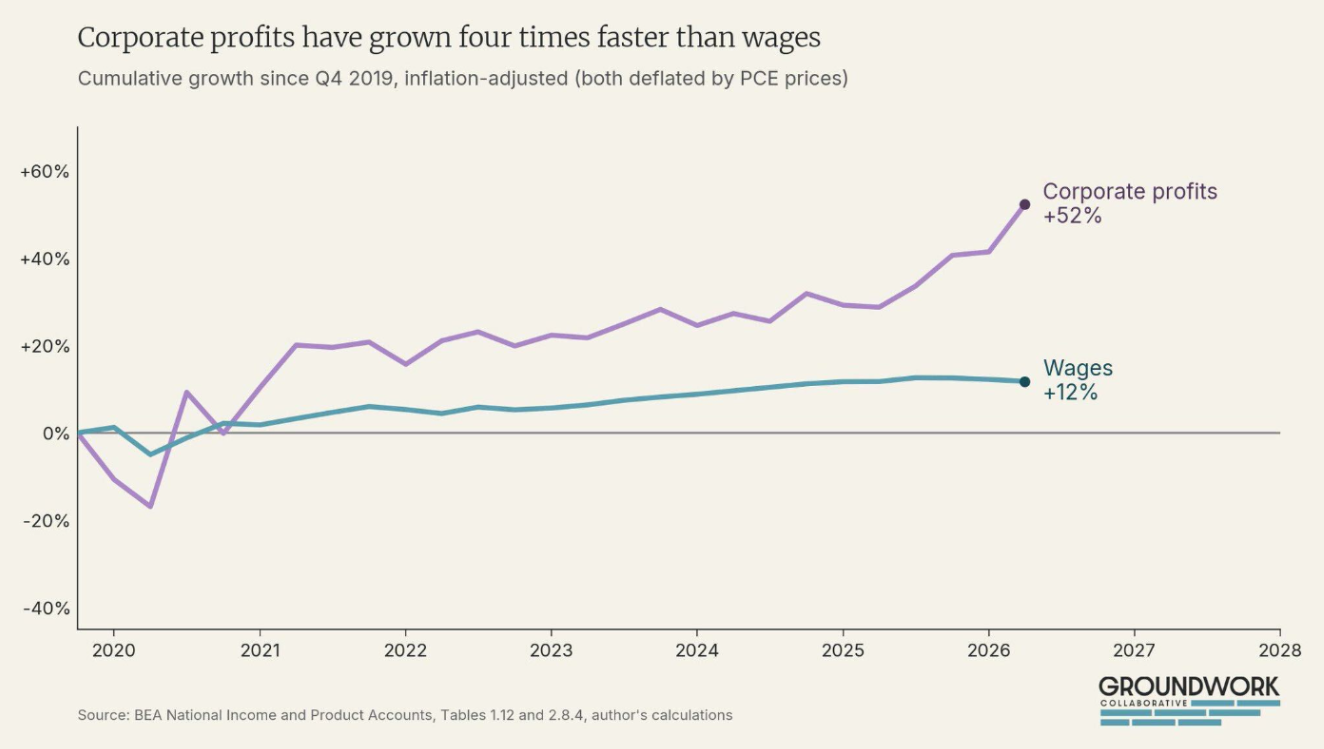
- Since the pandemic, corporate profits have grown more than four times faster than workers’ pay, adjusted for inflation. The gap is widening under Trump. Over the past year, growth in corporate profits accelerated, while real wages flatlined.
- On a macro scale, two-thirds of workers expect AI to make work worse by eliminating jobs and putting greater pressure on workers, rather than improving the worker experience by freeing up time spent on repetitive tasks and assisting with more challenging work.
- Unemployed workers are much more likely than employed workers to feel that AI is having a negative impact on their line of work (41% vs 27%), and far more likely to say the effect is very negative (17% vs 8%).
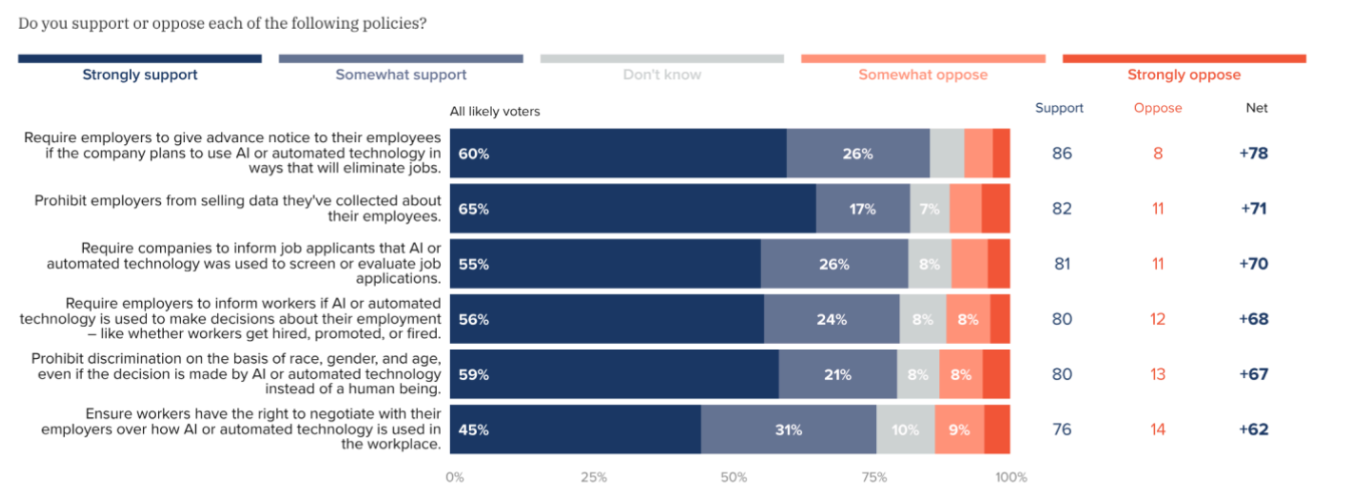
- Recent polling from Groundwork Collaborative, Workshop, and Data for Progress finds that as concerns about the impacts of AI on the U.S. economy grow, Americans from across the political spectrum overwhelmingly say protections for workers are worth the costs to businesses:
- More than two-thirds of voters are concerned about AI leading to job losses in the U.S. economy.
- Americans want protections for workers, when faced with tradeoffs: Large numbers of voters (74%) say legal protections against AI for workers outweigh higher business costs or slower innovation.
- Job retraining programs are not enough: While majorities believe the government, employers, and AI companies bear responsibility for providing high-quality job training to workers who lose their jobs due to AI, a majority (53%) of voters say job retraining alone is not enough to make workers whole.
- At least two-thirds of Americans support every proposed worker protection on issues concerning job displacement, discrimination, surveillance, and the degradation of job quality.
- Strong majorities – including across party lines – believe direct government interventions to support the financial stability of impacted workers would be the most effective supports, with health insurance at the top of the list.
The Entry-Level Job Market is Historically Bad. Stop Blaming Gen Z.
- In March, Groundwork Senior Fellow and former Chief Economist at the Department of Labor, Janelle Jones, and Groundwork Research Associate Nia Law busted the common myth that Gen Z is unemployable in an op-ed for Fortune.
In the piece, Jones and Law write: “Months of hot takes have blamed Gen Z for bad attitudes, no work ethic, and too many demands. But labor market data tells a far less convenient story. The entry-level rungs of the employment ladder are splintering beneath America’s youngest workers — and the data makes clear this isn’t a generational character flaw. It’s a structural collapse.”
- Since the piece was published, things have only gotten worse:
- In July 2026, the unemployment rate for new college graduates ticked up to 5.7% – almost a full percentage point higher than graduation season last year. But for many of those who have landed a job, there is a catch: more than 40 percent of recent graduates are underemployed, working jobs that do not require the shiny degrees they just spent years earning.
- Artificial intelligence threatens to pull up the ladder on young workers just as they enter the labor market. A recent Stanford University study found that employment among workers ages 22 to 25 in occupations with significant AI exposure – software development, customer service – fell 19% since 2022 relative to their less-exposed peers. And the warning signs are flashing brighter since the op-ed’s publication, with the employment gap growing 4 percentage points.
- Entry level jobs are fewer and farther between as hiring tilts towards senior roles. Over the past year, postings for senior level jobs climbed nearly 15%, while entry level postings fell by nearly 8%, deepening a decline that began in 2022.
Get in touch with Groundwork’s experts on workers’ sentiment, voters’ views of the labor market, recent data reports, and more at press@groundworkcollaborative.org.