Innovative Research / Groundwork Collaborative
Deal or Decoy? Amazon’s Deceptive Discounts
November 16, 2026
Overview
Nearly 1 in 3 of more than 350 products Amazon advertised as deals during recent Black Friday and Cyber Monday sales provided no savings at all.
Executive Summary
We reviewed the prices of hundreds of products that Amazon advertised as “deals” across Black Friday and Cyber Monday to answer a simple question: do “deals” during Amazon’s holiday sale events offer customers lower prices for products than what they could’ve paid in the preceding weeks?1 Many times, we found that the answer was no.
Amidst today’s affordability crisis, discounts and sales are all the more appealing to shoppers. Consumers are on the hunt for deals and reasonably expect them to offer a true discount. That assumption alone can motivate shoppers to spend. In 2025, major sale events drove nearly $70 billion in online spending, with Amazon at the center.2
Amazon markets these sale events as a time of huge savings. Ahead of holiday sale events in 2025, Doug Herrington, CEO of Worldwide Amazon Stores, said the retail giant was “providing customers with incredible Black Friday Week and Cyber Monday deals across a vast selection of products with deep discounts across more than 35 categories and some of [Amazon’s] lowest prices of the year.”3 Yet, anecdotal reporting has called into question the extent to which these sales actually offer customers a deal.
To test this, we examined the products Amazon itself promoted as the best discounts customers could score during the sale events. Our review of the more than 350 “deals” Amazon highlighted found:
- Nearly 1 in 3 “deals” offered no real savings. Of the more than 350 products Amazon advertised as “deals” we examined, 29.1% of products were priced the same or higher during the sale event than the month leading up to it. The share increases to nearly 60% when we look back 90 days before the sale event.
- These weren’t one-off flukes: Half of those items were priced at or below the “deal” price on at least eight of the 30 days leading up to the sale.
- In fact, nearly 1 in 10 “deals” offered customers a higher price during the sale event. Of the more than 350 products that Amazon advertised as “deals” we examined, we found that 9.4% were priced higher than they were in the month leading up to the sale event. That share nearly triples to 27% when we look back 90 days before the sale event.
These findings give pause to the notion that Amazon’s sale events always offer shoppers the guaranteed best times to stock up on household essentials or save on holiday gifts.
Deal or Decoy? Amazon’s Deceptive Discounts
We reviewed the prices of hundreds of Amazon “deals” across Black Friday and Cyber Monday to answer a simple question: do “deals” during Amazon’s holiday sale events offer customers lower prices for products than what they could’ve paid in the preceding weeks? Many times, we found that the answer was no.
Read the Report.
Introduction
On the day after Thanksgiving, millions of consumers will head to big-box stores in search of deals. “Black Friday,” as we know it today, got its name from the Philadelphia police in the 1950s and 1960s, who used the moniker to describe the gridlock that choked Center City at the start of Christmas shopping season.4 The day has become an economic driver unto itself: a record 203 million Americans shopped between Thanksgiving and “Cyber Monday” in 2025.5
Increasingly, shoppers are staying home on the blockbuster shopping day. Fewer people shopped in stores on Black Friday in 2025 than in 2024, while online spending grew by 9.1% to a total of nearly $12 billion.6 Online, one retailer looms large: Amazon. Amazon’s share of e-commerce is nearly 40%, and the retail giant runs at least four major sale events each year, including a 12-day “Black Friday Week” in 2025.7 By enticing shoppers with discounts and deals, Amazon has turned branded sale events into major revenue drivers. Entire ecosystems of guides and trackers dedicate themselves to tracking down the best deals, profiting off affiliate links.8
Shoppers logging onto Amazon during one of these events will often see a struckthrough price, a bright red discount badge, and a promise of big savings. Our investigation shows that these claims are often misleading.
In fact, nearly 1 in 3 of more than 350 products Amazon advertised as deals during recent Black Friday and Cyber Monday sales provided no savings at all over a price available in the month before.
These sale events are central to Amazon’s revenue. Nearly one-third of Amazon’s revenue is concentrated in the fourth quarter, which includes both Black Friday and Cyber Monday.9 Amazon added the “Prime Big Deal Days” sale in October 2022, and the “Big Spring Sale” in 2024. Amazon expanded the once two-day Prime Day event to four days in 2025, triggering a frenzy across the retail industry that drove $24 billion in total U.S. online spending.10
The success of these events is anchored on the promise of savings for shoppers. Doug Herrington, CEO of Worldwide Amazon Stores, said in November 2025 that Amazon was “providing customers with incredible Black Friday Week and Cyber Monday deals” with “deep discounts across more than 35 categories and some of our lowest prices of the year so far on top brands.”11 Amazon echoes the promise of these savings to investors, too, with executives reporting that customers “saved billions” during holiday shopping events.12
Consumers aren’t shopping these marquee annual sale events for the excitement alone; they are increasingly looking to these events to offset rising prices. Over the past few years, consumers have faced steep price hikes on essential goods and services, including groceries, rent, electricity, and health care.13 Household savings diminished as prices climbed.14 These cost-of-living pressures have caused more consumers to plan around sale events, saving up and delaying purchases for weeks in anticipation of the sales.15 It is no surprise that more consumers planned to participate in sale events in recent this holiday shopping seasons than in the past, strategically planning their spending to take advantage of discounts.16 This year, 70% of U.S. customers plan to take advantage of the Black Friday and Cyber Monday promotional period, up from 64% in 2025.17
Amazon claims it aims to “meet or beat other retailers’ prices every day so customers don’t have to spend time comparing prices.”18 For families who hold off on a purchase for weeks to catch a deal, the difference isn’t a rounding error. Our findings suggest that shoppers shouldn’t take that promise at face value. This report details what shoppers see during Amazon’s sale events, how we tested the “deals” offered, and what policymakers can do, including under existing law, to ensure that a sale is actually a sale.
What Shoppers See During Amazon’s Sale Events
Amazon markets sale events prominently on its platform. Each sale event has its own dedicated page where shoppers can browse the many products being offered as a “deal.” Figure 1 shows a selection of products captured on Amazon’s Black Friday 2024 landing page on November 29, 2024. The grid is shown on Amazon’s sale event landing pages and clearly signals to consumers that a sale is happening: a sale event price next to a struckthrough “list price” or “typical price,” a red badge displaying the discount percentage, and a red “Black Friday Deal” label.
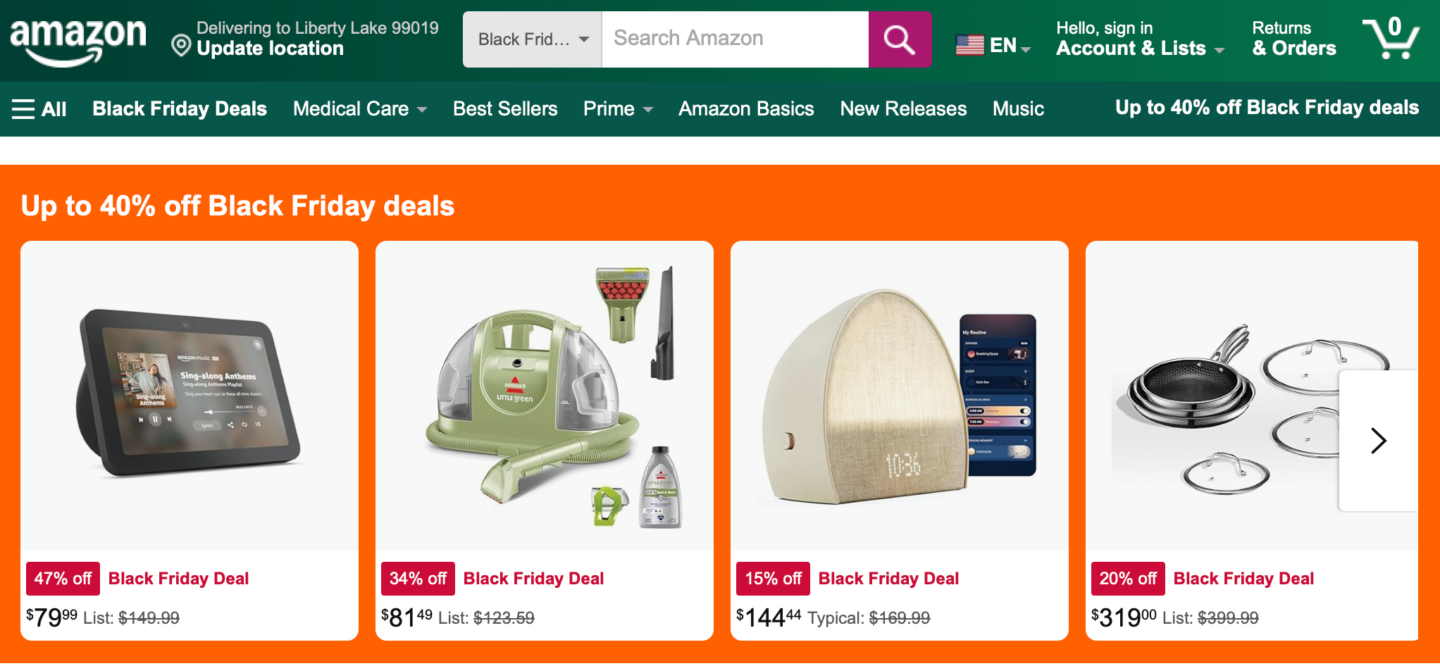
Figure 1. Screenshot of Amazon’s Black Friday 2024 Page.
In recent years, Amazon has also created a deals page for each sale event, which features a curated list of products typically marketed as the “best” deals of the sale event (see Figure 2).19 For example, on its Black Friday 2025 deals page, the retailer told customers, “With so many deals to explore, we’ve handpicked some of the best ones you’ll find.” Across events, Amazon claims these deals offer “some of the lowest prices of the year” that can cause shoppers to delay purchases they might have made earlier or create a sense of urgency for products they might not have otherwise purchased during the sale period. The urgency effectively translates: If they don’t buy in the short sale window, they may pay a higher price.
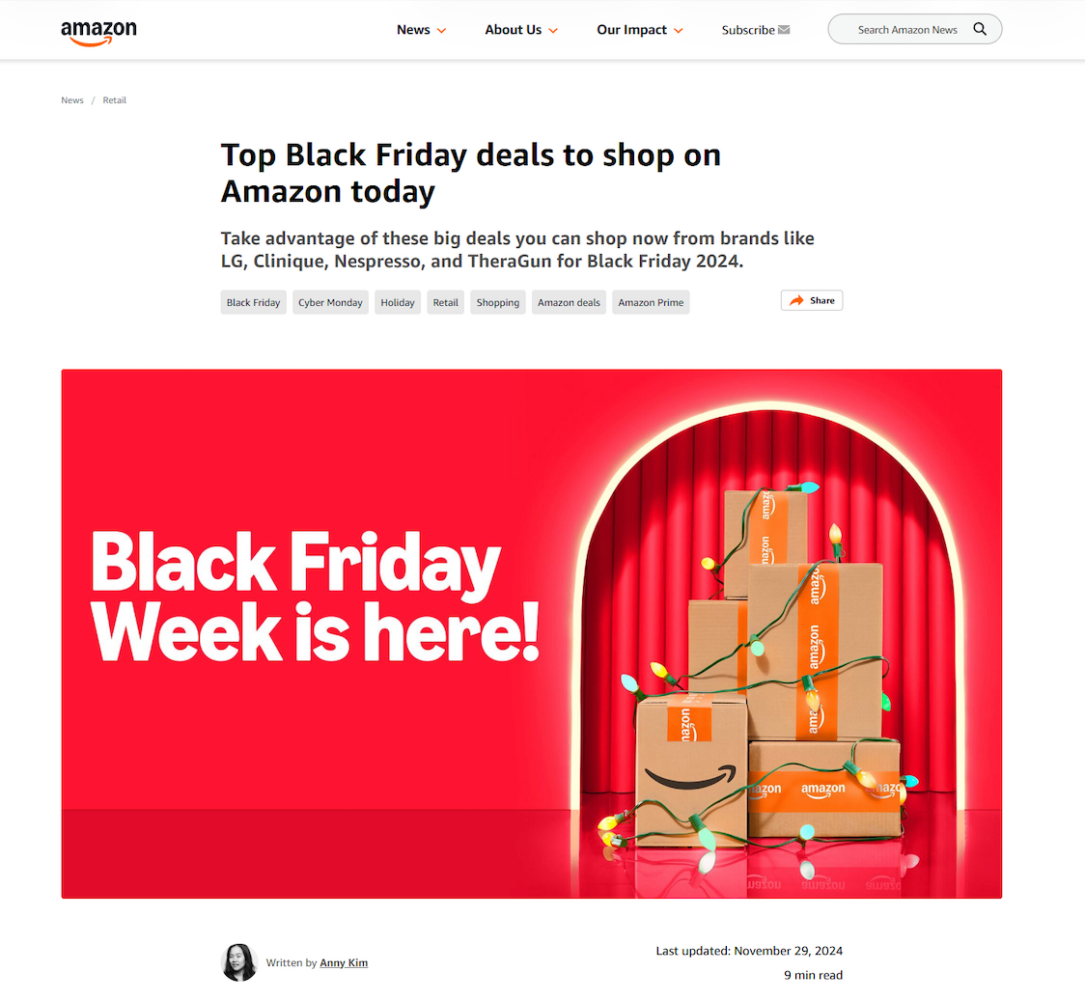
Figure 2. Screenshot of Amazon’s Black Friday 2024 Deals Page.
Both the sale event homepage and the deals page direct customers to individual product pages, where the shoppers can actually purchase the item (Figure 3 shows an example). During Black Friday 2025, its product page featured a struckthrough “list price” of $64.99, a lower “deal price” of $24.99 right above it, a red “-62%” badge, and “Black Friday Deal” label.
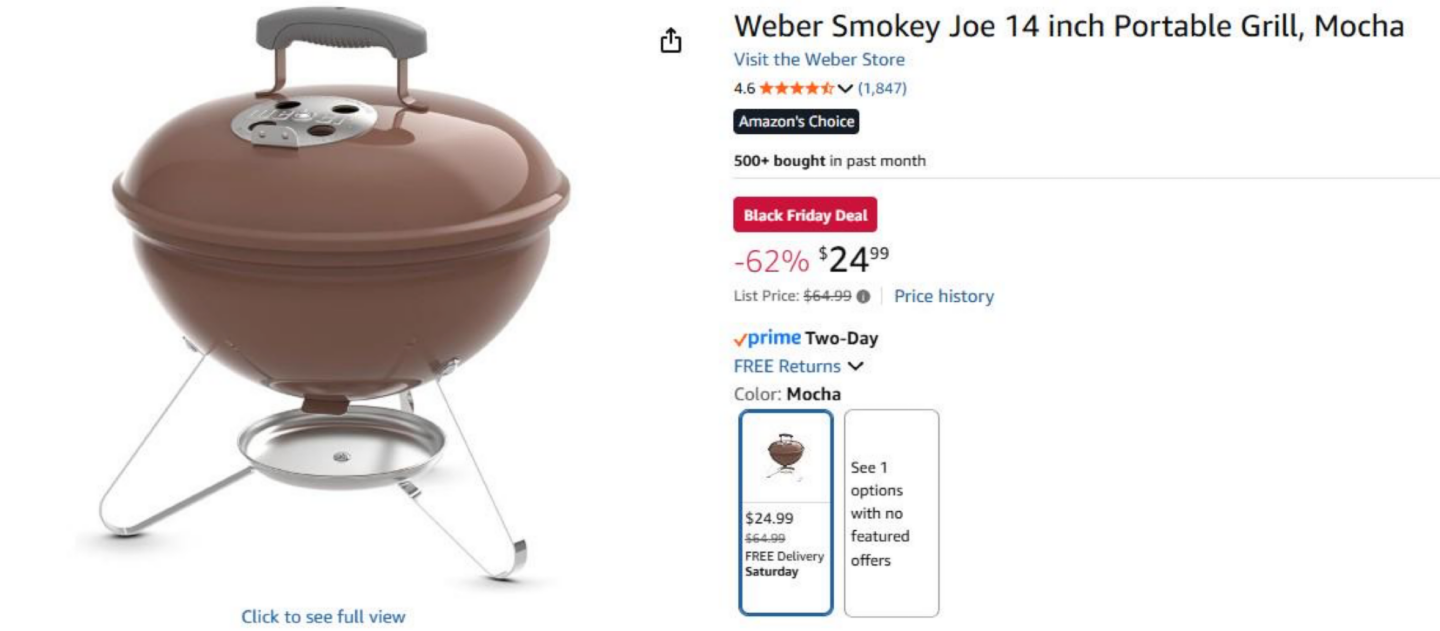
Figure 3. Screenshot of Weber Smokey Joe 14 inch Portable Grill During Black Friday 2025.
How We Tested Amazon’s “Deals”
We asked a simple question: Do Amazon’s “deals” beat the price tag of the same product leading up to the sale event? To test if each Amazon “deal” delivered real savings, we compared the lowest price offered during the sale event to the lowest price offered leading up to the sale event.
We analyzed the products Amazon chose to feature on its deals pages for recent sale events, which the retailer markets as some of the best discounts available. Amazon promoted 185 products on its Black Friday 2025 deals page, 152 on Cyber Monday 2025, 53 on Black Friday 2024, and 26 on Cyber Monday 2024.
We collected prices for each product throughout 2024 and 2025 using Keepa, a third-party service that scrapes real-time pricing data from Amazon product pages.20 Prices on Amazon can change weekly or even daily, so Keepa collects prices multiple times each day for most products. In the event that a product had more than one price in a single day, we took the lowest price Keepa recorded that the product was offered for on that day.21 For each product, we also took the lowest price offered for the item during incremental time periods leading up to the sale event and the lowest price during each sale event.22
To be included in the analysis sample, at least one price must have been observed in both the sale event period and in the 10 days prior to the sale event. In total, 351 unique products are included in the analysis: 160 for Black Friday 2025 (87%), 123 for Cyber Monday 2025 (81%), 48 for Black Friday 2024 (91%), and 20 for Cyber Monday 2024 (77%). Further, three products in the sample were promoted for both Black Friday 2024 and Cyber Monday 2024, and are included in the Black Friday 2024 sample only. Thirteen products were promoted for both Black Friday 2025 and Cyber Monday 2025, and are included in the Black Friday 2025 sample only, which in practice lowers the share of “deals” we flag as offering no real savings.
Because the Black Friday and Cyber Monday sale events are so close together and some products are on sale during both events, we end the comparison window for both sale events (i.e., the period leading up to the sale event) the day before the beginning of the Black Friday event.23 As a result, the sale event prices for Black Friday and Cyber Monday products are measured against the same “normal” prices, ensuring a “deal” is not flagged because it matched a previous sale price.
Our primary analysis calculates the share of Amazon-promoted products with a sale event price that is the same or higher than the lowest recent price over incremental pre-sale-event windows (10, 15, 30, 60, and 90 days). These comparison windows span the reference periods across most existing state consumer protection laws on discount pricing (see Appendix B for a summary of these state laws). We anchor our headline findings to the 30-day window since no single U.S. benchmark defines how “recent” a reference period must be, but the European Union’s (EU) Omnibus Directive requires that a product can only be advertised as discounted if its price is the lowest offered in the prior 30 days.24 However, we find that results generally hold across other comparison windows and report those in Appendix C of the report.
We also conducted several secondary analyses of whether the sale event price was cheaper than the lowest recent price, each answering one of the following questions:
- When a product’s sale event price was the same or higher than the recent low, how many days beforehand was the product selling at that price or cheaper? Among products that were available for the same price or lower before the sale event, we evaluate how often the sale price was matched or beat.
- For “deals” that carried a higher price than the price of the same products before the sale event, how much more was the “deal” on average? Among products available for a lower price before the sale, we calculate the product’s “overpayment,” the difference between the sale event price and the lowest price leading up to the sale event, to estimate how much shoppers potentially overpaid if they bought during the sale event.
- Are “same or worse deals” more common in some product categories than others? We calculate the share of Amazon-promoted products with a sale event price that is the same or higher than the lowest recent price by category (e.g., electronics, toys, and games). See Appendix C for the category-level findings.
Findings
Nearly 1 in 3 Amazon “deals” we examined offered shoppers prices for products that were no cheaper than a price available in the month leading up to the sale event.
Of the 351 “deals” we examined, nearly 1 in 3 (29.1%) had a sale event price that was the same or higher than the lowest price in the 30 days leading up to the sale event (see Figure 4). Nearly 1 in 4 (23.5%) of “deals” were no cheaper than a price available on Amazon for the same product in the 10 days leading up to the sale event. This share increases to more than half (57.3%) when we look back over the 90 days leading up to the sale (see Appendix C).
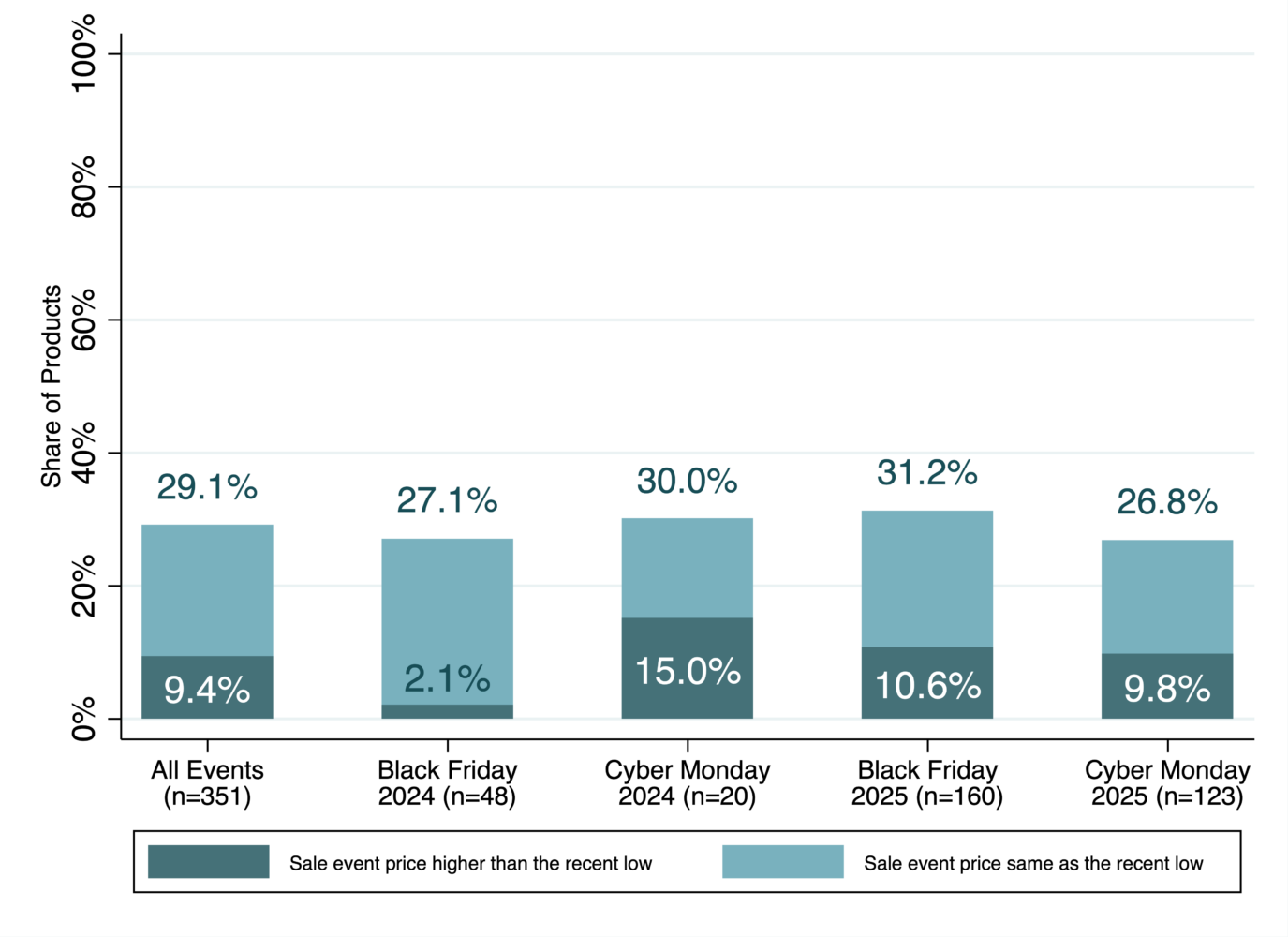
Figure 4. Share of Amazon “deals” no cheaper than the recent low, by sale event.
For example, a pair of Beats Solo 4 headphones “on sale” for $129.95 had already been priced at $129.95 12 days before the start of the Black Friday 2025 sale event. A Dyson handheld vacuum “on sale” for $249.95 had already been offered at that price 17 days before the start of the sale event. During the Cyber Monday 2025 sale event, a Fitbit Charge 6 fitness tracker “on sale” for $99.95 was available at that same price 20 days before the sale event. A Sol de Janeiro travel perfume set was “on sale” for $54.60 and was available at that same price 27 days prior to the start of the Cyber Monday 2025 sale event.
A fair question to ask is whether the share of “same or worse deals” is being driven by one-day flukes – a sudden price drop that occurred before the sale event that occurred once – or if products were reasonably available for the same or a better price prior to the sale event. To assess this, we counted how many days before the sale event each product had been selling at or below its sale event price.
We find that the typical product had a selling price that was the same as or cheaper than its sale event price on eight of the 30 days leading up to the sale.
Some “deals” offered shoppers a higher price than they could’ve paid on the same product before the sale.
Of the 351 “deals” we examined, roughly 9% had a sale event price that was higher than the lowest price of the product in the 30 days leading up to the sale event (see Figure 4). This triples to nearly 27% if we look at the lowest price in the 90 days leading up to the sale event (see Appendix C). Across all sale events, the median overpayment was 19% higher than the lowest price customers could have paid in the 30 days leading up to the sale.
For example, an Apple Watch Series 10 (GPS + Cellular, 46mm, gold titanium) “on sale” during the Black Friday 2025 sale event for $679.99 had been $602 nearly a month earlier, meaning the “deal” cost 13% more than the recent low. During the same sale event, a yellow pair of Hunter Women’s Short Rain Boots “on sale” for $126.99 had been $79.97 just nine days before the sale event started, meaning the “deal” cost 59% more than the recent low. During the Cyber Monday 2025 sale event, a pair of men’s UGG Butte boots “on sale” for $179.98 had been $98.40 27 days before the start of the sale event, meaning the “deal” cost 83% more than the recent low. A Carhartt knit beanie “on sale” for $19.77 had been $14.74 10 days before the start of the Cyber Monday 2025 sale event, meaning the “deal” cost 34% more than the recent low.
We Aren’t the First to Question Amazon’s Pricing
Our empirical findings align with several other anecdotal experiments. In 2025, Washington Post columnist Geoffrey Fowler compared the prices of nearly 50 products he had recently purchased on Amazon to their prices during one of Amazon’s major sale events. For several products marketed during the sale event, he found their price was no cheaper than what he had paid weeks earlier.25 In mid-2026, the Dutch Consumers’ Association tracked the prices of more than 100 air fryers and Bluetooth speakers sold by Amazon that were “on sale” during the two months leading up to the World Cup. They found that more than 40% of “deals” offered no discount because prices leading up to the sale were lower than prices during the sale.26
Following Amazon’s annual Prime Day sale event in June 2026, an analysis of more than 1,000 products which had price changes on Prime Day found that 44.7% matched the lowest price observed in the month leading up to Prime Day, and 42.8% were priced higher than recent-lows.27 An NBC News analysis of Amazon’s prices ahead of its annual Prime Day sale event found that the price of several items increased above typical prices in the week leading up to the Prime Day 2025 sale event, making Prime Day discounts appear larger than they would have appeared if the sale price was compared to the typical price.28 For example, NBC found that a Canon digital camera was offered for $799 in the weeks leading up to Prime Day, the price increased to $879 a week before Prime Day, and then the item was offered at $749 during Prime Day; the sale price appeared to offer customers a nearly 15% markdown, but it was only 6% lower than the price in the weeks leading up to the sale.
Several lawsuits have also accused Amazon of misleading its customers. In 2025, Amazon settled a Federal Trade Commission (FTC) case that claimed Amazon had tricked customers into signing up for Prime memberships and made it difficult for them to cancel. Amazon was ordered to pay $2.5 billion.29 In April 2026, new evidence emerged in California’s price-fixing suit against Amazon: the state claims that Amazon pressured brands like Levi’s and Hanes to persuade rival retailers, like Walmart and Target, to raise their prices when those prices were lower than Amazon’s prices.30
Amazon has faced scrutiny over how it presents discounts to customers, especially in its use of reference or list prices – prices shown next to current prices intended to represent what a product is typically or previously sold for. In September 2025, a proposed class action alleged that Amazon misled Prime Day customers by displaying the sale event’s discounts from list prices at which the products had not actually been priced for at least 90 days before the sale.31 The complaint includes an example of a children’s tablet that was advertised at 40% off but sold for $72.18 on Prime Day. But just a few months prior, Amazon had sold the same tablet for roughly $50 – a price much closer to what shoppers typically paid.
In November 2014, a class action lawsuit alleged that Amazon’s list prices were deceptive and estimates of customer savings were overstated.32 In January 2017, Amazon paid $1.1 million to settle with the Canadian Competition Bureau after it alleged that Amazon’s reference prices were misleading.33 In April 2018, the UK’s advertising watchdog upheld several complaints against Amazon over inflated savings claims that were based on reference prices Amazon could not show products actually sold for.34 In July 2025, a German Regional Court ruled that Amazon’s reference prices for discounted products during its Prime Deal Days sale event misled customers.35
Taken together, these cases point to a recurring pattern of legal and public scrutiny over how Amazon treats its customers, giving shoppers reasonable concern over whether its sale events truly deliver the best deals of the year.
Policy Landscape
Unfair or deceptive acts or practices (UDAP) laws governing discount advertising focus largely on the reference price retailers advertise as the price being discounted. The problem is that these laws focus on whether the struckthrough list price is honest – if the product is typically or was historically sold at that price – not whether the “sale” price is actually cheaper than the typical or historical price. A retailer could fully comply while offering a “deal” to consumers that is no cheaper than the typical or recent price of the item. Not only should discounts reflect a markdown from a real, recent price, the discounted price should also be the lowest price offered compared to recent prices.
Consumer protection laws governing discount advertising on the books are fragmented and vague. At the federal level, Federal Trade Commission (FTC) guidelines state that if a retailer advertises a product as discounted, the former price being discounted must be the “actual, bona fide price” offered to the public “on a regular basis for a reasonably substantial period of time.”36 The guidelines do not define “actual bona fide price,” “regular basis,” or “reasonably substantial period of time,” leaving the standard hard to enforce and open to interpretation in a seller’s favor.
The FTC guidelines are not only vague, but have not been actively enforced since the Nixon administration, effectively leaving states and private litigators to hold retailers accountable.37 However, most states do not have laws on the books governing discount advertising, and the laws are sporadic for the few states that do (see Appendix B for a full accounting of state laws).
To remedy this, when an item is advertised as a sale or a deal, policymakers should require retailers to disclose the lowest price the product has sold for in the previous 30 days. This would align with the EU’s directive that requires retailers, including Amazon, to show the lowest price offered in the prior 30 days during sales offered to EU consumers.38 This directive does not restrict what retailers charge or whether they can run a sale, but simply provides sufficient information to consumers to help them make more informed spending decisions. Lawmakers in states with regulations on the books should strengthen them to at least this standard. Those in states without standards should move swiftly to adopt such a standard. Further, the FTC should resume enforcement of its Deceptive Pricing Guide in the short term while working to issue formal rulemaking with real teeth.
Conclusion
When American shoppers are told they are getting a deal, the price they pay should be lower than what the product typically or recently cost. Our findings show that, during Amazon’s sale events, customers can’t count on this basic promise. Many “deal” prices were no lower than what Amazon charged in the weeks before the sale – and in some cases, they were higher. Amazon is the dominant retailer in online shopping, with roughly 40% of the U.S. e-commerce market and 200 million U.S. Prime subscribers. If our findings hold across its sale inventory, millions of Americans could overpay for goods marketed as bargains.
Consumers deserve the confidence in knowing they are getting real savings whenever a “deal” is marketed. Federal and state regulators should start by enforcing the laws already on the books. They must also broaden their definition of deceptive discount advertising to cover a retailer’s failure to prominently disclose that consumers could have gotten a better price leading up to the sale.
About the Authors
Breyon Williams, Ph.D., is the chief economist at Groundwork Collaborative. Breyon’s work spans government, consulting, and the nonprofit sector. Prior to joining Groundwork, he was a researcher at Mathematica, where he led complex evaluations for the U.S. Department of Education (including its Institute of Education Sciences), the U.S. Department of Labor, and major philanthropies. His research has been published in top economic journals, including the Journal of Law and Economics and the Economics of Education Review. He holds a Ph.D. in economics from the University of South Carolina.
Elizabeth Pancotti is the vice president of policy, advocacy, and research at Groundwork Collaborative. Prior to joining Groundwork, she advised Sen. Bernie Sanders (I-VT) on economic policy in several roles on the Senate Health, Education, Labor, and Pensions and Senate Budget Committees. She has researched policy issues spanning unemployment insurance and health care to education and tax at the Roosevelt Institute, Employ America, and the National Bureau of Economic Research. Her work has been featured in The New York Times, The Washington Post, and the Guardian, and she is a frequent contributor to Bloomberg, Marketplace, and MSNOW. Liz has a B.S. in economics from American University.
Lindsay Owens is the president and CEO of Groundwork Collaborative and the author of Gouged: The End of A Fair Price—and What That Means for Your Wallet. A nationally recognized public policy expert, she is widely sought after for media commentary, congressional testimony, and innovative investigative research on corporate malfeasance, financial markets, consumer protection, and affordability. She regularly advises government officials, candidates for elected office, and members of Congress, and has served as a senior advisor to lawmakers including Sen. Elizabeth Warren (D-MA). Her writing has appeared in The New York Times, The Washington Post, and Rolling Stone, and she frequently contributes to CNN, CNBC, CBS, Bloomberg, and the Wall Street Journal. Owens holds a Ph.D. in sociology from Stanford University and a bachelor’s degree from the University of Pennsylvania.
Acknowledgments
The authors thank Seth Frotman, Alex Jacquez, Tara Mikkilineni, and Liz Brown for their feedback and insights during the production of this report. Alex Stratton conducted an independent replication of the analysis. Robert Pettis provided data collection and analytical support throughout the project, Sohum Sheth and Nia Law contributed research assistance. Mary Kate Lambert provided copyediting and Conor Levey provided graphic design. We are grateful for the entire Groundwork Collaborative team, whose research, creativity, communications, and operational expertise made this project possible. This work reflects the collective effort and dedication of colleagues across the organization advancing our mission to build a fairer economy for all.
About Groundwork Collaborative
Groundwork Collaborative, established in 2018, is an economic think tank that transforms the way people understand the economy. To win policies that create strong, broadly shared prosperity and true opportunity for all, we advance new narratives about what a good economy looks like. Groundwork’s unique tripartite structure – part communications shop, part think tank, and part issue advocacy organization – allows us to drive economic narratives with credibility, expertise, and impact.
Appendix
A. Keepa
Keepa is a credible and widely relied-on source of historical Amazon pricing data.39 Its data have been used in peer-reviewed research to examine trends in Amazon’s marketplace and pricing practices.40 Keepa’s price histories have similarly been used by investigative outlets and consumer organizations such as ProPublica,41 The Markup,42 and Public Citizen,43 and have appeared in consumer litigation concerning Amazon’s pricing practices.44 Keepa is used by academic researchers, consumer advocates, journalists, and litigants as a rigorous source representing several billion Amazon products across a dozen marketplaces, providing strong external indications of Keepa’s validity to analyze Amazon’s pricing movements.
Keepa’s transparency also supports its credibility. Keepa publishes the computer code behind its data service, and from that code you can see how it tracks price histories for each product. You can also see how Keepa records missing data and price changes over time.45 Keepa’s transparency, broad-base historical coverage, and repeated use by academics, journalists, and legal practitioners make it a trustworthy source for evaluating Amazon’s pricing practices.
B. State Laws on Discount Advertising
Appendix Table 1. State Laws on Discount Advertising
| State |
Basis for a Genuine “Sale” Price |
Key Requirement |
Citation |
| Alaska |
Materiality + time cap |
A “sale” or “reduced” price must be a materially significant reduction from the seller’s regular price. It is deceptive if the “sale” price is the same as the price charged for more than six months of any 12-month period. |
9 AAC 05.020 |
| California |
Prevailing market price (3 months) |
A former price must have been the prevailing market price within the three months before the advertisement, unless the ad clearly and conspicuously states the date that price prevailed. |
Cal. Bus. & Prof. Code § 17501 |
| Connecticut |
Time-based (actual sale or offer) |
A former price comparison is valid only if the item was actually sold at that price within the prior 90 days, or actively offered at that price for at least four weeks within the prior 90 days (or another disclosed period). |
Conn. Agencies Regs. § 42-110b-12a |
| Illinois |
Substantial sales or good-faith offer |
A former price comparison requires either a substantial number of recent sales at that price, or a good faith offering of the item at that price for a reasonably substantial recent period. |
14 Ill. Admin. Code § 470.220 |
| Massachusetts |
Good faith + time/volume safe harbors |
A former price must be bona fide and is presumed valid if it was charged on 40% of sales in the prior six months, offered during the 14 days immediately before the ad, or offered on 28 of the prior 90 days (with the date disclosed). The seller bears the burden of proof. |
940 CMR, § 6.05 |
| Missouri |
Good faith + volume/time presumption |
A former price must be actual and bona fide; over a period of 30 days to 12 months, it is presumed valid if at least 10% of the item’s unit sales were at or above that price, or the item was offered at or above that price at least 40% of the time, with the date or period disclosed. |
15 CSR 60-7.060 |
| New Jersey |
Volume + time substantiation |
A former price is treated as fictitious unless substantiated by a substantial number of actual sales within the prior 60 days, actively offered on at least 28 of the most recent 90 days, or a cost-plus-markup basis. |
N.J.A.C. § 13:45A-9.6 |
| North Carolina |
General UDAP (no specific rule) |
North Carolina has no dedicated former price rule. Deceptive discount advertising is policed under its general UDAP statute, with courts applying the FTC standard: a genuine, recent, bona fide former price. |
N.C. Gen. Stat. § 75-1.1 |
| North Dakota |
Time-based sales window + genuineness |
A former price comparison is valid only if a substantial number of sales occurred at that price within the three months before the ad (or the dates are disclosed), or the item was offered at that price in good faith for a reasonably substantial recent period. |
N.D. Admin. Code § 10-15-01-03 |
| Ohio |
Genuine “regular price” |
A former price comparison must use the seller’s genuine regular price: the price openly and actively sold on a continuing basis for a substantial period. A reference price that is not the current regular price must be clearly and conspicuously disclosed. |
Ohio Admin. Code 109:4-3-12 |
| Oregon |
Good faith (30-day benchmark) |
A former price must have been used in good faith to make or offer sales, generally within the preceding 30 days (or another disclosed period). Raising a price in order to later claim a reduction is not good faith. |
Or. Admin. Code § 137-020-0010 |
| South Dakota |
Time-based (7 days / 60) or disclose basis |
A price-reduction ad must either state the specific basis for the claim, or the higher former price must have been offered for at least seven consecutive business days during the 60 days before the ad. Supporting records must be kept for two years. |
SDCL § 37-24-6(2) |
| Utah |
Genuine “regular price” (15-day) |
A “reduced from regular price” claim is deceptive unless the former price was a genuine regular price. A price is presumed not a regular price if it was not offered as the nondiscount price for the 15 days immediately preceding the ad (exceptions for seasonal or perishable goods and cost changes). |
Utah Code § 13-11a-3(1)(p); § 13-11a-2(14) |
| Virginia |
Genuine substantial sales |
A former price must be one at which substantial sales were made in the recent regular course of business, or the goods were openly offered in good faith for a reasonably substantial period (or the price reflects a customary cost-plus markup), or the date must be disclosed. No fixed number of days applies. |
Va. Code § 59.1-207.41 |
All other states
(Federal baseline) |
General standard (no fixed timing) |
Under the FTC’s Guides Against Deceptive Pricing, a former price must be a genuine price at which the item was openly and actively offered for a reasonably substantial recent period, in good faith; a price held for only a few days is a false claim. States without a specific rule rely on their UDAP statutes, interpreted against this federal standard. |
16 CFR § 233.1 |
C. Additional Findings from the Primary and Secondary Analyses
Share of “same or worse deals” by comparison window: Appendix Figure 1 shows the percentage of products in our analysis sample with a sale event price that was the same or higher than the recent low by comparison window.46 As expected, the share of “same or worse deals” increases as we look back further from the start of the sale event.
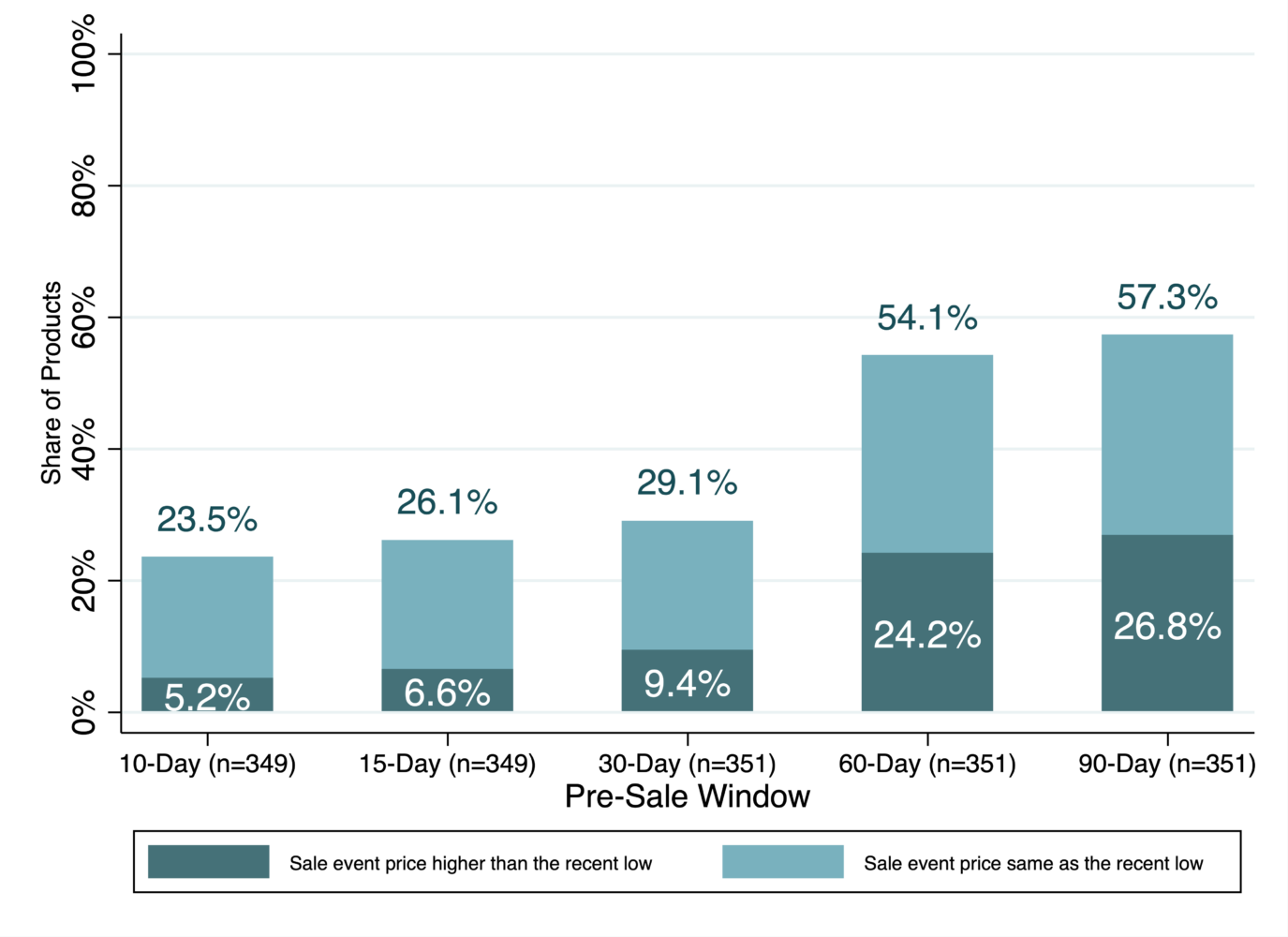
Appendix Figure 1. Share of Amazon “deals” across all events that were no cheaper than the recent low, by pre-sale window.
Share of “same or worse deals” by product category: Appendix Figure 2 shows the percentage of products in our analysis sample with a sale event price that was the same or higher than the recent low by product category.47 For example, the share of Amazon-promoted deals on toys and games available for the same or lower price ahead of the sale was more than triple the share of beauty deals that were “same or worse” deals.
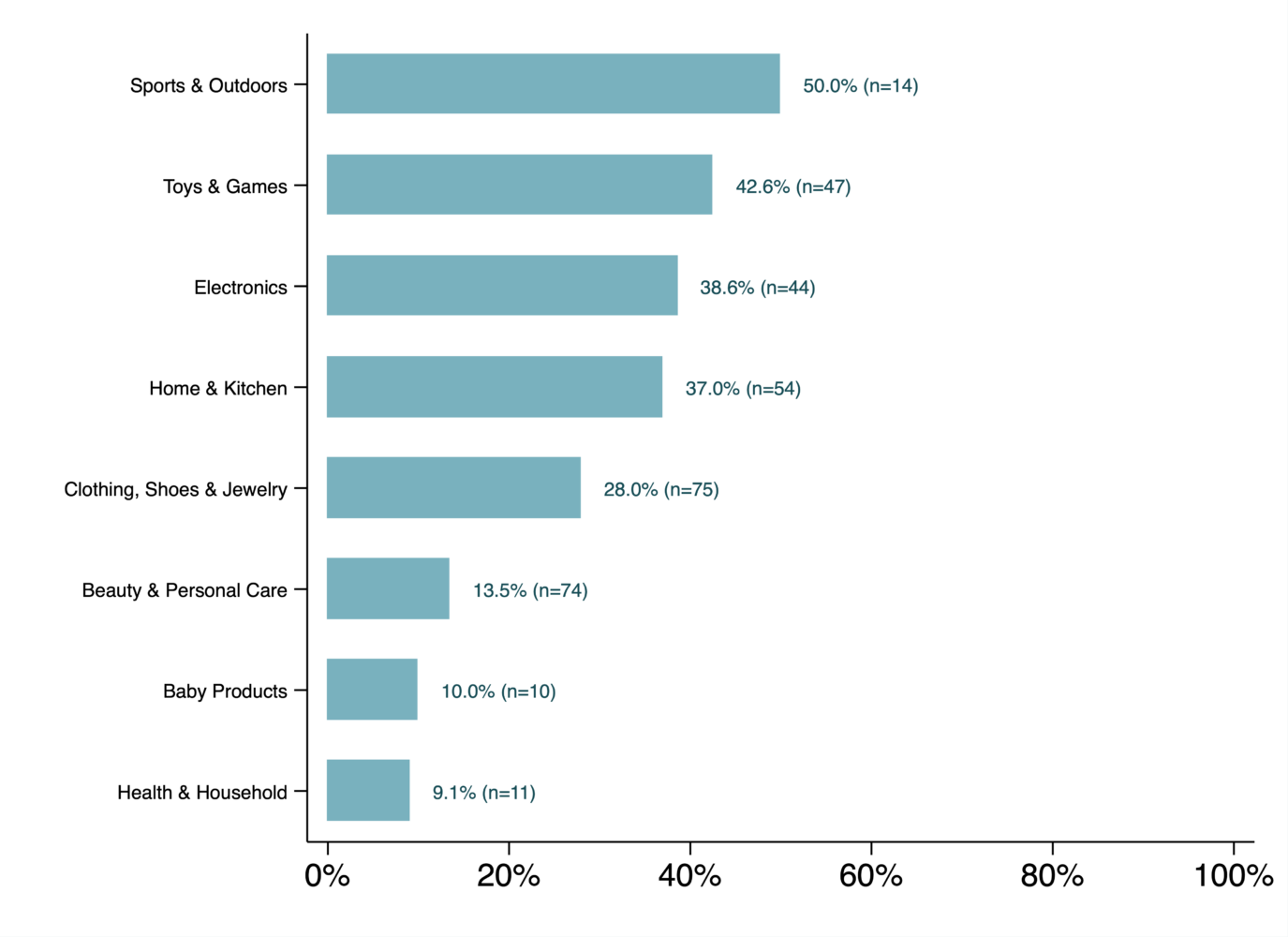
Appendix Figure 2. Share of Amazon “deals” across all events that were no cheaper than the recent low within the 30-day pre-sale window, by product category.
D. Stress Test Findings
We conducted a series of stress tests to see if our findings hold under different but reasonable analysis decisions.
To test if pre-sale-event low prices were one-off instances or sustained lower prices, we exclude one-off, one-day price lows leading up to the sale event. We only count a sale event price as a “same or worse deal” if it was the same as or higher than a recent low that lasted for at least two consecutive days in the pre-sale window. For instance, if a product briefly dropped below its sale event price for a single day in the 30 days leading up to the event, we do not count its sale event price as a worse deal.
Appendix Figure 3 shows that even when one-off, one-day price lows are excluded in the lead up to the sale event, nearly 1 in 4 “deals” (25.1%) that we examine are still no cheaper than the recent low.48 The primary findings are sustained across the comparison windows when this approach is adopted. This stress test demonstrates that the share of “same or worse deals” is not driven by one-off, one-day price dips, but rather price lows that rivaled or bested the sale event price on multiple days.
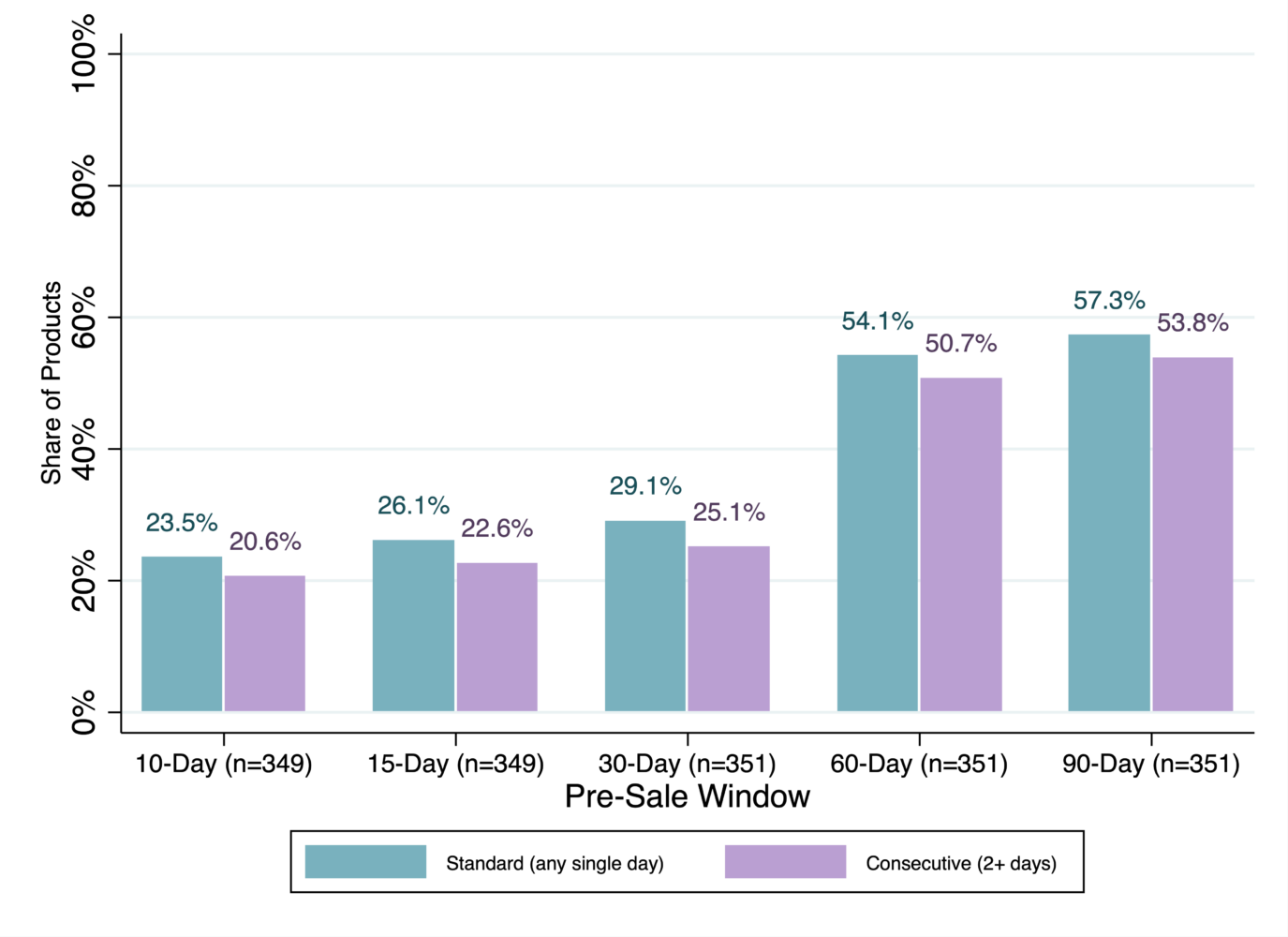
Appendix Figure 3. Share of Amazon “deals” across all events that were no cheaper than the recent low, excluding one-off, one-day price lows, by pre-sale window.
To isolate our analysis to Amazon’s own prices, not the prices of other sellers, we exclude the cases where Amazon may not control the price of the product. Instead of using the Buy Box price, which can represent the price of a product sold by either Amazon or a third-party seller, we use only prices for products sold by Amazon. Across all events, we find that more than 3 in 10 of the “deals”we examine (35.9%) were no cheaper than their recent low, so using Amazon’s own price always identifies a larger share of “same or worse deals” (see Appendix Figure 4). Much of the difference appears to be driven by Black Friday 2025, where more than 4 in 10 of the “deals” we examine were no cheaper than a month prior and more than 14% of “deals” were actually priced higher than recent low prices.
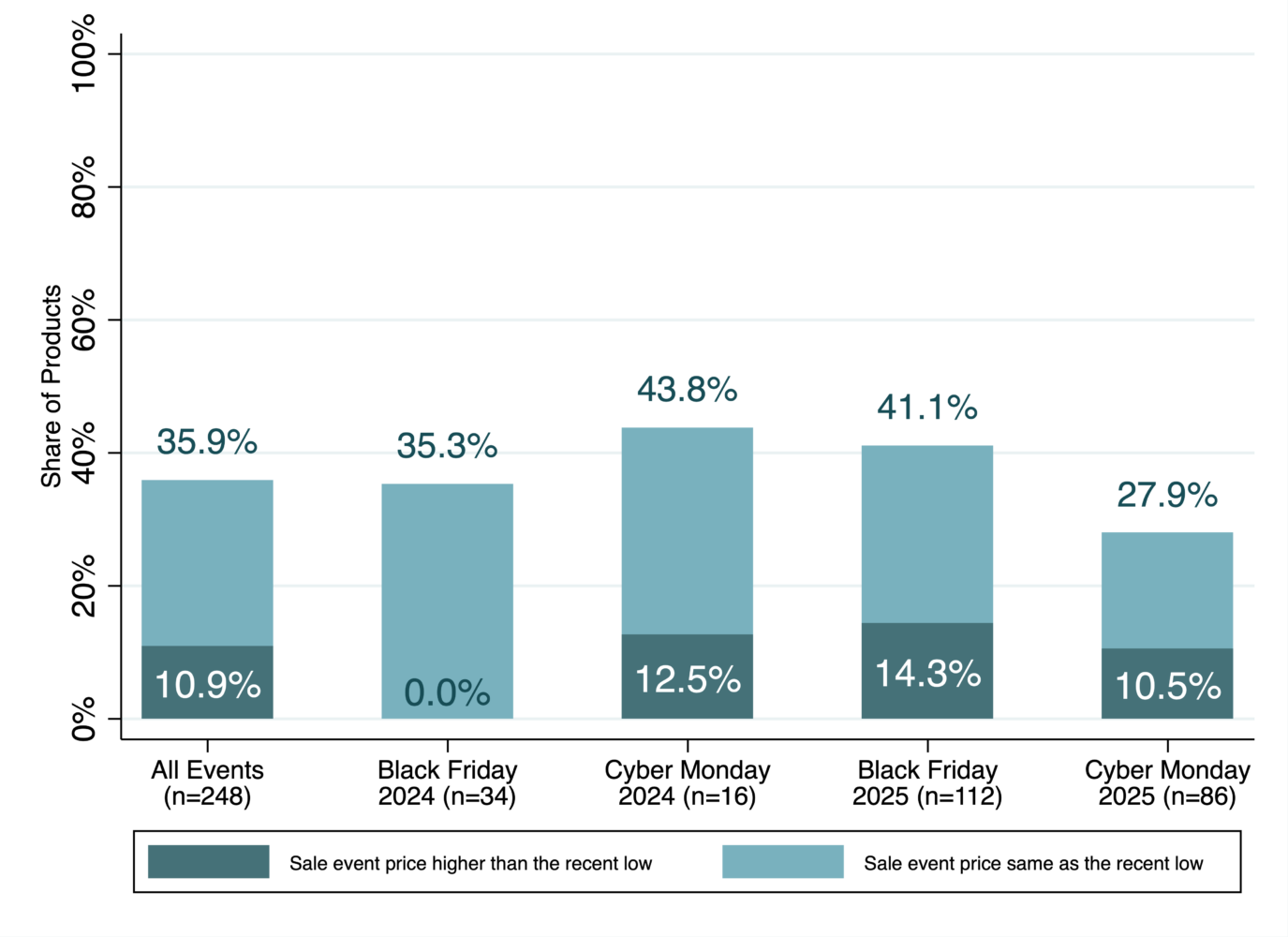
Appendix Figure 4. Share of Amazon “deals” across all events that were no cheaper than the recent low, using only Amazon’s own prices, by sale event.
We account for brief “lightning deal” flash prices. These “deals” usually last only a few hours, and are sometimes lower than a sale event price. Our main analysis compares the lowest sale event price to the lowest price leading up to the sale event using Buy Box and Prime-exclusive prices collected by Keepa. Keepa also collects “lightning deal” prices. Amazon offers “lightning deals” year-round, including during sale events. Although they are distinct from any given sale event, we include them in a stress test analysis by taking the lowest of the Buy Box, Prime-exclusive, and “lightning deal” prices for each product for which a “lightning deal” price is available, and then re-calculate the share of “deals” that are “same” or “worse.”
Appendix Figure 5 re-runs our primary analysis but credits lightning deals during the sale windows only, a generous inclusion that works in Amazon’s favor. If any of the “same or worse” deals from our main analysis include a lightning deal during the sale window that is the lowest price of any pre-sale low, that deal is reclassified as a genuine deal. Our findings held under this generous approach, with roughly 1 in 4 “deals” no cheaper than 30 days earlier.
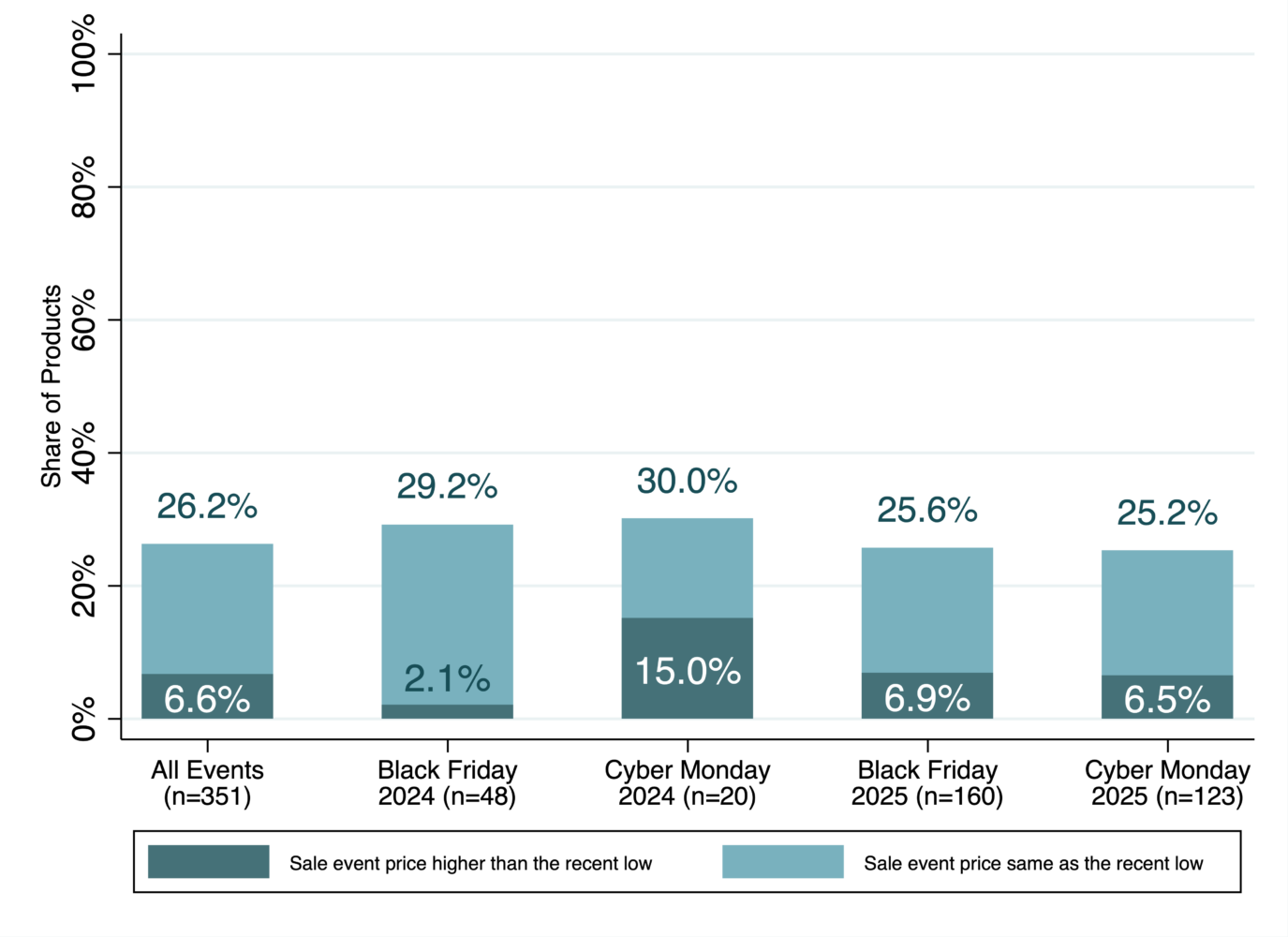
Appendix Figure 5. Share of Amazon “deals” across all events that were no cheaper than the recent low within the 30-day pre-sale window, crediting lightning deal prices, by sale event.
We consider potential “Early Event” deals. Amazon promotes some products as “Early Event” deals in the days leading up to sale events, dropping the price and keeping it at that price throughout the sale event. We’re unable to systematically determine which products were offered as “Early Event” deals, so for the purpose of this stress test, we assume all products may have been “Early Event” deals. Appendix Figure 6 displays the findings when we exclude prices in the 7-day lead up to a sale event, a generous inclusion that works in Amazon’s favor. If any “same or worse” deal is driven by a pre-sale low that occurred right before the start of the sale event, we reclassify that “deal” as genuine.
We find that when we drop pre-sale lows that occur in the week leading up to a sale event, 1 in 5 of the “deals” we examine are still the “same or worse,” and roughly 1 in 10 “worse” based on the lowest prices observed between eight and 30 days before the sale event. Between eight and 90 days ahead of the sale event, the share of “same or worse” deals rose to 51.6%, including 26.2% of deals that were worse.
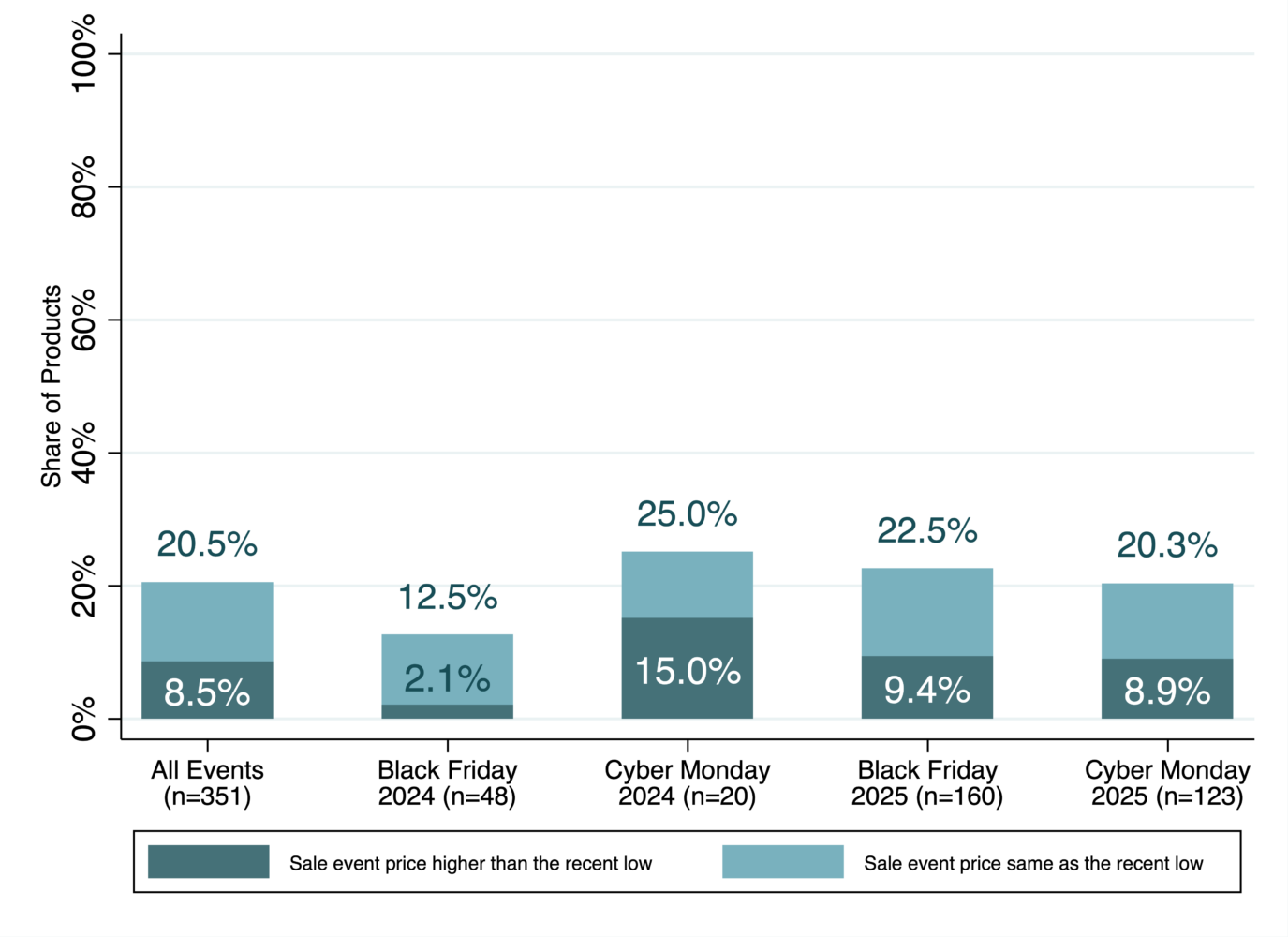
Appendix Figure 6. Share of Amazon “deals” across all events that were no cheaper than the recent low within the 30-day pre-sale window, excluding 7-day lead up prices, by sale event.
Endnotes
[1] The findings in this report describe the products in our analysis sample unless otherwise stated. Amazon presented these products on its event deals pages (described in further detail below) as some of the best deals available to customers during the sale events.
[2] Adobe, “Cyber Monday Hits Record $14.25 Billion in Online Spending with Over $1 Billion Driven by Buy Now Pay Later,” news release, December 2, 2025, https://news.adobe.com/news/2025/12/adobe-cyber-monday-hits-record. Adobe’s Cyber Week figure covers only the five days from Thanksgiving through Cyber Monday, while Amazon’s 2025 Black Friday week began November 20 and its Cyber Monday event ran through December 1 – total online spending across Amazon’s twelve-day window was larger.
[3] Amazon.com, Inc., “It’s the Season for Savings: Amazon’s Black Friday Week and Cyber Monday Deal Events Offer Deep Discounts on Customer-Favorite Brands from November 20 through December 1,” AmazonNews, November 9, 2025, https://press.aboutamazon.com/2025/11/its-the-season-for-savings-amazons-black-friday-week-and-cyber-monday-deal-events-offer-deep-discounts-on-customer-favorite-brands-from-november-20-through-december-1.
[4] Joseph P. Barrett, “Philly’s Role in the Naming of ‘Black Friday’ Started with Center City Traffic,” Philadelphia Inquirer, originally published November 25, 1994, https://www.inquirer.com/archive/black-friday-thanksgiving-origins-history-philly-20221122.html; Joseph Gambardello, “Did Philly Cops Coin ‘Black Friday’?,” Philadelphia Inquirer, November 21, 2012, https://www.inquirer.com/philly/hp/news_update/Black_Friday_started_in_Philly.html.
[5] National Retail Federation, “Thanksgiving Holiday Weekend Draws a Record 203 Million Shoppers,” press release, December 2, 2025, https://nrf.com/media-center/press-releases/thanksgiving-holiday-weekend-draws-a-record-203-million-shoppers. The survey counts 202.9 million consumers who shopped from Thanksgiving Day through Cyber Monday.
[6] National Retail Federation, “Thanksgiving Holiday Weekend Draws a Record 203 Million Shoppers.” 80.3 million in-store Black Friday shoppers in 2025, down from 81.7 million in 2024; Adobe, “Cyber Monday Hits Record $14.25 Billion in Online Spending with Over $1 Billion Driven by Buy Now Pay Later.” $11.8 billion in Black Friday online spending, up 9.1% year over year.
[7] Phil Wahba, “Amazon Overtakes Walmart on the Fortune 500 as Retail’s Center of Gravity Shifts,” Fortune, February 19, 2026, https://fortune.com/article/amazon-overtakes-walmart-fortune-500-doug-mcmilon-andy-jassy-retail-tech/.
[8] Sara Guaglione, “Publishers See Record Amazon Prime Day Sales,” Digiday, July 21, 2022, https://digiday.com/media/publishers-see-record-amazon-prime-day-sales/.
[9] Amazon Staff, “Amazon.com Announced Fourth Quarter Results,” AmazonNews, updated February 5, 2026, https://www.aboutamazon.com/news/company-news/amazon-earnings-q4-2025-report.
[10] Amazon Staff, “The History of Prime Day: A Look Back at Amazon’s Biggest Deal Event of the Summer,” AmazonNews, June 24, 2019, https://www.aboutamazon.com/news/retail/the-history-of-prime-day; Vivek Pandya, “Adobe: Prime Day event drove $24.1 billion in online spend across U.S. retailers,” Adobe for Business Blog, July 14, 2025, https://business.adobe.com/blog/prime-day-event-drove-24-billion-in-online-spend-across-us-retailers.
[11] Amazon.com, Inc., “It’s the Season for Savings: Amazon’s Black Friday Week and Cyber Monday Deal Events Offer Deep Discounts on Customer-Favorite Brands from November 20 through December 1.”
[12] Amazon.com, Inc., “Amazon’s Record-Breaking Black Friday Week And Cyber Monday Deal Event Was Its Biggest Thanksgiving Holiday Shopping Event Ever,” AmazonNews, December 3, 2024, https://press.aboutamazon.com/2024/12/amazons-record-breaking-black-friday-week-and-cyber-monday-deal-event-was-its-biggest-thanksgiving-holiday-shopping-event-ever.
[13] U.S. Bureau of Labor Statistics, “Consumer Price Index: 2025 in Review,” The Economics Daily, January 21, 2026, https://www.bls.gov/opub/ted/2026/consumer-price-index-2025-in-review.htm.
[14] U.S. Bureau of Economic Analysis, “Personal Saving Rate (PSAVERT),” FRED, Federal Reserve Bank of St. Louis, https://fred.stlouisfed.org/series/PSAVERT. The rate fell from 5.7% in January 2025 to 3.8% in September 2026.
[15] Numerator, “Prime Day 2026,” accessed August 18, 2026, https://www.numerator.com/prime-day/. Nearly half of Prime Day 2026 shoppers reported purchasing an item they had been waiting to buy until it went on sale, according to Numerator’s survey of verified Prime Day 2026 shoppers. Additional survey evidence finds that American shoppers delay purchases in anticipation of discounts, and often do so by a month or more. See, for example, Kyle James, “The Online Shopping Tricks Making Americans Hit ‘Wait’ Instead of ‘Buy,'” ConsumerAffairs, May 26, 2026, https://www.consumeraffairs.com/news/the-online-shopping-tricks-making-americans-hit-wait-instead-of-buy-052626.html.
[16] National Retail Federation, “Consumers to Spend Second-Highest Amount on Record, According to NRF Holiday Survey,” press release, October 16, 2025, https://nrf.com/media-center/press-releases/consumers-to-spend-second-highest-amount-on-record-according-to-nrf-holiday-survey.
[17] Bain & Company, “Black Friday through Cyber Monday Weekend Sales to Surpass $85 Billion,” press release, October 13, 2026, https://www.bain.com/about/media-center/press-releases/2026/black-friday-through-cyber-monday-weekend-sales-to-surpass-$85-billion-bain-company/.
[18] Amazon.com, Inc., “It’s the Season for Savings: Amazon’s Black Friday Week and Cyber Monday Deal Events Offer Deep Discounts on Customer-Favorite Brands from November 20 through December 1,” AmazonNews, November 9, 2025, https://press.aboutamazon.com/2025/11/its-the-season-for-savings-amazons-black-friday-week-and-cyber-monday-deal-events-offer-deep-discounts-on-customer-favorite-brands-from-november-20-through-december-1.
[19] Anny Kim, “Top Black Friday Deals to Shop on Amazon Today,” AmazonNews, updated November 26, 2024, https://www.aboutamazon.com/news/retail/best-black-friday-deals-amazon; Anny Kim, “Top Cyber Monday Deals to Shop on Amazon Today,” AmazonNews, updated December 2, 2024, https://www.aboutamazon.com/news/retail/cyber-monday-deals-2024-amazon; Jacqueline Smith and Anny Kim, “190+ of Amazon’s Best Deals to Shop Before Black Friday Week Ends on November 28,” AmazonNews, updated November 28, 2025, https://www.aboutamazon.com/news/retail/amazon-black-friday-best-deals-shop-2025-us; Jacqueline Smith and Anny Kim, “150+ of Amazon’s Best Cyber Monday Deals to Shop Before the Event Ends,” AmazonNews, updated December 1, 2025, https://www.aboutamazon.com/news/retail/cyber-monday-tech-deals-2025-us. After learning of our research, Amazon edited or removed these pages. You can find archived versions here: Black Friday 2024, Cyber Monday 2024, Black Friday 2025, Cyber Monday 2025.
[20] Keepa is a leading third-party tracker of Amazon price history, whose data is used in peer-reviewed research and litigation. See Appendix A for additional background on Keepa.
[21] Keepa records prices for most products several times per day, and at least every hour for popular ones. Products Amazon promotes arguably draw heavier shopper traffic, putting them in that higher-frequency tier. We only include products in our analysis if Keepa updated the product’s data at least an average of once per day during the product’s respective sale event (which is not the case for roughly 6% of the products advertised across the four sale events’ deal pages). On average, Keepa updated the data for the products in our analysis roughly five times per day during the sale event period. Even so, brief intra-hour price dips could still be missed in our data. We use the lowest price Keepa observed each day. This is a conservative approach because an unobserved dip would also have to be the day’s lowest to change a product’s classification.
[22] For example, during Black Friday Week, if an item was offered at $100 for a portion of the sale event and $120 on other days during the sale week, we say the product was on “sale” for $100 during the entire sale event. As a result, it’s possible that our analysis underestimates the share of products that were a genuine deal, as shoppers could have paid more than the sale event price recorded in our dataset.
[23] Black Friday Week 2025 started on November 20, 2025, so the pre-sale window for both the Black Friday and Cyber Monday sale events ends on November 19, 2025. Black Friday Week 2024 started on November 21, 2024 so the pre-sale window for both the Black Friday and Cyber Monday sale events ends on November 20, 2024. The Cyber Monday pre-sale window is not shortened, but is shifted earlier. It still spans a full 30 days.
[24] 16 C.F.R. § 233.1, https://www.ecfr.gov/current/title-16/chapter-I/subchapter-B/part-233. The Federal Trade Commission requires that the reference price advertised during a sale be a price that was offered for a “reasonably substantial period of time,” but does not specify the time period; Directive (EU) 2019/2161 of the European Parliament and of the Council of 27 November 2019 Amending Council Directive 93/13/EEC and Directives 98/6/EC, 2005/29/EC and 2011/83/EU of the European Parliament and of the Council As Regards the Better Enforcement and Modernisation of Union Consumer Protection Rules, 2019 O.J. (L 328), 7–28, https://eur-lex.europa.eu/eli/dir/2019/2161/oj/eng. The EU directive – which does not technically govern US companies or retail sales – provides a non-arbitrary yardstick in guiding how we present the findings.
[25] Geoffrey A. Fowler, “I Tracked Amazon’s Prime Day Prices. We’ve Been Played.,” The Washington Post, October 9, 2025, https://www.washingtonpost.com/technology/2025/10/09/amazon-prime-day-prices/.
[26] Babs van der Staak, “Consumers’ Association calls on Amazon and Bol to stop fake offers,” Consumentenbond, July 17, 2026, https://www.consumentenbond.nl/nieuws/2026/consumentenbond-sommeert-amazon-en-bol-te-stoppen-met-nepaanbiedingen.
[27] Visualping, “We Tracked Amazon Prices to See if the Deals Were Real,” Visualping, updated June 23, 2026, https://visualping.io/prime-day-26; Suzanne Blake, “Some Amazon Products Don’t Hit Lowest Price for Prime Day – New Report,” Newsweek, June 25, 2026, https://www.newsweek.com/most-amazon-prime-day-deals-arent-real-new-report-indicates-12120556.
[28] Maya Hunter and Emily Lorsch, “Summer Discounts at Amazon, Walmart and Other Retailers Aren’t Always as Deep as They Look,” NBC News, July 13, 2025, https://www.nbcnews.com/business/consumer/amazon-prime-day-walmart-deals-discounts-rcna218040.
[29] Mary Cunningham, “Amazon to Pay $2.5 Billion to Settle Federal Claims It Misled Prime Members,” CBS News, September 25, 2025, https://www.cbsnews.com/news/amazon-prime-membership-ftc-2-5-billion-settlement-customer-refunds/.
[30] David McCabe, “California Accuses Amazon of Price Fixing in Legal Filing,” The New York Times, April 20, 2026, https://www.nytimes.com/2026/04/20/technology/amazon-antitrust-suit-california.html.
[31] Armstrong et al. v. Amazon.com, Inc., No. 2:25-cv-01826 (W.D. Wash. 2025), https://truthinadvertising.org/wp-content/uploads/2025/09/Armstrong-v-Amazon-complaint.pdf.
[32] Fagerstrom v. Amazon.com, Inc., No. 37-2014-00040303-CU-BT-CTL (Cal. Super. Ct. San Diego Cnty. 2014), https://clg.org/pdf/2/2/9/Amazon.com-Complaint.pdf.
[33] Paul Vieira, “Amazon to Pay Fine Related to Pricing Practices in Canada,” Wall Street Journal, January 11, 2017, https://www.wsj.com/articles/amazon-to-pay-fine-related-to-pricing-practices-in-canada-1484161028.
[34] Advertising Standards Authority, “ASA Ruling on Amazon Europe Core Sarl,” Complaint Ref. A17-392915, April 4, 2018, https://www.asa.org.uk/rulings/amazon-europe-core-sarl-a17-392915.html.
[35] “Verbraucherzentrale obsiegt beim LG München I: Amazon kassiert Niederlage im Streit um Rabatte” [Consumer Group Prevails at Munich Regional Court I: Amazon Suffers Defeat in Dispute Over Discounts], Legal Tribune Online, July 15, 2025, https://www.lto.de/recht/nachrichten/n/4hko1395024-lg-muenchen-i-verbraucherzentrale-gegen-amazon-prime-deal-days.
[36] Federal Trade Commission, “§ 233.1 Former Price Comparisons,” 16 C.F.R. § 233.1, Legal Information Institute, Cornell Law School, accessed August 7, 2026, https://www.law.cornell.edu/cfr/text/16/233.1.
[37] David Adam Friedman, “Reconsidering Fictitious Pricing,” Minnesota Law Review 100, no. 3 (2016): https://doi.org/10.24926/265535.1097.
[38] Council Directive (EU) 2019/2161, 2019 O.J. (L 328) 7–28.
[39] Keepa, https://keepa.com/.
[40] Imke Reimers and Joel Waldfogel, “Digitization and Pre-Purchase Information: The Causal and Welfare Impacts of Reviews and Crowd Ratings,” American Economic Review 111, no. 6 (2021): https://www.aeaweb.org/doi/10.1257/aer.20200153; Lukas Jurgensmeier, Jan Bischoff, and Bernd Skiera, “Opportunities for Self-Preferencing in International Online Marketplaces,” International Marketing Review 41, no. 5 (2024): https://doi.org/10.1108/IMR-03-2024-0094; Chinonso E. Etumnu and Trey Malone, “An Empirical Examination of BuyBox Assignments in Online Grocery Retail,” Agribusiness 42, no. 3 (2024): 1230-1247, https://onlinelibrary.wiley.com/doi/abs/10.1002/agr.21978; Kwok Hao Lee and Leon Musolff, “Entry Into Two-Sided Markets Shaped By Platform-Guided Search,” https://lmusolff.com/papers/TwoSidedMarketsPlatformGuidedSearch.pdf.
[41] Marshall Allen and Lisa Song, “You Might Be Buying a Hand Sanitizer That Won’t Work for Coronavirus,” ProPublica, March 6, 2020, https://www.propublica.org/article/coronavirus-hand-sanitizers-cdc-recommended-alcohol.
[42] Harrison, Sara, “Why Am I Paying $60 for That Bag of Rice on Amazon.com?,” The Markup, April 28, 2020 https://themarkup.org/the-breakdown/2020/04/28/why-am-i-paying-60-for-that-bag-of-rice-on-amazon-com.
[43] Alex Harman, Prime-Gouging: How Amazon Raised Prices to Profit from the Pandemic (Public Citizen, 2020), https://www.citizen.org/wp-content/uploads/Prime-Gouging-report.pdf.
[44] Greenberg v. Amazon.com, Inc., No. 2:21-cv-00898 (W.D. Wash. 2021), https://www.classaction.org/media/greenberg-et-al-v-amazon-com-inc.pdf.
[45] Keepa publicly posts the code for its official data tool on GitHub, which documents each price series Keepa tracks and how missing offers and unchanged prices are recorded. See https://github.com/keepacom/api_backend.
[46] There are 349 products in the 10 and 15 day windows. Two Cyber Monday products had at least one price during the 10 days leading up to the sale event, but did not have any prices between eight and 30 days before the event. As a result, they drop out of the sample because we also remove Black Friday week from the pre-sale period for Cyber Monday products.
[47] Appendix Figure 2 includes the categories for which there are at least 10 products across the 351 products included in our analysis.
[48] There are 349 products in the 10 and 15 day windows. Two Cyber Monday products had at least one price during the 10 days leading up to the sale event, but did not have any prices between eight and 30 days before the event. As a result, they drop out of the sample because we also remove Black Friday week from the pre-sale period for Cyber Monday products.